The Pragmatic Engineer · Video summary
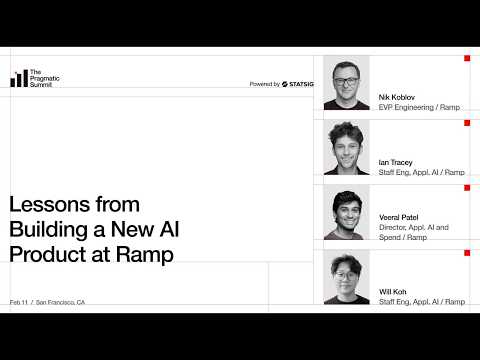
Ramp: Lessons from Building a New AI Product - The Pragmatic Summit
Ramp shares lessons on building AI products, emphasizing a single agent with many skills, iterative development, and a culture shift for faster, impactful delivery.

 Watch on YouTube ↗
Key takeaways
- 🎯Shift from building thousands of specialized agents to a single agent with a thousand skills to drive your AI framework.04:10
- 🚀Consolidate disparate AI agents into a single, versatile agent with a broad skill set to streamline development and management.04:10
- 💡In the new AI paradigm, software should focus on building autonomous systems of action that can react, reason, and act with minimal human supervision.05:01
- 🚀Consolidate conversational interactions into a single conversational UX (Omnihat) deployed across all product surfaces, complementing traditional UIs.05:15
- 🔍AI products cannot be oneshotted; start simple and iterate, ensuring alignment across product, design, and engineering that perfection isn't immediate.10:54
- 📈The context provided to LLMs is more critical than the models themselves; learn from live data to extract relevant context like employee roles and titles.11:41
Chapters
- 0:05🎯 Introduction to RAMP and AI at the Summit
- 0:15🎯 Simplified Expense Use Case & Time Savings
- 0:29🎯 Building Automated Agents and Paradigm Shift
- 6:16🎯 Consolidating Interactions and Building a Framework
- 7:11🎯 Policy Agent and Real-Time Spend Classification
- 10:10🎯 Rethinking Rules Using Natural Language
- 11:53🎯 Learning and Iterating with Internal Data
- 16:28🎯 Applying Data Labels and Evals for Confidence
- 18:47🎯 Integrating Cybersecurity and Versioning
- 23:34🎯 Cultural and Technical Principles for AI Infrastructure
- 26:09🎯 Handling Hallucination, Safety, and Trust
- 26:40🎯 Off-the-shelf Tool Catalog and Ecosystem
- 28:06🎯 Internal Context Integration and Ramp Inspect
- 31:19🎯 Impact of Ramp Inspect on Development Workflow
- 32:50🎯 Team Divergence and the Value of Judgment
- 36:32🎯 Reflections on Building AI-Driven Finance Products
The digest
Ramp, a leading finance platform serving over 50,000 businesses, shares insights from creating AI-powered agents that automate expense management and finance workflows. This detailed briefing covers their transition from numerous specialized agents toward a unified conversational AI, the design and iterative development of their policy enforcement agent, and the complex infrastructure and cultural shifts required to embed AI deeply into product and engineering processes. These lessons provide a roadmap for companies aiming to harness AI to reduce manual finance work and accelerate product delivery with safety and scalability.
High-Level Overview
Ramp is transforming finance operations for modern businesses by automating time-consuming manual tasks, starting with expense management. By leveraging AI agents that can autonomously reason, act, and enforce policies, Ramp significantly reduces administrative overhead. The company learned that rather than building many single-function agents, focusing on a unified agent with diverse skills creates a simpler, more scalable system. Central to success has been an iterative approach grounded in careful data labeling, continuous evaluation, and building AI infrastructure that supports both developer and organizational agility. Beyond technical innovation, Ramp highlights the profound cultural adjustments necessary across product, engineering, and finance teams to deliver impactful AI features rapidly and responsibly.
This content is essential for product managers, engineers, and AI practitioners building AI-powered automation tools, particularly in finance and operational workflows.
Keep reading in The Digest
The full 6-minute article, 12 more sections, and every new episode from The Pragmatic Engineer and the creators you follow.
- Simplifying Expense Automation with Autonomous AI Agents
- Paradigm Shift: From Many Single Agents to One Agent with Many Skills
- The Policy Agent: Rethinking Expense Policy Enforcement
- How the Policy Agent Works
- Development Lessons
- Ensuring Reliability and Alignment
- Adoption and Impact
- AI Infrastructure: Building Scalable, Cost-Efficient, and Traceable Systems
- Internal AI-Powered Development: Ramp Inspect for Background Coding
- Cultural Shifts: From Code Speed to High-Leverage Engineering Judgment
- Practical Implications & Takeaways
- Actionable Recommendations
More from The Pragmatic Engineer

Scaling Uber with Thuan Pham (Uber’s first CTO)
Uber's former CTO Thuan Pham shares high-leverage lessons from scaling Uber, emphasizing necessity-driven engineering, the power of relationships, and the evolution of AI in software development.

Nicole Forsgren: Leading high-performing engineering teams in the age of AI - The Pragmatic Summit
AI accelerates coding but exposes systemic bottlenecks in reviews, deployments, and processes, requiring a focus on agent experience and human systems to maintain delivery speed and quality.
Product-minded engineers in an AI-native world
Product engineers focus on user impact and value, blending technical skills with product vision to build 10x better products.

Simon Willison: Engineering practices that make coding agents work - The Pragmatic Summit
Coding agents are transforming development. Focus on test-driven development (TDD), sandboxing, and template-driven development to leverage AI for higher quality, faster code.

Building WhatsApp with Jean Lee
WhatsApp's success stemmed from extreme focus, minimal process, and a grandma-first quality standard, enabling a small team to build a global product.

From IDEs to AI Agents with Steve Yegge
AI is rapidly changing software engineering, moving from code completion to agent orchestration. This shift necessitates adaptation, impacting job roles, company structures, and the very definition of productivity.