The Pragmatic Engineer · Video summary
From IDEs to AI Agents with Steve Yegge
AI is rapidly changing software engineering, moving from code completion to agent orchestration. This shift necessitates adaptation, impacting job roles, company structures, and the very definition of productivity.

 Watch on YouTube ↗
Key takeaways
- 🎯The 'bitter lesson' in AI research suggests that larger models and more data are more effective than trying to imbue AI with human domain knowledge, indicating a future of increasingly powerful, generalist AI systems.04:51
- 📈The software engineering landscape is undergoing a rapid abstraction leap, mirroring the graphics industry's evolution. Historically, engineers needed to understand low-level details like assembly or pixel rendering; now, the focus shifts to higher-level concepts like game worlds and AI agents.07:43
- 🚀Actively experiment with AI agents and tools beyond basic code completion (like Copilot) to understand their capabilities and integrate them into your workflow.18:00
- 💡Innovation is increasingly shifting from large, bureaucratic companies to small, agile teams (2-20 people) that can leverage AI agents to rival the output of larger, slower organizations bogged down by their own scale and legacy systems.19:21
- 👥The 'developer workstation' is evolving from local laptops to cloud-based environments, enabling the execution of numerous AI agents without being constrained by local hardware limitations.22:15
- 🔧The 'levels of AI adoption' for engineers range from no AI (Level 1) to running multiple agents in parallel (Level 6+), with most currently stuck at lower levels, highlighting a significant gap in AI integration and productivity.22:33
Chapters
- 0:00🎯 Introduction to AI levels and Gas Town
- 0:43🎯 Steve Yegge's background and recent projects
- 1:02🎯 AI adoption levels for engineers
- 16:34🎯 The exponential growth curve of AI progress
- 19:21🎯 The future of software engineering jobs
- 24:50🎯 The collapse of IDEs and the return of cloud conversations
- 32:00🎯 Gas Town architecture and concept
- 35:00🎯 Gas Town challenges and evolution
- 36:50🎯 Gas Town's role in the evolution of orchestration
- 41:58🎯 Challenges and risks of AI-driven productivity gains
- 56:20🎯 Thoughts on innovation stagnation at large companies
- 1:05:12🎯 industry-wide change and adaptation
- 1:08:20🎯 The importance of experimentation and open source remixing
- 1:21:03🎯 The evolution of debugging and tech tools
- 1:27:38🎯 Predictions for 2027 and AI impact
- 1:30:10🎯 Final thoughts on AI's societal and industry impact
- 1:30:38🎯 Historical industry shifts and current trends
The digest
High-Level Overview
Steve Yegge, a veteran software engineer with 40 years of experience at Amazon and Google, explores the rapidly evolving role of AI in software development. He introduces a nuanced framework for AI adoption among engineers, discusses the profound shifts in productivity and workflows driven by AI agents, and forecasts the looming transformation of software engineering from monolithic codebases to distributed, agent-driven systems. This discussion is crucial for professional engineers, technical leaders, and innovators seeking to understand how AI will reshape the craft, culture, and economics of software creation.
Keep reading in The Digest
The full 7-minute article, 17 more sections, and every new episode from The Pragmatic Engineer and the creators you follow.
- Structured Deep Dive
- Steve Yegge’s Eight Levels of AI Adoption in Engineering
- Gas Town: An AI Agent Orchestrator Prototype
- The Evolving Role of IDEs and Developer Tooling
- AI’s Impact on Innovation and Corporate Dynamics
- The "Vampire Burnout" Effect
- Changing Software Development Methodologies
- AI and Personal Software Creation — The Democratization of Coding
- Predictions for the Near Future (By 2027)
- Reflection on Engineering Identity and Change
- Key Frameworks & Mental Models
- Steve Yegge's 8 Levels of AI Adoption in Engineering
- Sonar’s Agentcentric Development Cycle (AC/DC)
- The Bitter Lesson (Richard Sutton)
- Vulkan-Style Transition in Software Engineering
- Practical Implications & Takeaways
- Action-Oriented Summary
More from The Pragmatic Engineer

Scaling Uber with Thuan Pham (Uber’s first CTO)
Uber's former CTO Thuan Pham shares high-leverage lessons from scaling Uber, emphasizing necessity-driven engineering, the power of relationships, and the evolution of AI in software development.

Nicole Forsgren: Leading high-performing engineering teams in the age of AI - The Pragmatic Summit
AI accelerates coding but exposes systemic bottlenecks in reviews, deployments, and processes, requiring a focus on agent experience and human systems to maintain delivery speed and quality.
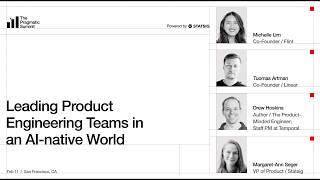
Product-minded engineers in an AI-native world
Product engineers focus on user impact and value, blending technical skills with product vision to build 10x better products.

Simon Willison: Engineering practices that make coding agents work - The Pragmatic Summit
Coding agents are transforming development. Focus on test-driven development (TDD), sandboxing, and template-driven development to leverage AI for higher quality, faster code.

Building WhatsApp with Jean Lee
WhatsApp's success stemmed from extreme focus, minimal process, and a grandma-first quality standard, enabling a small team to build a global product.

Uber: Leading engineering through an agentic shift - The Pragmatic Summit
Uber's agentic AI shift leverages AI to augment engineers, moving from automating toil to enabling superhuman productivity and focusing on creative work.