Instituto de Matemáticas de la UNAM · Video summary
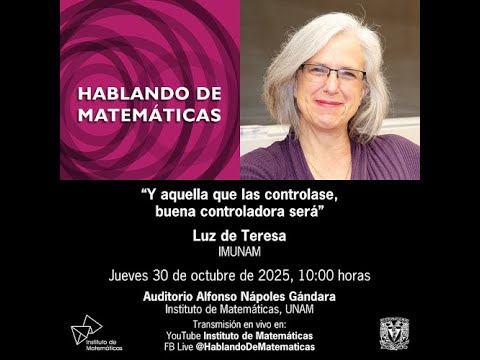
Y aquella que las controlase, buena controladora será
Explora la historia, matemáticas y aplicaciones del control en ingeniería y ciencias, resaltando que la teoría matemática avanzada es esencial para controlar sistemas complejos y peligrosos.
 Watch on YouTube ↗
Key takeaways
- 🎯El control ha sido una forma de manipular el entorno desde la antigüedad, usando objetos como estatuas y mecanismos simples.00:05
- 💡La teoría matemática del control se origina en ingeniería, como los reguladores de Wat, que autorregulan procesos mediante ecuaciones diferenciales y álgebra lineal.07:37
- ⚡Para sistemas altamente peligrosos o no experimentables como energía nuclear o tsunamis, el control matemático y simulaciones son la única vía segura para predecir y gestionar comportamientos.08:16
- 🔍El control en sistemas reales, como reactor nuclear o control de tumores, requiere modelos matemáticos precisos y complejos, además de simulaciones numéricas que tengan respaldo teórico sólido.11:46
- 📈Los sistemas controlables se determinan examinando la matriz de control, que combina las matrices A y B, y su rango, fundamental para especificar si un sistema puede ser manipulado en cualquier momento.20:00
- 🚀Aplicar matemáticas avanzadas como álgebra lineal, análisis funcional y modelos estocásticos en problemas de control.44:00
Chapters
- 0:05🎤 Introducción y contexto
- 1:24⏳ Control en la historia y ejemplos antiguos
- 2:44⚙️ Mecanismos de control en la vida diaria
- 4:45🔧 Origen y fundamentos del control en ingeniería y matemáticas
- 6:10🚀 Control en la revolución industrial y regulación de máquinas
- 9:30🖥️ Simulación y control digital
- 10:31🧮 Matemáticas en la teoría de control
- 28:24🚗 Control en vehículos autónomos y conducción
- 32:23🔬 Control en biomedicina y cáncer
- 40:18🎯 Control en ingeniería y diseño de vehículos
- 43:51🌍 Control en medio ambiente y fenómenos naturales
- 44:21🧠 Matemáticas avanzadas en control moderno
- 46:42📈 Importancia y desafíos actuales en control
- 48:14🤝 Interdisciplinaridad y futura investigación
The digest
Control theory explores how to influence systems so they behave in desired ways. This talk traces its origins from ancient mechanical devices to modern mathematical models and diverse applications such as engineering, medicine, and autonomous vehicles. It highlights the increasing complexity of control problems and the essential role of advanced mathematics to design, analyze, and implement effective controls in real-world scenarios.
High Level Overview
Control theory studies how to modify and regulate systems to achieve specified outcomes. This theory is vital for engineers, mathematicians, and scientists working in fields that require managing complex, dynamic processes—from industrial machines and climate control to medical therapies and self-driving cars. As systems grow more intricate and the stakes higher, the mathematical underpinning of control theory becomes indispensable for safe and efficient operation. Understanding this blend of historical innovation, engineering intuition, and rigorous mathematics provides insights into both the challenges and potential of control in technology and life sciences.
Keep reading in The Digest
The full 7-minute article, 13 more sections, and every new episode from Instituto de Matemáticas de la UNAM and the creators you follow.
- Origins and Historical Context of Control (00:20–06:00)
- What Constitutes a Control System? (10:40–13:10)
- Mathematical Models: Linear Ordinary Differential Equations (ODEs) (13:10–20:30)
- Kalman’s Controllability Criterion (20:30–24:50)
- Nonlinear Control and Vehicle Parking Example (25:00–30:30)
- Control Problems Beyond Basic Controllability: Optimal Control and Constraints (30:30–36:30)
- Autonomous Vehicles and Trajectory Tracking (36:30–39:30)
- Geometric Control in Aerodynamics and Rocket Design (40:00–43:20)
- Mathematical Tools and Challenges in Control Theory (43:20–48:20)
- Conclusions and Open Problems
- Key Frameworks and Models
- Practical Implications & Takeaways
- Action-Oriented Summary
More from Instituto de Matemáticas de la UNAM

¿Cómo mezclar un mazo de cartas? Caminatas aleatorias y álgebras de Iwahori-Hecke.
Explore random walks on groups using Iwahori-Hecke algebras to model card shuffling, revealing insights into mixing times and spectral gaps.
Computational Complexity and Explanations in Physics
Explore how computational complexity impacts physics, from quantum computing's philosophical implications to its role in black hole paradoxes and thermodynamics.

Ximena Catepillán en Diálogos entre Matemáticas y cultura
Explore the mathematical structures within indigenous kinship systems, revealing group theory and abstract algebra embedded in cultural practices.

Edmund Harriss en Diálogos entre Matemáticas y Cultura
Explore the profound connection between art and mathematics, revealing how mathematical thinking can enrich artistic creation and vice-versa, leading to new forms of expression and understanding.

La inevitabilidad de los agujeros negros y la topología de su horizonte.
Explore the inevitability of black holes and their event horizon topology through advanced spacetime geometry and causality theory.

El problema del encaje de árboles en gráficas
Exploring tree embedding in graphs and digraphs, focusing on density conditions and degree properties to guarantee subgraph containment.