Instituto de Matemáticas de la UNAM · Video summary
La inevitabilidad de los agujeros negros y la topología de su horizonte.
Explore the inevitability of black holes and their event horizon topology through advanced spacetime geometry and causality theory.

 Watch on YouTube ↗
Key takeaways
- 🎯Black holes are not just theoretical curiosities but are mathematically inevitable under certain conditions within General Relativity, challenging earlier assumptions of their rarity due to required symmetries.00:48
- 🚀Re-evaluate the commonality of black holes: Understand that mathematical theorems prove their inevitability under broad conditions, not just as specific solutions.00:48
- 💡The causal structure of spacetime, defined by light cones and the distinction between temporal, null, and spatial vectors, is fundamental to understanding its geometry and topology, independent of explicit metric solutions.02:43
- 🔧Focus on causal structure as a primary tool for analyzing spacetimes when explicit metric solutions are intractable, as it reveals fundamental geometric and topological properties.02:43
- 📈Globally hyperbolic spacetimes, characterized by compact causal diamonds and the existence of Cauchy surfaces, provide a robust framework for studying spacetime evolution and are analogous to complete Riemannian manifolds.11:30
- 🔍Conformal completion (Penrose diagrams) allows for the study of spacetime behavior at infinity by mapping it to a compact manifold, revealing structures like Scri (null infinity) and enabling a more complete understanding of spacetimes.16:12
Chapters
- 0:15🎯 Introducción y contexto sobre agujeros negros
- 2:34🎯 Teoría causal y espacio-tiempo
- 3:21🎯 Superficies de luz y clasificación causal
- 11:37🎯 Condiciones para espacio-tiempo globalmente hiperbólico
- 20:48🎯 Definición y caracterización de agujeros negros
- 25:08🎯 Condiciones para que exista un agujero negro
- 28:05🎯 Teorema de singularidad de Penrose
- 37:11🎯 Superficies atrapadas en espacios asintóticamente planos
- 47:38🎯 Topología del horizonte de eventos
- 54:22🎯 Implicaciones físicas y observacionales
- 56:20🎯 Resumen y conclusiones finales
The digest
High Level Overview
Este seminario explora por qué los agujeros negros son fenómenos inevitables y comunes en la relatividad general, profundizando en las propiedades geométricas y topológicas de sus horizontes de eventos. Se presentan dos teoremas fundamentales: el teorema de singularidad de Penrose, que garantiza la existencia de singularidades bajo condiciones físicas generales, y el teorema de Hawking sobre la topología del horizonte de eventos, que establece que el horizonte debe ser topológicamente una esfera. El análisis se hace a través de la teoría causal y el uso de diagramas de Penrose, mostrando que los agujeros negros no requieren simetrías particulares ni condiciones muy restrictivas, enfatizando su ubicuidad teórica. Este contenido es relevante para investigadores y estudiantes avanzados en física matemática, relatividad general y geometría diferencial.
Keep reading in The Digest
The full 9-minute article, 21 more sections, and every new episode from Instituto de Matemáticas de la UNAM and the creators you follow.
- Introducción: ¿Por qué son comunes los agujeros negros? (00:15–02:15)
- Fundamentos de la Teoría Causal y espacio-tiempo (02:16–14:00)
- Espaciotiempos globalmente hiperbólicos y superficies de Cauchy (11:30–15:50)
- Definición y estudio de agujeros negros mediante compresiones conformes (16:00–22:00)
- Limitación de la definición global y la necesidad de detección local: superficies atrapadas (22:00–26:00)
- Condiciones de energía y su importancia física (25:00–26:30)
- Teorema de singularidad de Penrose: demostración y consecuencias (27:00–36:45)
- Topología del horizonte de eventos y teorema de Hawking (38:50–53:10)
- Regiones de agujero negro, blancas y dominio de comunicaciones exteriores (45:00–47:00)
- Resultados clave de Wald y Cruce sobre la topología del horizonte (48:30–53:00)
- Preguntas y discusión final (53:15–56:20)
- Key Frameworks and Models
- 1. Teoría Causal y Relación Causal en espacios Lorentzianos
- 2. Espacios globalmente hiperbólicos y superficies de Cauchy
- 3. Diagramas de Penrose y compresión conforme
- 4. Ecuación de Raychaudhuri
- 5. Superficies atrapadas
- 6. Teorema de singularidad de Penrose
- 7. Topología del horizonte y censura topológica
- Practical Implications & Takeaways
- Action-Oriented Summary
More from Instituto de Matemáticas de la UNAM

¿Cómo mezclar un mazo de cartas? Caminatas aleatorias y álgebras de Iwahori-Hecke.
Explore random walks on groups using Iwahori-Hecke algebras to model card shuffling, revealing insights into mixing times and spectral gaps.
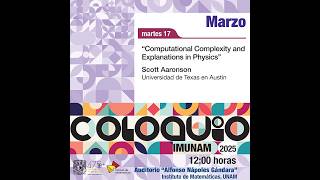
Computational Complexity and Explanations in Physics
Explore how computational complexity impacts physics, from quantum computing's philosophical implications to its role in black hole paradoxes and thermodynamics.

Ximena Catepillán en Diálogos entre Matemáticas y cultura
Explore the mathematical structures within indigenous kinship systems, revealing group theory and abstract algebra embedded in cultural practices.

Edmund Harriss en Diálogos entre Matemáticas y Cultura
Explore the profound connection between art and mathematics, revealing how mathematical thinking can enrich artistic creation and vice-versa, leading to new forms of expression and understanding.

El problema del encaje de árboles en gráficas
Exploring tree embedding in graphs and digraphs, focusing on density conditions and degree properties to guarantee subgraph containment.

Modelos subrogados en problemas inversos de EDPs
Leveraging surrogate models drastically accelerates solving complex inverse problems in PDEs, offering significant computational speedups and robust uncertainty quantification.