Instituto de Matemáticas de la UNAM · Video summary
¿Cómo mezclar un mazo de cartas? Caminatas aleatorias y álgebras de Iwahori-Hecke.
Explore random walks on groups using Iwahori-Hecke algebras to model card shuffling, revealing insights into mixing times and spectral gaps.

 Watch on YouTube ↗
Key takeaways
- 🎯The core idea is to model card shuffling as a random walk on the symmetric group, where each permutation represents a state of the deck.04:46
- 🔧Consider how the 'Q' parameter in biased random walks could model real-world processes where transitions are not uniform.13:00
- 💡Standard shuffles like 'random to random' can be generalized using Iwahori-Hecke algebras, which introduce a deformation parameter 'Q' allowing for biased transitions.13:36
- 🔄The stationary distribution for the classical 'random to random' shuffle is uniform. For the 'Q-deformed' shuffle, it becomes the Mallow distribution, which depends on the length (number of inversions) of the permutation.26:53
- 📊When analyzing systems with many states (like permutations), focus on spectral properties (like the spectral gap) to understand convergence speed rather than just individual transition probabilities.31:23
- 🔍The spectral gap of the transition matrix (or operator) is a crucial measure for understanding how quickly a shuffled deck approaches a stationary distribution (i.e., becomes well-shuffled). A larger gap means faster convergence.32:15
Chapters
- 0:15🎯 Bienvenida y presentación del tema
- 1:26🎯 Introducción a mezclar cartas y shuffles
- 3:21🎯 Modelos básicos de shuffles: bottom to random, top to random y random to random
- 4:46🎯 Propiedades de las cadenas de Markov en grupos
- 14:11🎯 Algebra de Iguajor-Jeque y su relación con modelos de azar
- 20:14🎯 Longitud de permutaciones y reglas de reducción
- 26:43🎯 Distribución estacionaria y propiedades ergódicas
- 32:10🎯 Tiempo de relajación y tiempo de mezcla
- 35:04🎯 Herramientas gráficas y diagramas de Yong y J
- 38:52🎯 Efecto del parámetro Q en la dinámica
- 42:23🎯 Observaciones finales y perspectivas futuras
- 44:21🎯 Preguntas y cierre
The digest
High Level Overview
Esta presentación explora la conexión entre el barajeo de cartas —modelado matemáticamente como caminatas aleatorias en el grupo simétrico— y las estructuras algebraicas conocidas como álgebras de Iwahori-Hecke. Se abordan modelos clásicos de barajeo, como el "random to random", y su generalización mediante parámetros de deformación que introducen sesgos en las probabilidades de transición. La charla es relevante para matemáticos interesados en probabilidad, álgebra combinatoria y teoría de grupos, proporcionando un marco para estudiar la dinámica y el comportamiento asintótico del barajeo y su relación con procesos de Markov y análisis espectral.
Keep reading in The Digest
The full 8-minute article, 12 more sections, and every new episode from Instituto de Matemáticas de la UNAM and the creators you follow.
- Caminatas aleatorias y barajeo de cartas: Modelos clásicos y definiciones básicas
- Propiedad de Markov, matrices de transición y grafos de Cayley
- Introducción al sesgo en las probabilidades y la deformación $Q$
- Álgebras de Iwahori-Hecke: definición, propiedades y conexión con barajeos
- Descripción de "longitud de una permutación", diagramas de trenza y visualización gráfica
- Propiedades ergódicas y análisis espectral: distribución estacionaria y tiempo de mezcla
- Uso de herramientas combinatorias avanzadas: diagramas de Young y teoría de representaciones
- Regímenes de comportamiento y perspectivas futuras: cut-off y probabilidad integrable
- Preguntas destacadas y aclaraciones finales
- Key Framework: Modelo de barajeo sesgado vía álgebra de Iwahori-Hecke
- Practical Implications & Takeaways
- Action-Oriented Summary
More from Instituto de Matemáticas de la UNAM
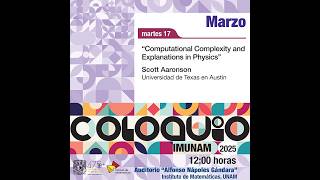
Computational Complexity and Explanations in Physics
Explore how computational complexity impacts physics, from quantum computing's philosophical implications to its role in black hole paradoxes and thermodynamics.

Ximena Catepillán en Diálogos entre Matemáticas y cultura
Explore the mathematical structures within indigenous kinship systems, revealing group theory and abstract algebra embedded in cultural practices.

Edmund Harriss en Diálogos entre Matemáticas y Cultura
Explore the profound connection between art and mathematics, revealing how mathematical thinking can enrich artistic creation and vice-versa, leading to new forms of expression and understanding.

La inevitabilidad de los agujeros negros y la topología de su horizonte.
Explore the inevitability of black holes and their event horizon topology through advanced spacetime geometry and causality theory.

El problema del encaje de árboles en gráficas
Exploring tree embedding in graphs and digraphs, focusing on density conditions and degree properties to guarantee subgraph containment.

Modelos subrogados en problemas inversos de EDPs
Leveraging surrogate models drastically accelerates solving complex inverse problems in PDEs, offering significant computational speedups and robust uncertainty quantification.