Instituto de Matemáticas de la UNAM · Video summary
Ximena Catepillán en Diálogos entre Matemáticas y cultura
Explore the mathematical structures within indigenous kinship systems, revealing group theory and abstract algebra embedded in cultural practices.

 Watch on YouTube ↗
Key takeaways
- 🎯Indigenous kinship systems, like those of the Wpiri and Aranda tribes in Australia and the Ambrim people in Vanuatu, demonstrate sophisticated mathematical structures that mirror abstract algebra, specifically group theory.01:35
- 🚀Explore academic literature on ethnomathematics to understand how cultural practices embody mathematical principles.01:50
- 💡The Wpiri kinship system is organized into eight sections, governed by rules for marriage and descent, where children's section is determined by the mother's section, illustrating a matriarchal structure with mathematical underpinnings.06:08
- ⚡The visual representations, such as the Wpiri diagram and the Aranda genealogical tables, along with the symbolic notation (e.g., M for mother, F for father), allow for the translation of kinship rules into algebraic operations.07:08
- 📚Seek out resources that visually map kinship systems or other cultural practices to abstract mathematical structures, such as diagrams or genealogical tables.07:08
- 🌟The concept of 'matriciclos' and 'patriciclos' in the Wpiri system, representing cycles of descent, further illustrates the group-theoretic properties embedded within the kinship structure.16:52
Chapters
- 0:14🎯 Bienvenida y presentación
- 1:01🎯 Resumen del contenido y estructura
- 3:34🎯 Sistemas de parentesco en tribus australianas
- 4:13🎯 Modelo matemático y esquema de parentesco
- 9:55🎯 Ejemplos específicos y análisis genealógico
- 26:50🎯 Conexión con teoría de grupos
- 49:51🎯 Aplicaciones y ejemplos matemáticos en cultura
- 55:02🎯 Arte, geometría y juegos tradicionales
- 59:50🎯 Proyectos futuros y eventos relacionados
- 1:01:01🎯 Cierre y despedida
The digest
High Level Overview
Este análisis expone cómo ciertos grupos indígenas australianos y de la isla Ambrim en Vanuatu emplean sistemas de parentesco estructurados mediante reglas específicas que pueden interpretarse y modelarse matemáticamente, en particular con teoría de grupos. La charla ofrece un enfoque interdisciplinario clave para entender la relación entre cultura y matemáticas, dirigido a antropólogos, matemáticos, educadores y cualquier profesional interesado en etnomatemática y estructuras sociales complejas.
Keep reading in The Digest
The full 6-minute article, 12 more sections, and every new episode from Instituto de Matemáticas de la UNAM and the creators you follow.
- Introducción a los Sistemas de Parentesco Indígenas (00:14 – 03:00)
- Sistema de Parentesco Warlpiri: Estructura y Reglas (03:00 – 19:00)
- Ejemplos familiares y cálculos (08:00 – 16:15)
- Conexión Matemática: Grupo Diédrico de Orden 8 (19:00 – 27:30)
- Sistema de Parentesco Aranda: Analogías y Diferencias (27:30 – 38:30)
- Sistema de Parentesco Ambrim en Vanuatu y Trazados Unicursales (38:30 – 46:00)
- Estructura Algebraica y Propiedades Formales (46:00 – 51:10)
- Aplicaciones Pedagógicas y Futuros Estudios (51:10 – 59:45)
- Resumen de las Conexiones Matemáticas y Culturales
- Key Framework: Modelado Matemático de Sistemas de Parentesco Indígenas
- Practical Implications & Takeaways
- Action-Oriented Summary: Aplicaciones y Recomendaciones
More from Instituto de Matemáticas de la UNAM

¿Cómo mezclar un mazo de cartas? Caminatas aleatorias y álgebras de Iwahori-Hecke.
Explore random walks on groups using Iwahori-Hecke algebras to model card shuffling, revealing insights into mixing times and spectral gaps.
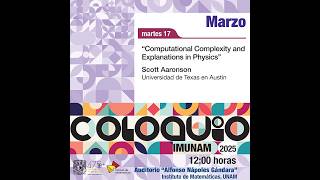
Computational Complexity and Explanations in Physics
Explore how computational complexity impacts physics, from quantum computing's philosophical implications to its role in black hole paradoxes and thermodynamics.

Edmund Harriss en Diálogos entre Matemáticas y Cultura
Explore the profound connection between art and mathematics, revealing how mathematical thinking can enrich artistic creation and vice-versa, leading to new forms of expression and understanding.

La inevitabilidad de los agujeros negros y la topología de su horizonte.
Explore the inevitability of black holes and their event horizon topology through advanced spacetime geometry and causality theory.

El problema del encaje de árboles en gráficas
Exploring tree embedding in graphs and digraphs, focusing on density conditions and degree properties to guarantee subgraph containment.

Modelos subrogados en problemas inversos de EDPs
Leveraging surrogate models drastically accelerates solving complex inverse problems in PDEs, offering significant computational speedups and robust uncertainty quantification.