Instituto de Matemáticas de la UNAM · Video summary
9 Encuentro Xavier Gómez-Mont
This lecture discusses polynomial vector fields and their dynamics on C2 and the three-dimensional sphere, emphasizing attractors and repellers.

 Watch on YouTube ↗
Key takeaways
- 💡Understanding the parameter space allows for insights into how the coefficients impact the dynamical behavior of the vector fields.13:00
- 🚀Explore parameter sensitivity in your project by analyzing how changes in coefficients affect dynamics.13:00
- 📊Bifurcations occur when transitioning between configurations, which can indicate significant changes in dynamic stability.13:50
- 🎯The dynamics of vector fields can be categorized into finite numbers of attractors and repellers, simplifying analysis.18:00
- 🔧Utilize software tools for computational analysis of vector fields to illustrate complex dynamics and bifurcation outcomes.30:00
- 🔍The construction of torus maps around attractors and repellers helps visualize the flow and interaction between dynamics.38:00
Chapters
- 0:08🙏 Introduction and Acknowledgments
- 2:06📊 Discussion of Parameter Space
- 4:09📈 Newton Equation and Vector Field
- 5:54🔄 Changing Parameter Families
- 7:21🌐 Three-Dimensional Sphere Dynamics
- 10:04📈 Differential Equations and Solutions
- 13:08⚖️ Characterizing Stability Sets
- 14:02🖥️ Computational Examples
- 16:03🔄 Reversing Time in Dynamics
- 17:12📉 Attractors and Repellers Theorem
- 31:40🔍 Visualizing Dynamics
- 32:48🧩 Bifurcation and Separating Sets
- 37:00🎨 Illustrative Pictures and Confusion
- 41:30⏳ Conclusions and Future Directions
The digest
High Level Overview
This lecture examines the dynamic behavior of polynomial vector fields on complex two-dimensional space (ℂ²) and their restriction to real three-dimensional spheres. It bridges abstract complex dynamics and real differential equations by associating complex foliations with real analytic vector fields on spheres. The core goal is to understand the structural stability and bifurcations of these vector fields through finite, topologically stable data—important for mathematicians studying complex dynamical systems, differential equations, and foliations.
Keep reading in The Digest
The full 6-minute article, 4 more sections, and every new episode from Instituto de Matemáticas de la UNAM and the creators you follow.
- Structured Deep Dive
- Key Frameworks and Concepts
- Practical Implications & Takeaways
- Action-Oriented Summary: Applying the Framework
More from Instituto de Matemáticas de la UNAM

¿Cómo mezclar un mazo de cartas? Caminatas aleatorias y álgebras de Iwahori-Hecke.
Explore random walks on groups using Iwahori-Hecke algebras to model card shuffling, revealing insights into mixing times and spectral gaps.
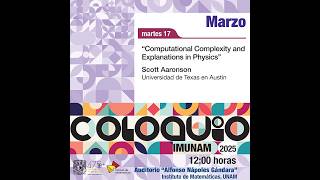
Computational Complexity and Explanations in Physics
Explore how computational complexity impacts physics, from quantum computing's philosophical implications to its role in black hole paradoxes and thermodynamics.

Ximena Catepillán en Diálogos entre Matemáticas y cultura
Explore the mathematical structures within indigenous kinship systems, revealing group theory and abstract algebra embedded in cultural practices.

Edmund Harriss en Diálogos entre Matemáticas y Cultura
Explore the profound connection between art and mathematics, revealing how mathematical thinking can enrich artistic creation and vice-versa, leading to new forms of expression and understanding.

La inevitabilidad de los agujeros negros y la topología de su horizonte.
Explore the inevitability of black holes and their event horizon topology through advanced spacetime geometry and causality theory.

El problema del encaje de árboles en gráficas
Exploring tree embedding in graphs and digraphs, focusing on density conditions and degree properties to guarantee subgraph containment.