Instituto de Matemáticas de la UNAM · Video summary
5 Encuentro Jesús Muciño
This talk explores polynomial differential equations and their perturbations, focusing on Ablian integrals and their zeros to understand dynamical systems.

 Watch on YouTube ↗
Key takeaways
- 🎯The study of polynomial differential equations involves understanding their singular foliations and how perturbations change their dynamics, a complex "universe" of possibilities.04:02
- 💡Ablian integrals measure the change in integrals along loops in the fibers of a polynomial, and their behavior reveals critical information about the perturbed system.06:57
- 📈The trivial monodromy condition is crucial, simplifying the study of Ablian integrals by ensuring that the integrals are well-behaved (polynomials of parameters) rather than multi-valued functions.12:56
- 🚀Investigate the trivial monodromy condition for your specific polynomial differential equations to determine if simplification is possible.12:56
- 🔍Polynomials with trivial global monodromy can be classified into three families, and importantly, they admit a global rectifying map that simplifies the differential equations.16:19
- 📚Familiarize yourself with the classification of polynomials with trivial global monodromy (three families) and their associated geometric properties (spheres with punctures).16:19
Chapters
- 0:08🎯 Introduction and Acknowledgments
- 1:39🎯 Context and Cultural Significance
- 2:51🎯 Setup of the Mathematical Problem
- 3:26🎯 Study of Perturbations and Foliations
- 6:57🎯 Aion Integrals and Their Behavior
- 8:36🎯 Monodromy and Triviality Conditions
- 9:33🎯 Bounding Zeros of Aion Integrals
- 18:24🎯 Global Geometry and Regularization
- 22:03🎯 Program for Studying Zeros of Bialion Integrals
- 26:21🎯 Examples and Applications
- 33:50🎯 Further Geometric and Topological Considerations
- 41:42🎯 Explicit Computations and Examples
- 49:47🎯 Questions and Open Problems
The digest
This presentation develops a deep analysis of polynomial Hamiltonian differential equations in two complex variables, focusing on the study of Abelian integrals related to their perturbations. It presents a comprehensive program to classify polynomials with trivial global monodromy and to compute effective bounds on the zeros of associated Abelian integrals. The work ties geometric, topological, and algebraic aspects of foliations, relying on normal forms and rational transformations, and has applications in understanding limit cycles and the global behavior of polynomial differential systems.
High-Level Overview
The core premise is to analyze polynomial Hamiltonian systems—differential equations derived from polynomials in two complex variables—and their perturbations. Such systems define foliations of the complex projective plane by algebraic curves. A key object of study is the Abelian integral, which arises when integrating perturbations over cycles in the leaves of these foliations. Understanding the zeros of these Abelian integrals relates directly to the emergence of limit cycles and complex dynamics in perturbed systems. The talk focuses on polynomials whose foliations exhibit trivial global monodromy, enabling classification and global uniformization methods. This framework allows effective computation of bounds on zeros of Abelian integrals, thereby advancing longstanding problems in dynamics and differential equations. The results are relevant for mathematicians studying foliations, dynamical systems, and algebraic geometry.
Keep reading in The Digest
The full 7-minute article, 11 more sections, and every new episode from Instituto de Matemáticas de la UNAM and the creators you follow.
- Polynomial Hamiltonian Foliations and Perturbations
- Abelian Integrals and Their Role
- Global Monodromy and Normal Forms
- Geometry of the Three Families
- Program and Algorithm for Studying Abelian Integrals
- Bounds on Zeros of Abelian Integrals and Limit Cycles
- Illustrative Example: Harmonic Oscillator
- Advanced Topics and Applications
- Key Frameworks and Mental Maps
- Practical Implications & Takeaways
- Action-Oriented Summary
More from Instituto de Matemáticas de la UNAM

¿Cómo mezclar un mazo de cartas? Caminatas aleatorias y álgebras de Iwahori-Hecke.
Explore random walks on groups using Iwahori-Hecke algebras to model card shuffling, revealing insights into mixing times and spectral gaps.
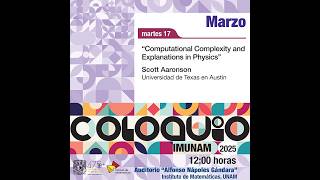
Computational Complexity and Explanations in Physics
Explore how computational complexity impacts physics, from quantum computing's philosophical implications to its role in black hole paradoxes and thermodynamics.

Ximena Catepillán en Diálogos entre Matemáticas y cultura
Explore the mathematical structures within indigenous kinship systems, revealing group theory and abstract algebra embedded in cultural practices.

Edmund Harriss en Diálogos entre Matemáticas y Cultura
Explore the profound connection between art and mathematics, revealing how mathematical thinking can enrich artistic creation and vice-versa, leading to new forms of expression and understanding.

La inevitabilidad de los agujeros negros y la topología de su horizonte.
Explore the inevitability of black holes and their event horizon topology through advanced spacetime geometry and causality theory.

El problema del encaje de árboles en gráficas
Exploring tree embedding in graphs and digraphs, focusing on density conditions and degree properties to guarantee subgraph containment.