Instituto de Matemáticas de la UNAM · Video summary
13 Encuentro Pavao Mardesic
Pavo Mardesic discusses zero cycles and their displacement functions, providing insights into mathematical principles in deformation theory.

 Watch on YouTube ↗
Key takeaways
- 📊Insights from the implicit function theorem help extend simple zeros into more complex cases when examining deformation.16:56
- 📚Study the implicit function theorem to better understand its implications in your field.16:59
- 🔍A primary goal is to determine the number of zeros in displaced functions, shedding light on limit cycles.18:01
- 📈The 16th Hilbert problem relates the number of zeros in functions to properties of cycles, revealing deeper mathematical relationships.18:54
- ⚡The displacement function measures changes in cycles upon perturbation, critical in understanding dynamical systems.20:00
- 💡Utilize the displacement function concept to analyze perturbations in dynamical systems.20:10
Chapters
- 0:05🎤 Introduction to Pavo
- 1:40📊 Overview of the Talk
- 3:03🔍 Motivation for the Research
- 3:49📉 Classical Problem Description
- 6:13🔄 Displacement Function
- 10:59📈 Two Major Problems
- 17:41🔬 Discussion of the Hilbert Problems
- 20:06🗃️ Definition of Zero Cycles
- 30:20🔗 Integration Over Zero Cycles
- 33:15📜 Displacement Functions on Zero Cycles
- 46:02💡 Key Findings and Results
- 53:37❓ Conclusion and Questions
The digest
High Level Overview
This lecture focuses on the study of tangential and infinitesimal problems related to polynomial deformations, with a particular emphasis on zero cycles and their connection to Hilbert's 16th problem concerning limit cycles in polynomial vector fields. The speaker introduces a reduced model involving zero cycles, which are simpler than traditionally studied one-dimensional cycles, develops displacement functions and Melnikov-type integrals in this context, and presents exact bounds on the number of zeros of these functions, highlighting their significance for the classical problem of counting limit cycles. This is relevant for mathematicians and researchers working on dynamical systems, algebraic geometry, and complex analysis.
Keep reading in The Digest
The full 6-minute article, 13 more sections, and every new episode from Instituto de Matemáticas de la UNAM and the creators you follow.
- Detailed Exposition
- 1. Motivation and Background: One Cycles and Displacement Functions
- 2. Transition from One Cycles to Zero Cycles
- 3. Abelian Integrals on Zero Cycles and Melnikov Functions
- 4. Counting Zeros: Main Theorems and Explicit Bounds
- 5. Comparison and Phenomena Beyond First Order Approximation
- 6. Relation to Hilbert's 16th Problem and Broader Context
- 7. Additional Concepts and Examples
- Key Frameworks and Mental Models
- Displacement Function Framework
- Zero Cycle Model
- Practical Implications and Takeaways
- Action-Oriented Summary
More from Instituto de Matemáticas de la UNAM

¿Cómo mezclar un mazo de cartas? Caminatas aleatorias y álgebras de Iwahori-Hecke.
Explore random walks on groups using Iwahori-Hecke algebras to model card shuffling, revealing insights into mixing times and spectral gaps.
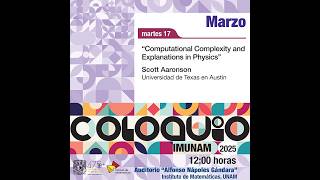
Computational Complexity and Explanations in Physics
Explore how computational complexity impacts physics, from quantum computing's philosophical implications to its role in black hole paradoxes and thermodynamics.

Ximena Catepillán en Diálogos entre Matemáticas y cultura
Explore the mathematical structures within indigenous kinship systems, revealing group theory and abstract algebra embedded in cultural practices.

Edmund Harriss en Diálogos entre Matemáticas y Cultura
Explore the profound connection between art and mathematics, revealing how mathematical thinking can enrich artistic creation and vice-versa, leading to new forms of expression and understanding.

La inevitabilidad de los agujeros negros y la topología de su horizonte.
Explore the inevitability of black holes and their event horizon topology through advanced spacetime geometry and causality theory.

El problema del encaje de árboles en gráficas
Exploring tree embedding in graphs and digraphs, focusing on density conditions and degree properties to guarantee subgraph containment.