Instituto de Matemáticas de la UNAM · Video summary
12 Encuentro Jessica Jaurez
Jessica Jaurez explores the tangency of foliations in the context of differential equations and their analytic classification.

 Watch on YouTube ↗
Key takeaways
- 💡Understanding the equivalence of foliations and their analytic classes can reveal deeper structural properties of differential equations.12:01
- 📈A holomorphic change of coordinates can link different foliation pairs, indicating a powerful connection within complex analytic contexts.12:01
- 🚀Apply holistic approaches to understand foliation pairs in different contexts.12:01
- 📚Invest time in studying the analytical equivalence and classification of tangency curves.12:01
- 🔧Explore holomorphic transformations to assess their impact on the dynamics of differential equations.12:01
- 🎯The tangency curve serves as an analytic invariant in foliation pairs, providing significant insights into their behavior and classification.12:54
Chapters
- 1:04🎤 Introduction
- 2:57🧠 Preliminary notions on differential equations and foliations
- 4:19⚙️ Analysis of tangency and intersection of foliations
- 6:24🔍 Example with linear vector fields
- 9:18🔄 Change of coordinates and invariance of tangency curves
- 15:41📊 Analytic invariants and classification spaces
- 26:32🚀 Local models and decomposition of foliation pairs
- 29:00📈 Functional space correspondence
- 45:31🔗 Relation between different classification spaces
- 48:38💡 Main conclusions and open questions
- 49:51❓ Q&A and closing remarks
The digest
This talk presents a detailed study of holomorphic foliations on complex surfaces, specifically focusing on the analytic classification of pairs of foliations and the properties of their tangency curves. It explores how these tangency curves serve as analytical invariants, how they behave under coordinate changes, and their relationship with the analytic classification spaces of the foliations themselves. The results address fundamental questions for mathematicians working in complex dynamical systems, foliation theory, and singularity theory.
High-Level Overview
The presentation delves into the analytic classification of pairs of holomorphic foliations defined near the origin in complex two-dimensional spaces, examining the geometric and analytic properties of their tangency curves—curves where two distinct foliations meet tangentially. These tangency curves are shown to be powerful invariants that reflect deep structural information about the foliations. The talk systematically develops frameworks to understand how these invariants behave under analytic equivalences and coordinate changes, connecting these ideas to the broader classification problem of complex foliations. It highlights recent advances in describing these classes via infinite-dimensional functional spaces and explores how the tangency curves' analytic classes relate to the foliations’. This is crucial for researchers interested in complex geometry, singular foliations, and dynamical systems.
Keep reading in The Digest
The full 7-minute article, 17 more sections, and every new episode from Instituto de Matemáticas de la UNAM and the creators you follow.
- Structured Deep Dive
- Introduction to Holomorphic Foliations and Tangency Curves (03:00–06:00)
- Analytical Equivalence of Foliation Pairs and Tangency Curves (10:00–13:30)
- Analytic Classification Spaces and Invariants (15:30–26:00)
- Analytic Classification Space of Foliation Pairs (26:00–30:00)
- Tangency Curves After the Blow-Up (31:00–37:40)
- Realization Problem and Analytic Normal Forms (38:00–44:00)
- Classification Space of Tangency Curves (44:00–46:00)
- Final Global Diagram and Relations Between Invariants (46:00–49:30)
- Discussion Highlights (50:00–55:55)
- Key Frameworks and Models
- 1. Tangency Curve of a Foliation Pair
- 2. Classes of Foliations
- 3. Analytic Classification Space
- 4. Normalizing Transformations
- Practical Implications & Takeaways
- Action-Oriented Summary
More from Instituto de Matemáticas de la UNAM

¿Cómo mezclar un mazo de cartas? Caminatas aleatorias y álgebras de Iwahori-Hecke.
Explore random walks on groups using Iwahori-Hecke algebras to model card shuffling, revealing insights into mixing times and spectral gaps.
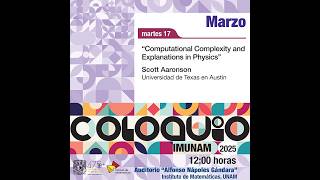
Computational Complexity and Explanations in Physics
Explore how computational complexity impacts physics, from quantum computing's philosophical implications to its role in black hole paradoxes and thermodynamics.

Ximena Catepillán en Diálogos entre Matemáticas y cultura
Explore the mathematical structures within indigenous kinship systems, revealing group theory and abstract algebra embedded in cultural practices.

Edmund Harriss en Diálogos entre Matemáticas y Cultura
Explore the profound connection between art and mathematics, revealing how mathematical thinking can enrich artistic creation and vice-versa, leading to new forms of expression and understanding.

La inevitabilidad de los agujeros negros y la topología de su horizonte.
Explore the inevitability of black holes and their event horizon topology through advanced spacetime geometry and causality theory.

El problema del encaje de árboles en gráficas
Exploring tree embedding in graphs and digraphs, focusing on density conditions and degree properties to guarantee subgraph containment.