Instituto de Matemáticas de la UNAM · Video summary
11 Encuentro Laura Ortiz
This talk elaborates on the geometric interpretation of analytic invariance in singular vector fields, leveraging classification frameworks and emphasizing the importance of roots in description.

 Watch on YouTube ↗
Key takeaways
- 💻Geometrical objects play a crucial role in interpreting formal normal forms and their analytic invariance.04:51
- 🌟Integrate geometric interpretations in your analysis of differential equations to enrich understanding.04:51
- 🎯Understanding analytic equivalence is vital—two vector fields are classified by their correspondence under transformation.05:11
- 🚀Utilize analytic equivalence principles to improve your approach when classifying vector fields.05:11
- 📊The significance of the polynomial relationship between vector fields highlights distinctive geometric structures.11:12
- 📈Focus on polynomial relations in your models to refine analytical methods for dynamic systems.11:12
Chapters
- 0:00🎤 Welcome and Introduction
- 0:22🏆 Introduction of Key Speaker
- 3:42🔍 Aim of the Talk
- 3:59🎲 Gluing Models
- 4:54📚 Analytic Classification of Vector Fields
- 6:55🧮 Equivalence of Vector Fields
- 8:48📏 Linearization Theorems
- 10:35🔑 Homogeneous Polynomials
- 12:30📊 Procedure of Resolution of Singularities
- 12:58🌐 Analytic Invariants
- 15:40📉 Invariance and Linearization
- 18:03🌀 Tangency Points and Their Role
- 42:25🔄 Transformation Invariance
- 50:04📈 Conclusion and Summary of Findings
- 50:33❓ Q&A Session
The digest
This presentation explores the deep geometric structures underlying the analytic classification of singular analytic vector fields in two complex variables. It focuses on resolving a longstanding problem concerning analytic invariants associated to vector fields with degenerate singularities, connecting formal normal forms to concrete geometric objects. The insights are significant for mathematicians working in dynamical systems, differential equations, and algebraic geometry, offering a rigorous framework for analytic equivalence and classification.
High-Level Overview
The talk addresses the analytic classification of singular analytic vector fields near degenerate singularities, particularly when the linear part vanishes. Building on notions from differential equations and foliation theory, the speaker describes how to capture analytic invariants—quantities or structures preserved under analytic coordinate changes—through geometric interpretations. This work confirms and expands on a conjecture by René Thom from the 1970s, providing a clear geometric framework that links abstract formal invariants from normal form theory to tangible analytic and topological structures. The talk also introduces a method of combining pairs of foliations to realize these invariants concretely.
Keep reading in The Digest
The full 5-minute article, 9 more sections, and every new episode from Instituto de Matemáticas de la UNAM and the creators you follow.
- Analytic Equivalence and Classification of Vector Fields
- Degenerate Singularities: Principal Part and Polynomial Invariants
- Holonomy and Analytic Invariants from Singular Points
- Thom’s Conjecture and Formal Normal Forms
- Dicritical vs. Nondicritical Cases & Pairs of Foliations
- Construction of Geometric Models for Invariants
- Key Frameworks & Mental Models
- Practical Implications & Takeaways
- Action-Oriented Summary
More from Instituto de Matemáticas de la UNAM

¿Cómo mezclar un mazo de cartas? Caminatas aleatorias y álgebras de Iwahori-Hecke.
Explore random walks on groups using Iwahori-Hecke algebras to model card shuffling, revealing insights into mixing times and spectral gaps.
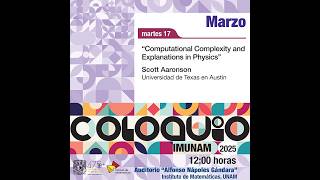
Computational Complexity and Explanations in Physics
Explore how computational complexity impacts physics, from quantum computing's philosophical implications to its role in black hole paradoxes and thermodynamics.

Ximena Catepillán en Diálogos entre Matemáticas y cultura
Explore the mathematical structures within indigenous kinship systems, revealing group theory and abstract algebra embedded in cultural practices.

Edmund Harriss en Diálogos entre Matemáticas y Cultura
Explore the profound connection between art and mathematics, revealing how mathematical thinking can enrich artistic creation and vice-versa, leading to new forms of expression and understanding.

La inevitabilidad de los agujeros negros y la topología de su horizonte.
Explore the inevitability of black holes and their event horizon topology through advanced spacetime geometry and causality theory.

El problema del encaje de árboles en gráficas
Exploring tree embedding in graphs and digraphs, focusing on density conditions and degree properties to guarantee subgraph containment.