misesmedia · Video summary
Visualizing The Boom-Bust Cycle with Roger Garrison
Roger Garrison's capital-based macroeconomics framework visualizes the boom-bust cycle using familiar diagrams, highlighting how monetary expansion distorts the time structure of production.

 Watch on YouTube ↗
Key takeaways
- 💡Garrison's approach bridges Keynesian (focus on demand/money) and Monetarist/RBC (focus on fundamentals/shocks) views by integrating capital theory and monetary theory, explaining how monetary factors create real malinvestments.08:36
- 🎯The Austrian business cycle theory, as visualized by Garrison, posits that artificially low interest rates driven by credit expansion (not genuine savings) lead to malinvestments in the time structure of production, causing an unsustainable boom.10:12
- 📚Familiarize yourself with Garrison's diagrams (loanable funds, PPF, Hayekian triangle) to better understand the mechanics of the boom-bust cycle.13:52
- 🔧Analyze current economic expansions by examining the source of falling interest rates: genuine savings or credit expansion.25:23
- 🔍The loanable funds market diagram shows that credit expansion shifts the supply curve right, lowering interest rates and increasing business investment demand, while simultaneously decreasing household saving, creating a fundamental mismatch.26:34
- 📈An unsustainable boom, induced by policy, allows the economy to temporarily move beyond the production possibilities frontier by neglecting maintenance and future production capacity, leading to a subsequent collapse.31:05
Chapters
- 0:02🎙️ Podcast Introduction
- 0:13🕊️ Commemorating Roger Garrison
- 0:21📊 Introduction to Garrison's Diagrams
- 0:46📚 Garrison's Influence on Austrian Economics
- 0:57📖 Overview of Garrison's Publications
- 1:40💡 Understanding Capital-Based Macroeconomics
- 2:00🏦 Keynesian vs. Monetarist Views
- 2:18⚖️ Austrian Economics Perspective
- 2:39📉 Sustainable vs. Unsustainable Booms
- 3:31📈 The Loanable Funds Diagram
- 4:10📈 Production Possibilities Frontier
- 4:48🔄 Investment and Consumption Dynamics
- 5:07🏗️ Unsustainable Economic Growth
- 5:38📉 Consequences of Overinvestment
- 6:00🔚 Conclusion and Takeaways
The digest
Visualizing the Boom-Bust Cycle: Roger Garrison's Capital-Based Macroeconomics
This video explains Roger Garrison's influential model for visualizing the Austrian theory of the business cycle. The core premise is that monetary policy, specifically artificially low interest rates driven by credit expansion rather than genuine savings, distorts the economy's capital structure, leading to unsustainable booms and subsequent busts. This framework is valuable for economists, policymakers, and anyone seeking a deeper understanding of macroeconomic fluctuations beyond simplistic demand-side explanations.
Keep reading in The Digest
The full 5-minute article, 4 more sections, and every new episode from misesmedia and the creators you follow.
- The Austrian Business Cycle Theory Through Garrison's Diagrams
- Key Frameworks, Models, or Mental Maps
- Practical Implications & Takeaways
- Action-Oriented Summary
More from misesmedia

Gold Whiplash and the Petrodollar | Mark Thornton
War in the Middle East is causing gold price volatility and threatening the petrodollar, leading to potential global price inflation and a devalued US dollar.

Trump Is Right on Birthright Citizenship
In this episode of the Power Market podcast, misesmedia discusses the contentious issue of birthright citizenship and its implications, particularly in light of a Supreme Court case challenging its validity, while also exploring the libertarian perspectives on naturalization and the broader implications of immigration policy. The hosts argue for a nuanced understanding of citizenship that separates it from mere immigration, highlighting the need for a more rigorous debate within libertarian circles.

Cantillon Effects and the Politics of Money Creation
Understand Cantillon Effects: new money doesn't reach everyone equally, creating winners and losers and distorting price signals and the economy.
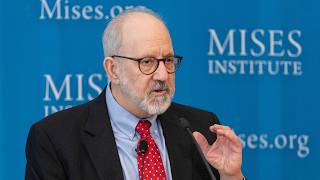
Rothbard on Interventionism: Writing the Last Chapter of Economic Theory | Joseph T. Salerno
Explores Rothbard's praxiological method to analyze interventionism, revealing that all economic phenomena stem from either voluntary action or coercion.

On the Shoulders of Shrinking Giants | Lucas M. Engelhardt
The video argues that the economics field increasingly neglects its history of thought, leading to the repetition of old debates and the misunderstanding of ideas as novel. It proposes solutions for better knowledge dissemination.

From Vienna to Madrid: A Libertarian Vision of Scientific and Moral Truth | Jesús Huerta de Soto
Economics reveals that spontaneous order from voluntary cooperation is superior to state coercion. The Austrian school, rooted in Spanish scholasticism, emphasizes subjective value, entrepreneurship, and the impossibility of socialist calculation.