misesmedia · Video summary
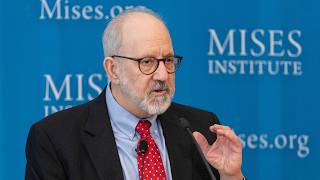
Gold Whiplash and the Petrodollar | Mark Thornton
War in the Middle East is causing gold price volatility and threatening the petrodollar, leading to potential global price inflation and a devalued US dollar.

 Watch on YouTube ↗
Key takeaways
- 🎯The war in the Middle East initially caused a downdraft in gold prices as owners in the region sold gold for liquidity (dollars) to finance operations or flee the conflict zone, despite gold's traditional role as a safe haven. 🎯01:57
- 💡The petrodollar system, where oil is priced in USD, is under threat due to geopolitical instability and the potential for other currencies (like the Chinese Yuan) to be used in oil transactions, which could devalue the US dollar and lead to global price inflation. 💡04:01
- 📈The current global economic situation is a combination of cost-push inflation (driven by supply chain disruptions and war) layered on top of monetary inflation (central bank actions to finance government debt), leading to higher prices for energy, food, and other goods. 📈05:31
- ⚡The war's impact extends beyond oil and gas to other critical industries like fertilizers, jet fuel, and aluminum, creating cascading supply chain disruptions and price increases globally, even if peace were to be declared immediately. ⚡19:10
- 🔍The Federal Reserve's liquidity programs and quantitative easing are designed to protect the financial system (Wall Street and the government) rather than tame inflation, suggesting a continued issuance of money and potential for further devaluation. 🔍38:08
- 🚀Private equity's reliance on debt and financial engineering has created a new form of 'junk bonds' with liquidity problems, necessitating Fed intervention and highlighting the inherent risks in a fiat currency regime driven by yield-seeking investors. 🚀40:35
Chapters
- 0:00🎯 Introduction and Market Swings
- 2:04🎯 Effects of War and Middle Eastern Market Dynamics
- 12:44🎯 Gold as a Hedge and Price Fluctuations
- 17:54🎯 Market Support Levels and Price Outlook
- 24:11🎯 Impact on the Petrodollar and US Dollar Outlook
- 33:07🎯 Inflation Expectations and Federal Reserve Policies
- 40:20🎯 Private Equity and Liquidity Problems
- 44:01🎯 Silver Market Outlook
- 47:21🎯 Market Psychology and Investment Strategies
- 50:01🎯 Geopolitical Risks and Economic Uncertainty
- 55:12🎯 Monitoring Key Indicators
The digest
High Level Overview
This conversation with economist Mark Thornton analyzes the recent volatile swings in precious metals markets, particularly gold and silver, amid the Middle East conflict and ongoing economic challenges. It explores how liquidity needs, geopolitical tensions, and disruptions to the petrodollar system contribute to shifting supply-demand dynamics, price inflation, and monetary instability. The insights are critical for investors, policymakers, and observers seeking a nuanced understanding of these interconnected global forces beyond simplistic inflation or war narratives.
Keep reading in The Digest
The full 6-minute article, 10 more sections, and every new episode from misesmedia and the creators you follow.
- The Dynamics Behind Precious Metals Market Swings
- War’s Disruptive Impact on Global Supply Chains and Inflation
- The Fragility of the Petrodollar System and U.S. Dollar Outlook
- Understanding Price Inflation vs. Monetary Inflation
- Liquidity Crisis in Private Equity and Market Implications
- Silver Market Volatility and Investment Strategy
- Broader Economic and Political Reflections
- Key Frameworks and Mental Models
- Practical Implications & Takeaways
- Action-Oriented Summary
More from misesmedia

Trump Is Right on Birthright Citizenship
In this episode of the Power Market podcast, misesmedia discusses the contentious issue of birthright citizenship and its implications, particularly in light of a Supreme Court case challenging its validity, while also exploring the libertarian perspectives on naturalization and the broader implications of immigration policy. The hosts argue for a nuanced understanding of citizenship that separates it from mere immigration, highlighting the need for a more rigorous debate within libertarian circles.

Cantillon Effects and the Politics of Money Creation
Understand Cantillon Effects: new money doesn't reach everyone equally, creating winners and losers and distorting price signals and the economy.
Rothbard on Interventionism: Writing the Last Chapter of Economic Theory | Joseph T. Salerno
Explores Rothbard's praxiological method to analyze interventionism, revealing that all economic phenomena stem from either voluntary action or coercion.

On the Shoulders of Shrinking Giants | Lucas M. Engelhardt
The video argues that the economics field increasingly neglects its history of thought, leading to the repetition of old debates and the misunderstanding of ideas as novel. It proposes solutions for better knowledge dissemination.

From Vienna to Madrid: A Libertarian Vision of Scientific and Moral Truth | Jesús Huerta de Soto
Economics reveals that spontaneous order from voluntary cooperation is superior to state coercion. The Austrian school, rooted in Spanish scholasticism, emphasizes subjective value, entrepreneurship, and the impossibility of socialist calculation.

Visualizing The Boom-Bust Cycle with Roger Garrison
Roger Garrison's capital-based macroeconomics framework visualizes the boom-bust cycle using familiar diagrams, highlighting how monetary expansion distorts the time structure of production.