misesmedia · Video summary
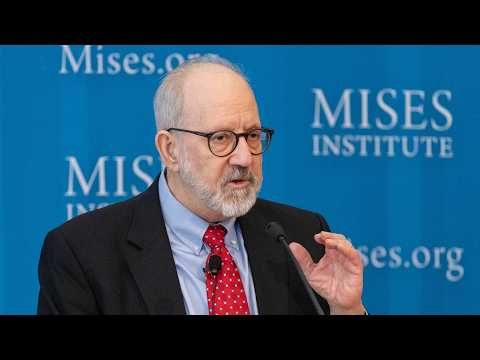
Rothbard on Interventionism: Writing the Last Chapter of Economic Theory | Joseph T. Salerno
Explores Rothbard's praxiological method to analyze interventionism, revealing that all economic phenomena stem from either voluntary action or coercion.

 Watch on YouTube ↗
Key takeaways
- 🎯Austrian economics, specifically Rothbard's work, views economic depressions as having a single, exogenous cause and a single cure, a departure from multi-causal theories.02:51
- 🚀Re-evaluate economic phenomena through the lens of praxiology, starting with individual action and logical deduction rather than aggregate data.04:46
- 💡Praxiology, the study of human action, is the foundational method, logically deducing economic theory from axioms like human action itself and self-evident truths.05:56
- 🔍The praxiological method relies on imaginary constructions (like the evenly rotating economy or a world without time preference) to isolate variables and deduce real-world economic laws.07:15
- 🔧Apply imaginary constructions to complex economic problems to isolate variables and understand underlying causal mechanisms, rather than relying solely on empirical models.07:15
- 🚀Rothbard's key innovation was integrating the analysis of government intervention into praxiological reasoning, extending economic theory to explain 'hampered' markets, not just free ones.14:14
Chapters
- 0:00🎤 Introduction and Personal Anecdote
- 0:55📚 Early Encounters with Rothbard's Work
- 2:32💡 Praxiology and Interventionism
- 3:46🏗️ The Praxiological Method
- 6:12🧠 Rothbard's Conviction in Praxiology
- 7:15✨ Imaginary Constructions in Economics
- 8:01⏳ Time Preference and Interest
- 9:22🔄 The Evenly Rotating Economy
- 13:26🏛️ Critique of Mainstream Economic Models
- 13:50🧩 Integrating Interventionism into Economic Theory
- 15:02⚖️ Revising the Free Market Construct
- 19:22🔑 The Role of Property Rights
- 20:22🚫 Defining the Purely Free Market
- 24:49📈 Analysis of Interventionism
- 25:53🗂️ Typology of Intervention
- 27:22⚖️ Critique of Mainstream Intervention Analysis
- 28:27👤 Individualist Utility Theory
- 31:18🤔 Value-Free Analysis vs. Normative Arguments
- 35:33🎯 The Monocausal Theory of Business Cycles
- 36:51🔗 Causality and Interconnectedness
- 39:44⚖️ The Two Principles: Market vs. Hegemony
- 40:12🕊️ Conclusion: The Choice for Mankind
The digest
Rothbard's Theory of Interventionism: A Praxiological Framework for Economic Analysis
This presentation details Murray Rothbard's groundbreaking work in developing a comprehensive and logically consistent theory of government interventionism within the framework of Austrian economics. Joseph T. Salerno explains how Rothbard, by rigorously applying the praxiological method, was able to integrate the analysis of all forms of intervention—including the business cycle—into the core of economic theory. This approach provides a unified understanding of market dynamics and the consequences of coercive actions, offering a systematic method for analyzing economic phenomena.
Keep reading in The Digest
The full 6-minute article, 6 more sections, and every new episode from misesmedia and the creators you follow.
- The Praxiological Method and its Application to Economics
- Rothbard's Refined Construct of the Free Market
- A Systematic Theory of Interventionism
- Utility Analysis and the Value-Free Nature of Economic Theory
- Monocausal Business Cycle Theory and the Nature of Causality
- Conclusion: The Two Principles of Human Interaction
More from misesmedia

Gold Whiplash and the Petrodollar | Mark Thornton
War in the Middle East is causing gold price volatility and threatening the petrodollar, leading to potential global price inflation and a devalued US dollar.

Trump Is Right on Birthright Citizenship
In this episode of the Power Market podcast, misesmedia discusses the contentious issue of birthright citizenship and its implications, particularly in light of a Supreme Court case challenging its validity, while also exploring the libertarian perspectives on naturalization and the broader implications of immigration policy. The hosts argue for a nuanced understanding of citizenship that separates it from mere immigration, highlighting the need for a more rigorous debate within libertarian circles.

Cantillon Effects and the Politics of Money Creation
Understand Cantillon Effects: new money doesn't reach everyone equally, creating winners and losers and distorting price signals and the economy.

On the Shoulders of Shrinking Giants | Lucas M. Engelhardt
The video argues that the economics field increasingly neglects its history of thought, leading to the repetition of old debates and the misunderstanding of ideas as novel. It proposes solutions for better knowledge dissemination.

From Vienna to Madrid: A Libertarian Vision of Scientific and Moral Truth | Jesús Huerta de Soto
Economics reveals that spontaneous order from voluntary cooperation is superior to state coercion. The Austrian school, rooted in Spanish scholasticism, emphasizes subjective value, entrepreneurship, and the impossibility of socialist calculation.

Visualizing The Boom-Bust Cycle with Roger Garrison
Roger Garrison's capital-based macroeconomics framework visualizes the boom-bust cycle using familiar diagrams, highlighting how monetary expansion distorts the time structure of production.