MythBusters · Video summary
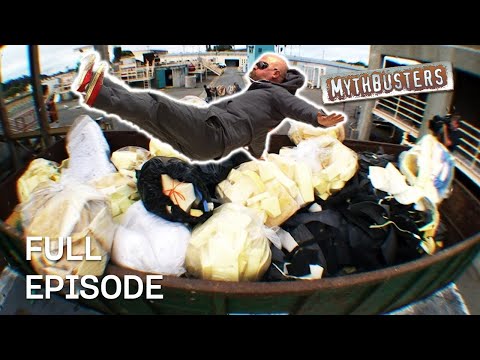
Will A Rooftop Dumpster Dive Really Save Your Life? | MythBusters | S6 E02 | Full Episode
Mythbusters tests if jumping into a dumpster is a safe escape and if old deep-sea diving suits could fatally crush divers. Dumpster landings are plausible with soft material, but risky due to unknown contents. Deep-sea diving pressure differentials are lethally dangerous.
 Watch on YouTube ↗
Key takeaways
- 🎯Safe falling technique involves landing flat on your back and using as much body volume as possible to maximize deceleration over a longer time, reducing impact risk.04:06
- 🚀If faced with a high fall, practice safe landing techniques by aiming to distribute impact over your entire back to maximize deceleration.04:06
- 🚀When considering an escape route involving a fall into a container, investigate the contents beforehand to ensure they provide adequate cushioning.15:21
- 🎯The ideal material for a dumpster landing that maximizes deceleration and minimizes injury is foam rubber, as it compresses effectively and reliably.18:35
- 🎯Jumping into a dumpster for an escape is plausible but not recommended due to the high variability of contents, which can range from soft materials to deadly hard objects, making the landing unpredictable and dangerous.44:01
- 🎯Failure of an air supply in old deep-sea diving suits, combined with the non-return valve, creates a drastic pressure differential that can catastrophically crush a diver.46:28
Chapters
- 1:32💥 Introduction to Myths
- 2:30🤸 Learning to Fall Safely
- 5:53⬆️ Increasing Fall Height
- 7:44🤿 Deep Sea Diving Myth Introduction
- 9:06🌊 Expert Consultation on Diving Myth
- 10:33🧊 Small-Scale Diving Test
- 13:21🗑️ Investigating Dumpster Contents
- 16:35📦 Testing Cushioning Materials
- 18:32💨 Foam Rubber as Best Material
- 20:05⬇️ Testing Mini Diver
- 24:05🐖 Introducing 'Meatman'
- 30:13🤖 Setting Up Dumpster Dive Control
- 31:30☁️ Airbag Fall Baseline
- 33:16💥 Dumpster Dive with Buster
- 34:36⚓ Full-Scale Dive Preparation
- 36:55🌊 Meatman's Descent
- 43:51👍 Dumpster Diving Myth Plausible
- 45:20✂️ Simulating Air Supply Failure
- 45:51🤯 Deep Sea Myth Confirmed
- 47:28✅ Deep Sea Diving Myth Confirmed
The digest
This episode of MythBusters rigorously investigates two popular myths: whether jumping from a rooftop into a dumpster can be a safe escape tactic as depicted in action films, and if a deep-sea diver’s suit could cause fatal bodily compression if its air supply fails underwater. With expert training, scaled experiments, and full-scale simulations, the team examines the physical realities behind these dramatic scenarios. These tests shed light on safety, physics, and common misconceptions, offering valuable insights for stunt performers, divers, and fans of movie myths alike.
High-Level Overview
The episode evaluates Hollywood’s portrayal of rooftop escapes using dumpsters and a legendary deep-sea diving suit failure scenario. Adam and Jamie first train with stunt coordinators to master safe falling techniques before testing if dumpsters truly cushion falls effectively enough for survival. Simultaneously, Carrie, Tori, and Grant explore whether a sudden loss of air pressure in early diving suits could cause catastrophic “squeeze” injuries as water pressure crushes the diver’s body. By combining expert consultation, creative scale modeling, and real-world recreations, the MythBusters provide comprehensive answers to these cinematic myths’ plausibility and dangers.
Keep reading in The Digest
The full 7-minute article, 17 more sections, and every new episode from MythBusters and the creators you follow.
- Deep Dive into Dumpster Diving Survival Myth
- The Movie Myth and Stunt Training (00:01–07:30)
- Dumpster Content Analysis and Risks (14:00–16:30)
- Identifying the Ideal Cushion: Material Crush Tests (16:45–18:30)
- Final Dumpster Dive Test with Buster (31:00–34:00)
- Conclusions on the Dumpster Myth
- Deep Dive into Deep-Sea Diving Suit “Squeeze” Myth
- Background and Expert Consultation (07:40–10:20)
- Scale Model Testing with Ballistics Gel Diver (11:00–22:00)
- Creation of “Meatman” Full-Scale Human Analog (23:00–28:00)
- Full-Scale Deep Dive Experiment (35:00–47:00)
- Key Frameworks and Principles
- 1. Safe Falling Technique
- 2. Physics of Deceleration and Impact
- 3. Pressure Differential and Squeeze Effect
- Practical Implications & Takeaways
- Action-Oriented Summary
More from MythBusters

Can Gummy Bears Actually Be Used As Rocket Fuel? | Mythbusters
Mythbusters tackles a fan-favorite myth: can gummy bears actually be used as rocket fuel? The team experiments with various gummy bear preparations to see if the sugary treats can propel a rocket.

MythBusters Tests Two Of The Most Explosive Myths In Their Final Season | Mythbusters
In their final season, the Mythbusters tackle two explosive myths: whether a cement truck can contain a dynamite blast in a mail truck, and if a hovercraft can safely traverse a minefield.

Can You Cook Shrimp By Firing Them Through a "Special" Gun? | Mythbusters
Mythbusters tackles two viral food fables: cooking shrimp by firing them through an air cannon and juicing fruit with explosives. They meticulously recreate the setups to determine if these bizarre culinary claims hold any truth.

Is The U-2 Spy Plane The Hardest Aircraft In The World To Land? | MythBusters
Mythbusters Adam Savage and Jamie Hyneman investigate the U-2 spy plane's legendary difficulty to land and the potential lethality of commercial drones.

MythBusters Test a Law That Half The Country Disagrees With | MythBusters
MythBusters Adam Savage and Jamie Hyneman tackle two common driving myths: whether hands-free phone use is as distracting as handheld, and if Hollywood-style reverse driving is possible in real life.

Could Walter White's Trunk Machine Gun Actually Work? | MythBusters
MythBusters tackles two explosive challenges: the literal meaning of "blowing it out of the water" with a ship and a depth charge, and the feasibility of Walter White's trunk-mounted machine gun from the Breaking Bad finale.