TED · Video summary
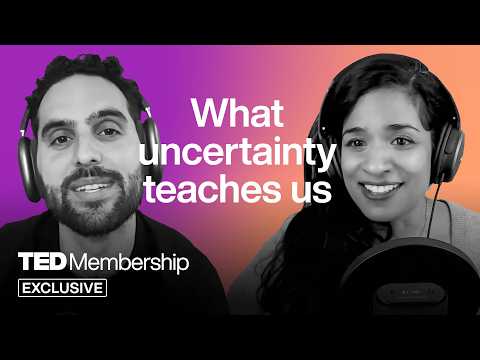
Why You Fear the Unknown — and What It Can Teach You | Maya Shankar and Simone Stolzoff | TED
In this conversation, Simone Stolzoff and Maya Shankar delve into the human aversion to uncertainty, exploring its evolutionary roots, societal implications, and personal impact. They discuss strategies for navigating the unknown, emphasizing the importance of anchoring identity in purpose rather than profession, and cultivating trust in one's future self.

 Watch on YouTube ↗
Key takeaways
- 🧠Humans often prefer the certainty of a negative outcome over the ambiguity of an uncertain one, even if the uncertain outcome has a 50% chance of being positive.00:26
- 🌳Our discomfort with uncertainty is rooted in an evolutionary survival instinct, where ambiguity in the wild could be fatal.03:02
- ⚓Anchoring your self-identity to 'what you do' (e.g., your profession) can make unexpected changes incredibly threatening; instead, anchor it to 'why you do it' (your core purpose or values).08:01
- ⛰️When we are willing to turn towards the unknown and withstand the initial stress, we can discover possibilities and higher peaks that were previously unimaginable.18:25
- ✨Moral elevation, the warm feeling from witnessing extraordinary behavior, can rewire our brains and expand our imagination about what we are capable of.26:00
- 🤔In moments of uncertainty, asking 'What does this choice say about who you are as a person?' can help connect decisions to your values and identity, allowing you to stand by them regardless of the outcome.32:54
Chapters
- 0:03The Human Aversion to Uncertainty
- 0:24Evolutionary Roots of Discomfort
- 0:49The Cost of Intolerance
- 0:53Identity and Change
- 3:55Finding Opportunity in the Fog
- 32:00Practical Tools for Embracing Uncertainty
The digest
Humans are inherently wired to seek certainty. A fascinating study from University College London illustrates this point vividly: participants facing a 50% chance of a painful electric shock were significantly more anxious and stressed than those with a 100% certainty of receiving the shock. This seemingly counterintuitive finding reveals a deep-seated preference for knowing what's coming, even if it's bad, over the ambiguity of the unknown. This aversion to uncertainty, while a survival instinct honed over millennia, can also be a significant impediment to growth and new possibilities.
The Evolutionary Roots of Our Discomfort
Our brains are designed to feel safe and secure when things are certain, and incredibly uncomfortable when they are not. Imagine an ancestor in the jungle hearing a rustle in the bushes – that uncertainty could be fatal. This primal wiring helps us make quick decisions and avoid danger, like putting on a seatbelt before a car ride. However, in modern life, this instinct can hinder us. For instance, studies on breast cancer patients show that the period between a biopsy and diagnosis is often the hardest part of the entire process, more challenging than chemotherapy or surgery. Once there's a diagnosis, energy can be directed towards a plan, but the uncertainty before that clarity is paralyzing.
Keep reading in The Digest
The full 4-minute article, 4 more sections, and every new episode from TED and the creators you follow.
- The Cost of Intolerance to Uncertainty
- Identity and Change: Anchoring in "Why" Not "What"
- Finding Opportunity in the Fog
- Practical Tools for Embracing Uncertainty
More from TED
How Tech Will (and Won’t) Replace Your Doctor | TED Intersections
In this episode of Intersections, Dr. Shuhan He and microbiologist Zack Abbott discuss the future of healthcare, from genetic engineering to the role of AI, and how our understanding of health metrics and the gut microbiome is evolving.

Why Is It So Hard for Men to Open Up? A Journalist and an Entrepreneur Answer | TED Intersections
In this episode of Intersections, Joshua Johnson and Blake Mycoskie discuss the importance of asking questions, having real conversations, and building meaningful relationships.

How to Make Learning Impossibly Fun | Mark Rober | TED
Mark Rober, a former NASA engineer and YouTube sensation, discusses his journey from designing McDonald's PlayPlaces to launching a $60 million STEM curriculum, Class CrunchLabs, aimed at making science education engaging and fun for kids.

Why Pursuing Happiness Makes You … Less Happy | Emily Esfahani Smith | TED
In her TED talk, Emily Esfahani Smith emphasizes the importance of pursuing a life of meaning over mere happiness, suggesting that true fulfillment comes from connecting and contributing to something beyond oneself, such as relationships and purpose, rather than chasing fleeting emotional states. She highlights that focusing on belonging and values can lead to a more resilient and satisfying life, especially during times of uncertainty.

11 People Had an Idea — Now They’re on the TED Stage | LIVE from TED2026!
Discover high-leverage ideas from global innovators on communication, sustainability, and societal progress. Explore non-obvious solutions to complex challenges.

How to Find Your Purpose (W/ Yara Shahidi) | How to Be a Better Human | TED
Embrace optimism as a practice, not just a feeling, by actively cultivating joy and finding purpose through highest orders and embracing amateurism.