TED · Video summary
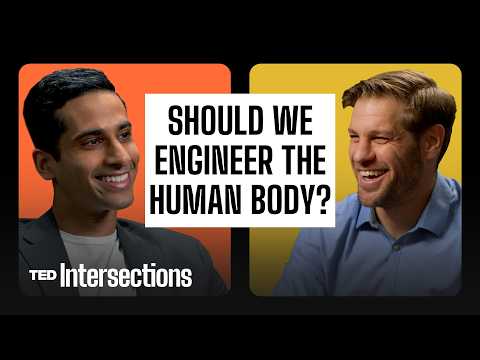
How Tech Will (and Won’t) Replace Your Doctor | TED Intersections
In this episode of Intersections, Dr. Shuhan He and microbiologist Zack Abbott discuss the future of healthcare, from genetic engineering to the role of AI, and how our understanding of health metrics and the gut microbiome is evolving.
 Watch on YouTube ↗
Key takeaways
- 🧘♀️Instead of focusing on numerous health metrics, we should prioritize our subjective feeling of health and well-being.01:24
- 🧬Genetic engineering, currently seen as radical, will become commonplace in healthcare within 20 years, especially for correcting genetic diseases like sickle cell anemia.03:06
- 🤖Artificial intelligence will handle much of routine healthcare, while human clinicians will focus on complex decisions requiring empathy and values integration.04:47
- 🍎The reluctance towards biotechnology in food stems from past applications that didn't benefit consumers; future biotech should focus on improving nutritional value and health outcomes.09:25
- 🛒People often reject genetically modified organisms (GMOs) because current offerings don't provide direct consumer benefits, creating a perceived risk without reward.11:43
- 🗣️Scientists and doctors often face a communication challenge because accurate, nuanced information is less provocative than simplified, black-and-white narratives.16:32
Chapters
- 0:00Introduction
- 0:43What health metric do you wish people would focus on more?
- 4:58What is something that seems radical in healthcare now that will seem ordinary 20 years from now?
- 10:41What do you think should be fair game in biology or medicine that people right now are reluctant about?
- 18:35What do people get wrong about the work you do?
- 30:02If science can change how our minds and bodies work, what should stay off limits?
- 37:10What is so special about the gut biome?
The digest
In an era saturated with health data and technological advancements, the conversation around health is shifting from mere quantification to a more holistic and personalized understanding. Dr. Shuhan He and microbiologist Zack Abbott delve into this evolving landscape, exploring the limitations of current health metrics, the transformative potential of genetic engineering and AI in healthcare, and the often-misunderstood role of the gut microbiome.
The Problem with Metrics: Feeling Over Numbers
We are inundated with health metrics, from cholesterol levels to daily step counts. While these numbers can be motivating and provide tangible goals, they often overshadow our innate ability to understand our own bodies. Dr. He argues that the most important health metric is a qualitative one: "Do I feel healthy today?" He emphasizes the importance of subjective well-being, asking if we have energy, feel unsettled, or are thriving. Abbott agrees, highlighting that individual biology is incredibly diverse, making universal numerical targets less effective. He points out the absurdity of needing a sleep tracker to determine if one feels well-rested, advocating for a return to listening to our bodies. This push towards quantification needs to be balanced with a vocabulary that allows us to articulate how we feel and what it means to live a good life.
Keep reading in The Digest
The full 3-minute article, 4 more sections, and every new episode from TED and the creators you follow.
- Genetic Engineering: From Radical to Routine
- AI in Healthcare: Augmenting, Not Replacing
- Biotech in Food: A Reluctant Embrace
- The Gut Microbiome: A Complex Ecosystem
More from TED
Why You Fear the Unknown — and What It Can Teach You | Maya Shankar and Simone Stolzoff | TED
In this conversation, Simone Stolzoff and Maya Shankar delve into the human aversion to uncertainty, exploring its evolutionary roots, societal implications, and personal impact. They discuss strategies for navigating the unknown, emphasizing the importance of anchoring identity in purpose rather than profession, and cultivating trust in one's future self.

Why Is It So Hard for Men to Open Up? A Journalist and an Entrepreneur Answer | TED Intersections
In this episode of Intersections, Joshua Johnson and Blake Mycoskie discuss the importance of asking questions, having real conversations, and building meaningful relationships.

How to Make Learning Impossibly Fun | Mark Rober | TED
Mark Rober, a former NASA engineer and YouTube sensation, discusses his journey from designing McDonald's PlayPlaces to launching a $60 million STEM curriculum, Class CrunchLabs, aimed at making science education engaging and fun for kids.

Why Pursuing Happiness Makes You … Less Happy | Emily Esfahani Smith | TED
In her TED talk, Emily Esfahani Smith emphasizes the importance of pursuing a life of meaning over mere happiness, suggesting that true fulfillment comes from connecting and contributing to something beyond oneself, such as relationships and purpose, rather than chasing fleeting emotional states. She highlights that focusing on belonging and values can lead to a more resilient and satisfying life, especially during times of uncertainty.

11 People Had an Idea — Now They’re on the TED Stage | LIVE from TED2026!
Discover high-leverage ideas from global innovators on communication, sustainability, and societal progress. Explore non-obvious solutions to complex challenges.

How to Find Your Purpose (W/ Yara Shahidi) | How to Be a Better Human | TED
Embrace optimism as a practice, not just a feeling, by actively cultivating joy and finding purpose through highest orders and embracing amateurism.