MythBusters · Video summary
The Mythbusters Cannon Test That Accidentally Made The News | MythBusters
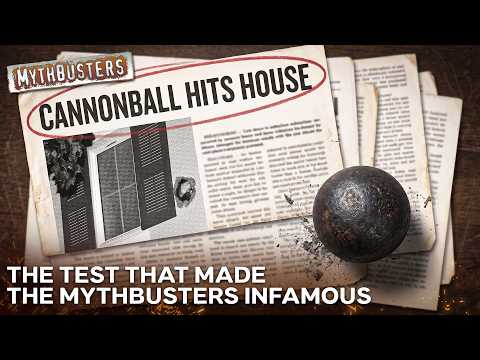
The MythBusters investigate a 15th-century myth about stone cannonballs. They test whether stone cannonballs could inflict similar damage to cast iron ones and shatter on impact, preventing reuse by the enemy.
 Watch on YouTube ↗
Key takeaways
- ⚠️A cannonball misfire during the episode's filming resulted in a cannonball accidentally going through someone's house, leading to an immediate halt of the experiment and a comprehensive safety review.00:05
- 💡The myth of stone cannonballs emerged from the strategic dilemma of 15th-century cannoneers who wanted to avoid giving valuable cast iron projectiles to the enemy.00:43
- 💨The true battle speed of a steel cannonball from an antique Civil War-era cannon was determined to be 1,200 feet per second, serving as the benchmark for testing the stone cannonballs.05:23
- 🪨Sandstone, limestone, and granite were chosen for the stone cannonballs due to their varying hardness and availability in 15th-century Europe.08:47
- 📦To protect the antique cannon from damage, the stone cannonballs were packaged inside cardboard canisters before being loaded and fired.14:46
- 💪The sandstone cannonball, despite being the softest, still caused significant damage, penetrating one layer and destroying two bricks before shattering.20:47
Chapters
- 0:34Introduction to the Stone Cannonball Myth
- 2:15The Plan: Testing Stone vs. Cast Iron Cannonballs
- 3:34Calibrating the Cannon with Old Moses
- 11:53The Cannonball Misfire and Safety Review
- 13:32Selecting the Right Rocks for Cannonballs
- 15:47Crafting the Stone Cannonballs
- 22:14Calibrating Stone Cannonballs to Battle Speed
- 28:20Building the Castles for Impact Testing
- 31:48Testing Stone Cannonballs Against Castles
The digest
The annals of 15th-century European warfare whisper of a peculiar tactic: the use of stone cannonballs. In an era where cast iron was a valuable commodity, susceptible to retrieval and repurposing by the enemy, the idea of a projectile that could deliver devastating force yet disintegrate upon impact held significant appeal. The MythBusters team, known for their rigorous scientific inquiry, set out to investigate this historical claim, delving into the physics of ballistics and the geological properties of various rocks.
The Cannonball Conundrum: Resourcefulness vs. Destruction
The core of the myth lies in the European cannoneers' reluctance to fire their precious cast iron cannonballs. Two primary reasons underpinned this hesitation: the enemy could easily retrieve and refire the cannonballs, or, perhaps more cunningly, melt them down to forge their own artillery. This presented a strategic dilemma, prompting the alleged innovation of stone cannonballs. The theory was simple yet profound: if a stone cannonball could match the destructive power of its metal counterpart but shatter on impact, it would deny the enemy valuable resources and ammunition. This ingenious solution, if true, would have been a game-changer in medieval siege warfare, offering a sustainable and unrecoverable form of projectile.
Keep reading in The Digest
The full 5-minute article, 6 more sections, and every new episode from MythBusters and the creators you follow.
- Calibrating for Carnage: The Quest for Battle Speed
- The Misadventure: A Cannonball's Unintended Journey
- The Return to the Quarry: A New Location, Renewed Determination
- Crafting the Projectiles: From Raw Rock to Spherical Shot
- The Formula for Force: Matching Velocity with Black Powder
- The Ultimate Test: Stone vs. Steel, Castle vs. Cannonball
More from MythBusters

Can Gummy Bears Actually Be Used As Rocket Fuel? | Mythbusters
Mythbusters tackles a fan-favorite myth: can gummy bears actually be used as rocket fuel? The team experiments with various gummy bear preparations to see if the sugary treats can propel a rocket.

MythBusters Tests Two Of The Most Explosive Myths In Their Final Season | Mythbusters
In their final season, the Mythbusters tackle two explosive myths: whether a cement truck can contain a dynamite blast in a mail truck, and if a hovercraft can safely traverse a minefield.

Can You Cook Shrimp By Firing Them Through a "Special" Gun? | Mythbusters
Mythbusters tackles two viral food fables: cooking shrimp by firing them through an air cannon and juicing fruit with explosives. They meticulously recreate the setups to determine if these bizarre culinary claims hold any truth.

Is The U-2 Spy Plane The Hardest Aircraft In The World To Land? | MythBusters
Mythbusters Adam Savage and Jamie Hyneman investigate the U-2 spy plane's legendary difficulty to land and the potential lethality of commercial drones.

MythBusters Test a Law That Half The Country Disagrees With | MythBusters
MythBusters Adam Savage and Jamie Hyneman tackle two common driving myths: whether hands-free phone use is as distracting as handheld, and if Hollywood-style reverse driving is possible in real life.

Could Walter White's Trunk Machine Gun Actually Work? | MythBusters
MythBusters tackles two explosive challenges: the literal meaning of "blowing it out of the water" with a ship and a depth charge, and the feasibility of Walter White's trunk-mounted machine gun from the Breaking Bad finale.