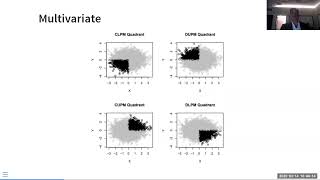
Dimitri Bianco · Video summary
Synthetic WOE
Learn synthetic weight of evidence (WOE) to improve model granularity and accuracy by addressing data sparsity and clustering issues with minimal complexity.
 Watch on YouTube ↗
Key takeaways
- 💡Weight of Evidence (WOE) is a variable transformation technique that cleans data noise, handles missing values, and converts categorical or special case numeric data into a numeric format suitable for models like logistic regression.00:44
- 📈The primary goal of WOE transformation is to create a monotonic relationship between the variable and the target (e.g., probability of default), which is crucial for model interpretability and business buy-in.06:15
- 🎯WOE is calculated using the natural log of the ratio of non-events (goods) to events (bads) within a specific bin, effectively quantifying the 'evidence' against an event occurring.09:35
- 🔍Data sparsity and clustering are key challenges that prevent reliable WOE estimation, leading to non-monotonic relationships and potentially misleading model interpretations.13:42
- 🔧Identify variables with data sparsity or clustering issues that result in unreliable WOE estimates and non-monotonic relationships.13:42
- 🚀Synthetic WOE addresses data sparsity by intelligently adding new data points (bins) between existing ones, using methods like simple averaging, non-linear estimation, or weighted averages to increase granularity without synthesizing entirely new data.18:28
Chapters
- 0:03🎯 Introduction to Synthetic Weight of Evidence
- 0:35🎯 What is Weight of Evidence?
- 2:07🎯 Binary Classification and PD Concept
- 3:49🎯 Modeling Defaults with Logistic Regression
- 5:07🎯 Comparison of Logistic Regression and Tree-Based Models
- 6:00🎯 Monotonic Relationships and Model Explainability
- 11:53🎯 Synthetic Weight of Evidence Concept
- 14:02🎯 Handling Data Sparsity and Clustering Issues
- 19:17🎯 Methods to Generate Synthetic Points
- 20:20🎯 Practical Application and Results
- 25:41🎯 Advantages and Limitations
- 26:13🎯 Conclusion and Resources
The digest
High-Level Overview
Synthetic Weight of Evidence (WoE) is a practical data transformation technique designed to improve predictive modeling in credit risk, particularly logistic regression-based probability of default (PD) models. It addresses common issues like data sparsity, handling of missing and special-case values, and the challenge of balancing granularity with model stability. This method refines traditional WoE by introducing synthetic intermediate values, improving model accuracy and interpretability without requiring complex data augmentation or distribution assumptions. It is especially relevant for credit risk professionals, data scientists, and statisticians working with binary classification problems involving noisy and incomplete data.
Keep reading in The Digest
The full 5-minute article, 7 more sections, and every new episode from Dimitri Bianco and the creators you follow.
- Understanding Weight of Evidence (WoE) in Credit Risk
- Challenges in Traditional WoE: Sparsity and Granularity
- Synthetic Weight of Evidence: Methodology and Rationale
- Applying Synthetic WoE in Practice
- Key Framework: Synthetic Weight of Evidence Generation
- Practical Implications & Takeaways
- Action-Oriented Summary