Founders Podcast · Video summary
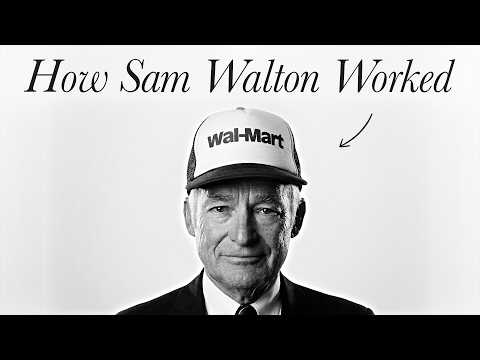
How Sam Walton Worked
Sam Walton, the unglamorous Arkansan who became America's richest man, built Walmart on a foundation of simple, yet fiercely executed principles: relentless work ethic, customer obsession, and a genius for cost control.
 Watch on YouTube ↗
Key takeaways
- 💡Sam Walton's business philosophy was "absurdly simple: buy cheap, sell low every day, and while doing it with a smile."01:35
- 🔄Walton was flexible and willing to change his mind 180 degrees when a business course didn't work out, without being too vain or blind to his mistakes.02:17
- ⚡Sam Walton had insanely high energy levels, a trait he exhibited from a young age, constantly busy and not wasting time.02:49
- 🚧A major turning point in Walton's life was when his landlord stole his first successful store, forcing him to start over and leading him to buy his own building for control.10:13
- ✈️The countless long commutes between his stores inspired Walton to think about expanding to multiple locations and eventually led him to become a pilot to cover ground faster.13:00
- 📝Walton was a "shameless copier" of good ideas from successful companies, believing that if they had something good, he would copy it.19:27
Chapters
- 0:00Sam Walton: The Ordinary Man Who Became America's Richest
- 1:51A Simple Idea, Taken Seriously
- 4:08Relentless Energy and a Dislike for Attention
- 6:46Learning the Ropes at J.C. Penney
- 11:30The Newport Setback and the Birth of an Empire
- 23:26Core Principles and Shameless Copying
- 32:15The Kmart Challenge and Unorthodox Beginnings
- 50:40Customer Obsession and Unwavering Focus
The digest
Sam Walton, the unassuming founder of Walmart, was far from an overnight success. For his first 50 years, he remained largely unknown, operating in the shadows of rural America. It wasn't until the early 1980s that the public discovered the richest man in America was not a Rockefeller or a Trump, but an "unglamorous guy from Arkansas." While his background seemed ordinary—growing up in Depression-era Missouri, working his way through college, and opening his first five-and-dime in a backwater town—underneath, Sam Walton was an extraordinary force.
A Simple Idea, Taken Seriously
Sam Walton's business philosophy, as described in Vance Trimble's "Sam Walton, the Inside Story of America's Richest Man," was "absurdly simple: buy cheap, sell low every day, and while doing it with a smile." This seemingly straightforward approach was a testament to Charlie Munger's idea of finding a simple concept and taking it very seriously. Walton, much like Henry Singleton and Michael Bloomberg, didn't adhere to rigid, long-term business plans. Instead, he woke up each day ready to work on Walmart, constantly adapting and changing his mind when presented with new information. This flexibility, combined with an iron will to uphold his core principles, allowed him to pivot 180 degrees when a business course wasn't working, without vanity or blindness to his mistakes.
Keep reading in The Digest
The full 5-minute article, 6 more sections, and every new episode from Founders Podcast and the creators you follow.
- Relentless Energy and a Dislike for Attention
- Learning the Ropes at J.C. Penney
- The Newport Setback and the Birth of an Empire
- Core Principles and Shameless Copying
- The Kmart Challenge and Unorthodox Beginnings
- Customer Obsession and Unwavering Focus
More from Founders Podcast

Ari Emanuel's Autobiography
Ari Emanuel's autobiography, "Roll the Calls," reveals his unconventional philosophy of "rage first, ask questions later" and his relentless drive to dominate the Hollywood agency world, fueled by his dyslexia and a near-fatal accident.

Mark Zuckerberg's Empire
Mark Zuckerberg's empire, Meta, has faced numerous challenges and criticisms, yet he continues to lead with an unwavering vision, drawing parallels to ancient Roman emperors and demonstrating a relentless pursuit of control and innovation.

How Michael Bloomberg Works
Michael Bloomberg's autobiography, "Bloomberg by Bloomberg," reveals his journey from being fired at 39 to building a multi-billion dollar financial information empire, emphasizing hard work, adaptability, and an unwavering focus on customer needs.

The Mind of Napoleon
Napoleon's mind is explored through his own words, revealing his relentless ambition, strategic thinking, and unique perspectives on life, destiny, and leadership.
How Henry Singleton Worked
Henry Singleton, a world-class mathematician and engineer, founded Teledyne in the 1960s and became one of history's greatest CEOs, achieving extraordinary returns through unconventional strategies.

How Obsession Built Christopher Nolan
Christopher Nolan's career, from micro-budget shorts to billion-dollar blockbusters, is a testament to unwavering obsession, discipline, and a unique vision that challenges conventional storytelling.