StarTalk · Video summary
Exploring Hidden Dimensions with Brian Greene
Exploring multiverses, string theory, and the nature of reality with Brian Greene. Discussions touch on quantum mechanics, higher dimensions, and the limits of our understanding.

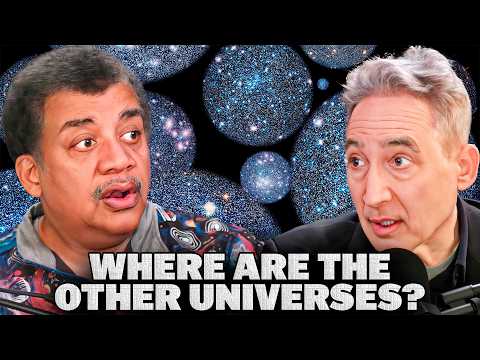 Watch on YouTube ↗
Key takeaways
- 🎯The multiverse is an umbrella concept encompassing any scenario where our world isn't the entirety of reality, with the many-worlds hypothesis from quantum mechanics being one specific flavor under this umbrella.05:16
- 💡The Many-Worlds Interpretation suggests that instead of a quantum measurement collapsing possibilities into one outcome, all possibilities are realized in separate, branching universes, a mathematically conservative view of quantum mechanics.09:04
- 🔧Explore the Many-Worlds Interpretation as a framework to understand quantum phenomena, recognizing it as one of many multiverse possibilities.09:04
- 🚀The information paradox concerning black holes is largely resolved by the understanding that information isn't lost but subtly encoded in quantum correlations of Hawking radiation or imprinted on the event horizon (holographic principle), implying information retrieval is possible.12:13
- 📈Mathematics is a powerful tool for describing reality, but not necessarily the truth of what's out there; this perspective shifts from viewing math as the ultimate arbiter of reality to a more flexible, tool-based approach.14:15
- 🚀Consider math as a tool for understanding the universe rather than the ultimate truth, allowing for flexibility in theoretical exploration.14:15
Chapters
- 0:00🎯 Introduction to Parallel Realities and the Multiverse
- 5:09🎯 The Many Worlds and Multiverse Concepts
- 6:50🎯 Quantum Mechanics and the Many-Worlds Interpretation
- 10:52🎯 Measurement and Reality in Quantum Mechanics
- 27:27🎯 Infinite Universes and Configurations
- 35:10🎯 Levels of Infinity and the Structure of Hilbert Space
- 39:40🎯 The Emergence and Likelihood of Our Existence
- 45:28🎯 Reconciliation of Multiverse Theories and Experiments
- 58:30🎯 String Theory and Extra Dimensions
- 1:01:40🎯 The Status and Future of String Theory
- 1:19:02🎯 The Nature of Time, Space, and Dimensions
- 1:25:19🎯 Questions about the Nature of the Universe
- 1:37:21🎯 Quantum Entanglement and Wormholes
The digest
High-Level Overview This episode features a deep, wide-ranging conversation with theoretical physicist Brian Greene, focusing on the concepts of hidden dimensions, the multiverse, quantum mechanics, and string theory. Greene clarifies complex ideas such as the many worlds interpretation, the mathematical underpinnings of reality, the search for fundamental particles, and the nature of time and space. The discussion also addresses popular cosmological questions, experimental challenges, and philosophical implications, offering a grounded yet expansive perspective on some of the most profound scientific inquiries of our time. This is valuable for physicists, students, and scientifically curious professionals seeking a nuanced understanding of cutting-edge theoretical physics.
Understanding the Many Worlds Interpretation and Multiverse (00:00 – 11:40)
Brian Greene begins by distinguishing the multiverse as an umbrella term encompassing various theoretical frameworks where reality extends beyond our observable universe. One such framework is the many worlds interpretation (MWI) of quantum mechanics, proposed by Hugh Everett in 1957. MWI suggests that quantum events do not collapse into a single outcome; instead, every possible outcome occurs, each in a different "world" or branch of reality.
Greene highlights a key tension noted since the 1920s and 1930s: quantum particles exist as probability clouds that only materialize definite outcomes upon measurement. The classical expectation of one definite reality contrasts sharply with this superposed quantum reality. Everett’s insight was to accept the mathematics as is, implying the simultaneous reality of all these outcomes — no "world splitting" per se, but a preexisting giant framework containing all possible states.
Each version of an observer experiences a single outcome, but a hypothetical "God’s eye view" would reveal multiple versions with different outcomes. Greene notes that while this idea might sound like speculation, it arises directly and conservatively from the foundational equations by Schrödinger.
Keep reading in The Digest
The full 9-minute article, 12 more sections, and every new episode from StarTalk and the creators you follow.
- Mathematics as a Description, Not Absolute Truth (13:55 – 18:00)
- Hilbert Space and the Structure of Quantum Worlds (18:10 – 22:00)
- Distinctions Between Many Worlds and Other Multiverse Ideas (22:01 – 47:00)
- Infinite Worlds and Levels of Infinity (27:25 – 39:20)
- The Improbability and Meaning of Existence (40:00 – 43:00)
- Challenges of Detecting and Interacting with Other Universes (43:00 – 50:00)
- String Theory’s Achievements and Limitations (50:00 – 1:04:00)
- Quantum Entanglement, Wormholes, and the Fabric of Spacetime (1:05:00 – 1:07:15)
- Selected Cosmic Queries and Expert Answers (1:07:15 – 1:56:00)
- Key Frameworks and Models
- Practical Implications & Takeaways
- Action-Oriented Summary
More from StarTalk

How We’ll Get to Alpha-Centauri | Cosmic Queries #115
Neil deGrasse Tyson and Chuck Nice tackle a grab bag of cosmic queries, from the nature of the multiverse and the challenges of interstellar travel to the peculiar terminology of astrophysics and the statistical biases of the human brain.

Why We Haven’t Reached Superintelligence, with David Krakauer
Neil deGrasse Tyson and his guests explore the nature and evolution of intelligence, from microbes to humans, and ponder the implications for artificial intelligence.

Inside the Search for Extra Dimensions, with Lara Anderson
Neil deGrasse Tyson and comic co-host Jordan Klepper interview physicist Lara Anderson about the search for extra dimensions and the current state of string theory.

Busting Nutrition Myths with Dr. Jessica Knurick
In this StarTalk episode, Dr. Jessica Knurick discusses the complexities of nutrition, debunking popular myths and emphasizing the importance of understanding dietary quality over quick fixes like weight loss drugs. The conversation highlights how misinformation and societal pressures complicate healthy eating choices, urging a focus on sustainable lifestyle changes.

Did Life Come From An Asteroid? With Harold Connolly Jr.
Asteroid sample return missions like OSIRIS-REx provide pristine early solar system material, revealing prebiotic compounds and insights into life's origins, while also informing planetary defense.

Neil deGrasse Tyson Confronts Andy Weir on the Science of Project Hail Mary
Neil deGrasse Tyson and Andy Weir discuss the hard science behind 'Project Hail Mary,' exploring alien biology, astrobiology, and propulsion physics.