StarTalk · Video summary
How We’ll Get to Alpha-Centauri | Cosmic Queries #115
Neil deGrasse Tyson and Chuck Nice tackle a grab bag of cosmic queries, from the nature of the multiverse and the challenges of interstellar travel to the peculiar terminology of astrophysics and the statistical biases of the human brain.

 Watch on YouTube ↗
Key takeaways
- 🌌The multiverse theory suggests our universe is one of many, possibly separated by inaccessible barriers, with each potentially having different laws of physics.01:56
- 🔭Experiments analyzing the cosmic microwave background have not found evidence of other universes impinging on ours.03:47
- 🏷️Astrophysicists often use descriptive, straightforward names for cosmic objects, contrasting with other scientific fields that use more complex jargon.11:54
- 🚀The Starshot project aims to send tiny spacecraft with light sails to Alpha Centauri, potentially reaching 20% the speed of light for a 20-year journey.19:49
- ⏱️The fastest spacecraft launched by humans would take 40,000 to 50,000 years to reach Alpha Centauri, highlighting the ambition of Starshot.21:34
- ⏳There is no absolute "now" in the universe; time is relative and personal, a concept challenging to our classically-wired brains.24:01
Chapters
- 0:37Introduction to Cosmic Queries Poppuri
- 0:39Astrophysics Jargon: Favorites and Pet Peeves
- 1:48The Multiverse: Boundaries and Overlaps
- 25:12The Planetary Nebula Misnomer
- 28:29Reaching Alpha Centauri: Starshot and Future Propulsion
- 36:50The Elusive "Now" in the Universe
- 41:51Gravity and the Rubber Sheet Analogy
- 47:21Hog's Object: Statistical Improbability in Galaxy Alignments
- 56:55Fractals, Geometry, and Understanding the Universe
The digest
In a special "Cosmic Queries Poppuri" edition of StarTalk, Neil deGrasse Tyson and Chuck Nice delve into a diverse array of questions from their audience, exploring everything from the boundaries of our universe to the linguistic quirks of astrophysics.
The Multiverse: Bubbles and Collisions
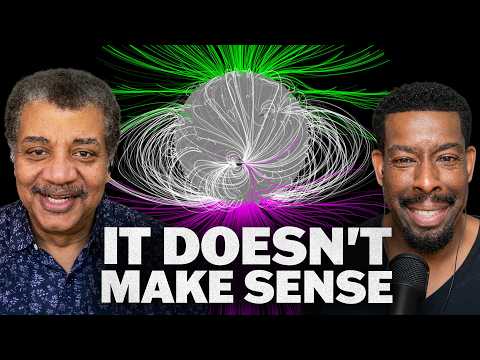
The concept of a multiverse, a collection of multiple universes, sparks a fascinating discussion. Tyson explains that there are several theoretical variations of the multiverse, often arising from the complex mathematics of the early universe, where quantum physics, general relativity, and string theory intertwine. One popular model envisions our universe as a bubble within an enormous grid of spacetime, with other bubbles representing other universes. These bubbles are theorized to be separated in such a way that inter-universe travel or interaction is impossible. The question of where one universe ends and another begins becomes a philosophical one, akin to asking where the end of a bubble is—it's also its beginning.
While these bubbles are expanding, they are not believed to overlap. Scientists have even conducted experiments, analyzing the cosmic microwave background (CMB) for statistical anomalies that might indicate an impingement from another universe. So far, no such signatures have been found, suggesting our universe remains distinct. Another multiverse theory posits entirely separate bubbles, embedded in higher dimensions, expanding independently and never meeting. A crucial and potentially dangerous aspect of these multiverses is the likelihood that the laws of physics could differ slightly from one to another. Imagine visiting another universe where the charge on an electron is different, potentially causing your atoms to fly apart or collapse.
Keep reading in The Digest
The full 4-minute article, 3 more sections, and every new episode from StarTalk and the creators you follow.
- Astronomical Jargon: From Romantic to Repugnant
- The Alpha Centauri Challenge: Starshot and Beyond
- The Elusive "Now" and the Rubber Sheet Analogy
More from StarTalk
Why We Haven’t Reached Superintelligence, with David Krakauer
Neil deGrasse Tyson and his guests explore the nature and evolution of intelligence, from microbes to humans, and ponder the implications for artificial intelligence.

Inside the Search for Extra Dimensions, with Lara Anderson
Neil deGrasse Tyson and comic co-host Jordan Klepper interview physicist Lara Anderson about the search for extra dimensions and the current state of string theory.

Busting Nutrition Myths with Dr. Jessica Knurick
In this StarTalk episode, Dr. Jessica Knurick discusses the complexities of nutrition, debunking popular myths and emphasizing the importance of understanding dietary quality over quick fixes like weight loss drugs. The conversation highlights how misinformation and societal pressures complicate healthy eating choices, urging a focus on sustainable lifestyle changes.

Did Life Come From An Asteroid? With Harold Connolly Jr.
Asteroid sample return missions like OSIRIS-REx provide pristine early solar system material, revealing prebiotic compounds and insights into life's origins, while also informing planetary defense.

Neil deGrasse Tyson Confronts Andy Weir on the Science of Project Hail Mary
Neil deGrasse Tyson and Andy Weir discuss the hard science behind 'Project Hail Mary,' exploring alien biology, astrobiology, and propulsion physics.

Scientists Who Got In Trouble for Being Right, with Matt Kaplan
Learn from scientists who were right but punished to understand how societal biases and entrenched interests can stifle progress, and how to avoid repeating these mistakes.