Graduate Mathematics · Video summary
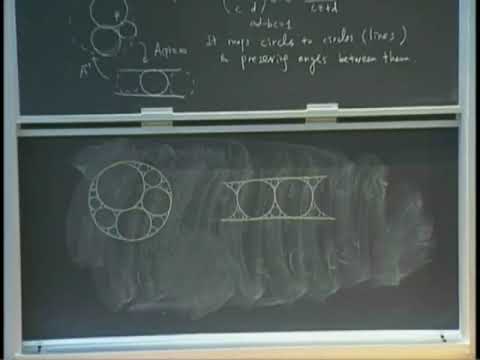
Apollonian circle packings via spectral methods - Hee Oh (Yale University)
Apollonian circle packings use advanced spectral methods to explore geometric configurations through modern proofs and transformations.
 Watch on YouTube ↗
Key takeaways
- 🔍The modern proof of Apollonius' theorem involves Möbius transformations which preserve circle properties, leading to infinite configurations.02:00
- 🚀Explore the implications of Möbius transformations in your geometric analyses to enhance method robustness.02:00
- 📊The counting function for Apollonian circle packings relates to the metric structure of their residual set, allowing finite and infinite comparisons.08:24
- 📝Develop a counting function model for your designs based on properties of Apollonian circle packings for analytical use.08:24
- ⚡The residual dimension of a packing is shown to be independent of the choice of circles, enhancing the understanding of geometric properties.09:53
- 📚Investigate the residual dimensions in your research to leverage geometric properties more effectively in your field.09:53
Chapters
- 0:11🎯 Introduction and Background on Apollonius' Theorem
- 1:53🎯 Spectral Methods and Transformation Framework
- 3:02🎯 Constructing Tangent Circles via Möbius Transformations
- 4:13🎯 Building Apollonian Circle Packings
- 6:49🎯 Curvature and Counting Functions
- 9:02🎯 Residual Set and Dimensional Invariants
- 14:48🎯 Asymptotic Counting and Error Terms
- 15:56🎯 Distribution of Small Circles and Geometric Measures
- 19:14🎯 Hyperbolic Space and Spectral Gaps
- 35:11🎯 Group Actions and Orbital Counts
- 39:52🎯 Effective Error Terms and Spectral Gap Significance
- 43:53🎯 Further Applications and Future Directions
The digest
High Level Overview
This work presents a rigorous mathematical treatment of Apollonian circle packings, a classical geometric construction, through modern spectral and hyperbolic geometric methods. The primary focus is on developing precise counting theorems for circles within these packings and interpreting these geometric structures via their symmetry groups and associated spectral gaps. These results provide deep connections between discrete group actions on hyperbolic space, fractal geometry, and number theory. The analysis is essential for mathematicians working in geometry, dynamical systems, and analytic number theory, shedding light on the distribution and asymptotics of circle packings beyond classical geometric intuition.
Keep reading in The Digest
The full 8-minute article, 14 more sections, and every new episode from Graduate Mathematics and the creators you follow.
- Structured Deep Dive
- 1. Apollonius’ Theorem and the Construction of Apollonian Circle Packings [00:30–06:30]
- 2. Defining the Counting Function and Residual Sets in Apollonian Packings [06:30–10:00]
- 3. Asymptotic Results and Existence of Constants for Circle Counting [10:00–14:00]
- 4. Distribution of Circles Within Subregions and Smooth Boundaries [15:00–18:30]
- 5. Linking Apollonian Packings to Hyperbolic Geometry and Kleinian Groups [19:00–26:00]
- 6. Reduction of Circle Counting to an Orbit Counting Problem on a Quadratic Cone [26:00–34:10]
- 7. Effective Counting and Error Terms via Spectral Gaps [34:10–42:30]
- 8. Links to Uniform Spectral Gaps and Number-Theoretic Applications [42:30–44:20]
- 9. Geometry of the Apollonian Group and Hyperbolic 3-space Actions [44:20–51:30]
- 10. Translations of Closed Orbits and Equidistribution Theorems [51:30–52:40]
- Key Frameworks and Mental Models
- Practical Implications & Takeaways
- Action-Oriented Summary
More from Graduate Mathematics

Peter Sarnak, Summation formulae in spectral theory and number theory [2021]
Peter Sarnak discusses spectral theory and number theory, focusing on summation formulas like Poisson, Selberg trace, and explicit formulas that connect spectral data with primes and zeros.

Tangles, Bangles and Knots with John Conway [2012]
John Conway explores the mathematical concepts of tangles, bangles, and knots, revealing their complex structures and relationships.
Fractran: A Ridiculous Logical Language with John Conway [2012]
John Conway explores Fractran, a logical language illustrating the power of simple fraction-based programs to simulate computation and undecidability theories.

Peter Scholze (Universität Bonn) - Condensed Mathematics (2019)
Condensed Mathematics by Peter Scholze explores complex mathematical structures through simplified frameworks that yield profound insights.
Thin groups as monodromy groups, Part II - Jordan Ellenberg (University of Wisconsin-Madison)
This video on thin groups as monodromy groups explores the dichotomy between finite index and thin cases, emphasizing deformation dynamics.

Thin groups as monodromy groups, Part I - Jordan Ellenberg (University of Wisconsin-Madison)
In this talk on thin groups, Jordan Ellenberg discusses their relevance in algebraic geometry and monodromy groups, highlighting their applications and implications.