Creative Planning · Video summary
10 Ways to Save on Your Taxes | Signal or Noise Ep 70 | Charlie Bilello | Peter Mallouk
Maximize tax savings with strategic planning by leveraging retirement accounts, HSAs, optimal asset placement, and proactive tax strategies.

 Watch on YouTube ↗
Key takeaways
- 🚀Prioritize maxing out employer retirement plan contributions up to the match, and consider Roth vs. Traditional based on current vs. expected future tax brackets.00:44
- 💡Prioritize maxing out retirement accounts, especially if there's an employer match, as it offers an immediate income tax deduction and tax-free growth, with Roth options providing tax-free withdrawals.00:44
- 🚀Review your employer's 401k match and ensure you contribute at least enough to capture the full match, as it's a guaranteed return on your investment.00:53
- 💡Maxing out retirement accounts offers a triple benefit: immediate income tax deduction, tax-free growth, and potential employer match, significantly boosting long-term wealth.01:50
- 🔧Analyze your current and expected future tax brackets to decide between Traditional vs. Roth contributions for retirement accounts, or consider splitting contributions.02:38
- 🔧Explore utilizing Health Savings Accounts (HSAs) if eligible, contributing the maximum, and investing funds for long-term tax-free growth for medical expenses.05:34
Chapters
- 0:00🎯 Introduction
- 0:44🎯 Max out retirement accounts
- 2:35🎯 Choosing between Roth and traditional plans
- 5:34🎯 Use an HSA as a stealth IRA
- 8:12🎯 Put assets in optimal accounts
- 10:01🎯 Harvest losses to offset gains
- 13:34🎯 Hold investments for long-term rates
- 14:45🎯 Donate appreciated assets instead of cash
- 17:22🎯 Consider a Roth conversion at the right time
- 19:25🎯 Use 529 plans for education savings
- 21:41🎯 Time income and deductions strategically
- 23:58🎯 Work with a proactive tax planner
- 25:20🎯 Wrap-up and promoting the book
The digest
This presentation outlines ten actionable, well-explained methods to reduce tax liabilities while maximizing investment growth and retirement readiness. It targets investors, business owners, and anyone seeking to optimize their financial planning with a tax-conscious approach. The discussion emphasizes the interplay of tax rules with retirement planning, charitable giving, and investment strategies, stressing proactive and informed decision-making.
1. Maximize Contributions to Retirement Accounts (00:44)
Contributing the maximum allowed to retirement accounts like 401(k)s or 403(b)s is highly effective because these accounts offer immediate income tax deductions on traditional contributions and tax-free growth. Employer matching contributions are essentially a guaranteed 100% return, making it critical to at least contribute enough to get the full match.
- Important note: Prioritize paying off high-interest credit card debt before funding these accounts.
- Different plans exist depending on employment status: traditional vs. Roth options.
- Selecting between traditional (tax deduction now, taxable withdrawals) and Roth (no deduction now, tax-free withdrawals) depends on current vs. future expected tax rates, best decided with an advisor.
- Splitting contributions between Roth and traditional can hedge against future tax uncertainties.
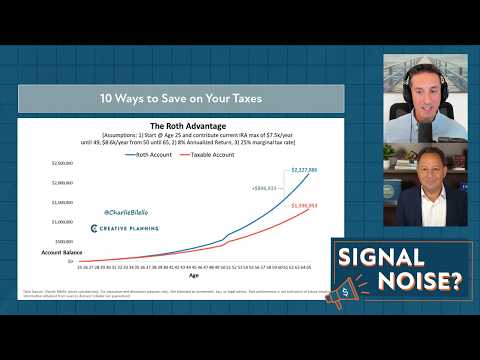
- Starting early, especially with Roth contributions, can create significant growth advantages, potentially nearly $900,000 more than taxable accounts after 40 years assuming an 8% return and 25% tax rate.
Keep reading in The Digest
The full 6-minute article, 12 more sections, and every new episode from Creative Planning and the creators you follow.
- 2. Leverage Health Savings Accounts (HSAs) as “Stealth” Retirement Accounts (05:34)
- 3. Place Assets in the Most Tax-Efficient Accounts (08:12)
- 4. Harvest Tax Losses Strategically to Offset Gains (10:01)
- 5. Hold Investments for Long-Term Capital Gains Treatment (13:34)
- 6. Donate Appreciated Securities Instead of Cash (14:45)
- 7. Consider Roth IRA Conversions at Optimal Times (17:22)
- 8. Use 529 Plans for Tax-Free Education Funding (19:24)
- 9. Time Income and Deduction Recognition Strategically (21:41)
- 10. Work with a Proactive Tax Strategist, Not Just a Preparer (23:58)
- Key Frameworks and Mental Models
- Practical Implications & Takeaways
- Action-Oriented Recommendations
More from Creative Planning

What Happens When Volatility Spikes? | The Week in Charts (4/2/26) | Charlie Bilello
High volatility presents opportunity for long-term investors, as elevated VIX levels historically precede better forward returns, despite current market corrections and geopolitical risks.

Oil Spikes and Recessions | The Week in Charts (3/23/26) | Charlie Bilello | Creative Planning
The return of risk due to geopolitical events and oil spikes is impacting markets, with investors weighing potential recessionary impacts against historical data and Fed policy shifts.
The Fog of War | Signal or Noise Ep 69 | Charlie Bilello | Peter Mallouk | Creative Planning
The Fog of War introduces significant uncertainty, impacting markets, consumers, and Fed policy, with earnings as the ultimate market driver.

An Inflationary Correction | The Week in Charts (3/13/26) | Charlie Bilello | Creative Planning
Markets face an inflationary correction driven by rising oil prices and geopolitical uncertainty. The Fed is unlikely to cut rates soon, but housing affordability is improving.

Schwab CEO Rick Wurster: Crypto, AI and the Shifts Impacting How We Invest
Schwab CEO Rick Wurster discusses key themes like convenience, the young investor, AI, and digital assets, emphasizing a client-first approach and disruptive innovation.