The Institute of Art and Ideas · Video summary
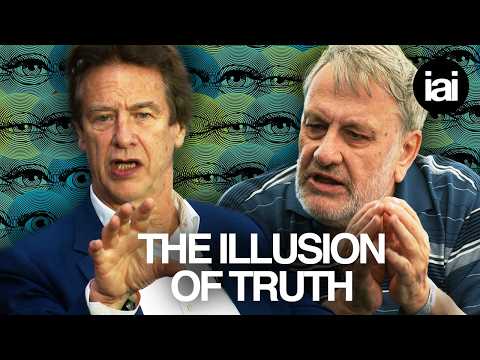
Why there's no such thing as knowledge | Slavoj Žižek and Hilary Lawson
Philosophers debate truth and reality, arguing our understanding is shaped by "closures" (frameworks of identity) rather than objective facts. Navigating this requires understanding how these closures function and fail.

 Watch on YouTube ↗
Key takeaways
- 💡Our perception of reality is constructed through "closures," which are ways of creating identities and holding the world, rather than direct apprehension of objective facts.06:19
- 🎯The "openness of the world" cannot be directly described; instead, we impose structures (closures) through physiology, sensation, and language to interact with it.06:44
- 🔧Analyze your own dominant "closures" in various aspects of life (work, relationships) to understand how you are constructing reality.07:50
- 🔍Closures have three key characteristics: they are unlimited in how they can be formed, they fail to perfectly capture reality, and they require stability to function, meaning we can only hold one at a time.08:07
- ⚖️A distinction exists between factual truth (how things are) and subjective truth (why we are fixated on certain interpretations or beliefs), which is crucial for understanding motivations and ideologies.12:28
- 🗣️Ideologies, like Nazism, often rely on constructing an external enemy (e.g., the figure of the Jew) to maintain their internal identity and political agency, regardless of the factual accuracy of their claims.15:36
Chapters
- 0:43🤔 Introduction to the Debate
- 3:34🌍 The End of the West and the Rise of Perspective
- 7:01💡 The Concept of 'Closure'
- 8:04🧠 Characteristics of Closure
- 10:42↔️ Žižek's Response: Beyond Closure
- 12:54💔 Pathological Jealousy as an Example
- 14:10🇩🇪 Nazis and the Figure of the Jew
- 17:27⚖️ Subjective Truth vs. Factual Truth
- 18:30🗣️ Lawson's Rebuttal: Identifying Lies
- 20:02🚫 Challenging Absurd Closures
- 21:12🤝 Convincing Through Shared Frameworks
The digest
Beyond Truth: Navigating a World Without Objective Reality
This discussion, featuring philosophers Slavoj Žižek and Hilary Lawson, challenges the conventional understanding of knowledge and reality. It argues that the Enlightenment ideal of a single, objective truth accessible through reason is fundamentally flawed. Instead, it proposes that our understanding of the world is always mediated by inherent structures of thought and language, leading to a plurality of perspectives. The core premise is that we must learn to navigate a world without relying on the assumption of a singular, discoverable reality, which has profound implications for how we understand truth, lies, and our interactions with others. This is particularly relevant for professionals in fields like philosophy, psychology, politics, and anyone grappling with competing narratives and the nature of belief.
Keep reading in The Digest
The full 6-minute article, 6 more sections, and every new episode from The Institute of Art and Ideas and the creators you follow.
- The Illusion of Objective Reality and the Rise of Perspectivism
- Closure: How We Construct Meaning in an Open World
- Žižek's Intervention: Beyond Closure to Subjective Truth
- Navigating Lies and Convincing Others
- Practical Implications and Takeaways
- Action-Oriented Summary
More from The Institute of Art and Ideas

We've misunderstood the physics of our universe | Sabine Hossenfelder, Ivette Fuentes, James Ladyman
Physics struggles to unify quantum mechanics and general relativity, challenging our understanding of scale and fundamental reality.

Woke vs work: The Left's identity crisis | Maurice Glasman, Bhaskar Sunkara, Pam Cox
The Left faces an identity crisis, debating whether to prioritize progressivism and diversity over solidarity and economic growth, and how to balance market forces with social good.

Why our understanding of quantum physics is flawed | Jacob Barandes
Quantum physics' measurement problem arises from unclear axioms; a non-Markovian approach offers a simpler, empirically equivalent alternative to the standard model.