Meet Kevin · Video summary
Warning: The Collapse of OpenAI & Memory.
OpenAI faces valuation challenges with a <b>17.5% guaranteed return</b>, while memory chip stocks are seeing price corrections after a significant run-up, presenting potential investment opportunities.

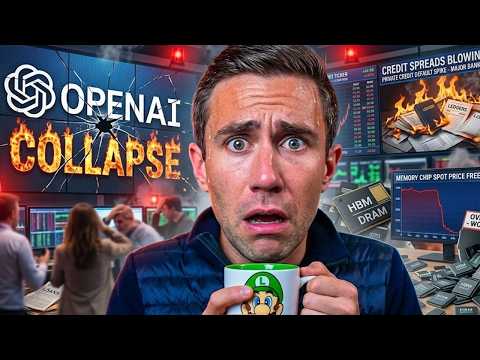 Watch on YouTube ↗
Key takeaways
- 🎯Companies offering guaranteed high rates of return (like OpenAI's <b>17.5%</b>) may signal an inflated valuation and difficulty in attracting investment at current price points.00:50
- 🚀Re-evaluate investments in <b>high-valuation AI companies</b> that offer guaranteed returns, as this may signal overvaluation.00:50
- 💡The AI race is becoming commoditized, with <b>models becoming increasingly similar</b>, suggesting that differentiation and valuation will hinge on factors beyond core model performance.02:14
- 📈A lack of demand for shares in the secondary market for private companies (like OpenAI) is a strong indicator of <b>"price" or valuation issues</b>, as private markets lack immediate public price discovery.04:08
- 🔍Memory chip prices have seen a dramatic rise (approx. <b>7.5x</b>) but are now correcting downwards by about <b>20%</b> from their peak, indicating a potential market top after a significant cycle.07:47
- 🔧Consider the impact of <b>AI memory optimization research</b> on future demand for memory chips and related stock performance.08:11
Chapters
- 0:00🎯 Introduction and Overview of Market Conditions
- 0:46🎯 OpenAI's Funding and Valuation
- 1:22🎯 Comparison Between OpenAI and Anthropic
- 1:58🎯 Market Race Among AI Models
- 4:03🎯 Struggle to Sell OpenAI Shares in Private Market
- 6:53🎯 Public Market Pressures and Outlook
- 6:55🎯 Memory Chip Market and Prices
- 8:11🎯 Advancements in AI Memory Efficiency
- 9:05🎯 Helium and Supply Chain Issues
- 9:48🎯 Memory Sector Outlook and Valuations
- 10:33🎯 Investment and Trading Strategies in Memory Stocks
- 10:50🎯 OpenAI's Capital Expenditures and Memory Supply
- 11:53🎯 Market Valuations and PEG Ratios in Memory Industry
- 17:48🎯 Private Credit Stabilization and Risks
- 19:18🎯 Macro Economic Indicators and Market Outlook
- 21:11🎯 Market Valuations of Major Big Tech Stocks
- 23:08🎯 Summary and Final Advice
The digest
High-level Overview This analysis unpacks critical developments around OpenAI’s financial and market status, highlighting problems with its secondary share market, lofty valuations, and fundraising strategies. It contrasts OpenAI with competitors like Anthropic, explores private credit stability amid macro risks, and delves into memory chip price fluctuations driven by technological advances and geopolitical factors. The breakdown provides clarity on what these shifts mean for investors, tech industry watchers, and broader market participants.
OpenAI’s Financial and Market Struggles (00:44–06:50)
OpenAI is facing mounting skepticism as private equity investors are offered a guaranteed minimum return of 17.5%, an unusually high rate that signals confidence issues rather than strength. Typically, guarantees imply assurance, but in this case, such a high promised return reflects a possible overvaluation. OpenAI’s post-money valuation sits between $830 billion and $852 billion, more than double Anthropic’s $380 billion, despite the latter’s models attracting positive attention.
There is a private secondary market issue where holders of OpenAI shares struggle to find buyers. Several hedge funds and venture capital firms report an inability to offload shares, reflecting market doubts about the company’s worth at this price. By contrast, Anthropic shares are in demand due to their more reasonable valuation and promising AI offerings like Claude, indicating a market shift toward competitors.
OpenAI continues to raise massive funds in primary markets, with recent commitments exceeding $122 billion including investments from Amazon ($15 billion with potential to scale to $35 billion contingent on an IPO or achieving AGI) and Nvidia and SoftBank collectively pledging $30 billion. However, OpenAI’s revenue of approximately $24 billion annualized versus its near $850 billion valuation implies a staggering 35x Price-to-Sales (P/S) ratio and it remains unprofitable, preventing meaningful Price-to-Earnings (P/E) calculations.
Subscription growth appears to be decelerating as early adopters move to other platforms, intensifying concerns about OpenAI’s growth trajectory. To offset revenue pressures, OpenAI has begun running ads to about 20% of its eligible free users, contributing roughly $100 million ARR, which is less than 0.5% of total revenue and not yet material.
Amid this, Amazon and Nvidia have signaled reluctance to continue funding unless OpenAI goes public, putting pressure on the company to seek an IPO to establish a transparent market valuation. This environment suggests that the current private valuation is unsustainable as the AI market edges toward commoditization, compressing multiples industry-wide.
Keep reading in The Digest
The full 6-minute article, 6 more sections, and every new episode from Meet Kevin and the creators you follow.
- Memory Chip Price Trends and Industry Supply Dynamics (06:50–16:00)
- Private Credit Market Stabilization and Economic Context (17:48–19:20)
- Tech Market Valuations and Investment Takeaways (19:20–23:16)
- Key Frameworks & Analysis Models
- Practical Implications & Takeaways
- Action-Oriented Summary
More from Meet Kevin

The Shadow Debt Crisis JUST Got Twice as Bad.
The private credit market is facing a shadow debt crisis, with actual default rates potentially much higher than reported. This, coupled with rising debt in the AI sector and government, signals a precarious economic environment.

My $2 Million Dollar Fixer is getting RUINED by California
Kevin Paffrath takes viewers on a tour of his latest real estate project: a $2 million fixer-upper in Ventura, California, highlighting the challenges and opportunities of building in the Golden State.

oh f**k me
Meet Kevin analyzes the potential for his market predictions to be wrong, examining arguments for higher Treasury yields and the impact of the "suckening" on market liquidity.

How Midterms will F**K Up the Stock Market
The midterm elections could have a multi-trillion dollar impact on the stock market, particularly influencing data center spending and the broader economy. Depending on whether Republicans or Democrats sweep, or if there's a divided Congress, different sectors will thrive or face headwinds.

Trump JUST *Launched* the GREAT Wealth Transfer
Donald Trump's policies have inadvertently orchestrated the largest wealth transfer in history, funneling wealth from the poor to the rich through a combination of war spending, tax cuts, and market dynamics.

Our Economy is about to EXPLODE | Agentic AI SHOCK
The economy is cooking, with the technology sector accelerating its growth to its fastest pace in over five years, driven by artificial intelligence spending. However, rising bond yields and widening credit spreads present potential risks.