Orthodox Ethos · Video summary
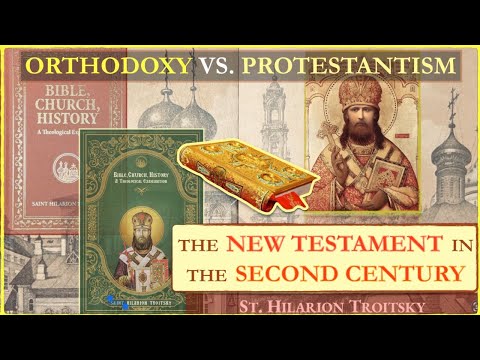
The New Testament in the Second Century - St. Hilarion Troitsky
The early Church's canon of scripture was formed in response to heresy, not as an isolated intellectual exercise, highlighting the vital role of tradition and the Church's discernment.
 Watch on YouTube ↗
Key takeaways
- 💪Zeal without knowledge, or 'zeal not according to knowledge,' is a recurring theme in heresy, leading to pride and division, as seen in figures like Montinus and later Protestant reformers.11:48
- 💡The Church's determination of the canon was a grassroots process, beginning with the faithful and confirmed by the hierarchy, not dictated by a central authority.14:58
- ⚡The methodology of the enemy (Satanism, Luciferianism) often mirrors or twists Orthodox symbolism, serving as an indirect witness to the truth of the Church.26:14
- 📚The Church's response to heresies through councils and canon formation was not a new development of doctrine but a defense of the faith once delivered, preserving continuity with the apostolic tradition.33:16
- 🚀The development of the New Testament canon was not about inventing doctrine, but about defending and codifying the apostolic faith that was already lived and experienced by the Church.33:27
- 🔑The early Church's approach to scripture was holistic, integrating oral tradition with written texts, emphasizing that true understanding comes from the life and teaching of the Church, not just individual interpretation.44:14
Chapters
- 0:26🎯 Introduction and Opening Remarks
- 8:09🎯 Father's Reflections on Veneration of Saints
- 9:54🎯 Churches, Heretics, and the Authority in Canonization
- 45:42🎯 Authenticity and Preservation of Sacred Texts
- 55:44🎯 Heretics and the Development of the Canon
- 57:57🎯 Marcianism and Its Rejection of the Old Testament
- 1:05:22🎯 Heretics' Manipulation of Scripture and Revelation
- 1:33:02🎯 The Church's Response to Heresy and the Canon Formation
- 1:34:10🎯 The Role of Councils and Saints in Defining Orthodoxy
- 1:39:19🎯 Miracles and the Holy Fire
- 2:09:48🎯 Modern Heresies and Their Roots in Ancient Heresies
- 2:20:31🎯 Practical Advice on Faith and Spiritual Life
- 2:24:21🎯 Significance of Church History and the Faithfulness of Saints
- 2:24:21🎯 Future of Orthodoxy and Perseverance
- 3:08:04🎯 Closing and Final Blessings
The digest
High-Level Overview
This detailed examination unpacks the process by which the New Testament canon was formed in the early Christian Church, focusing on the second century and the challenges posed by heretical movements such as the Marcianites and Montanists. Drawing on the work of St. Hilarion Troitsky, it elucidates the dynamic between Scripture and Tradition, the pivotal role of Church Fathers and councils, and the continued relevance of these historical struggles for contemporary orthodoxy. This content is essential for theologians, church historians, and anyone seeking a deeper understanding of how the early Church preserved doctrinal integrity amid competing claims and evolving scriptural texts.
Keep reading in The Digest
The full 6-minute article, 11 more sections, and every new episode from Orthodox Ethos and the creators you follow.
- Early Church Context and the Absence of a New Testament Canon
- The Role of Heresies and Apologetics in Canon Formation
- The Marcianites (Marcianism)
- The Montanists (Montanism)
- Church Fathers and the Process of Defining the Canon
- Tradition and Scripture: A Unified Deposit of Faith
- The Danger of “Improving” the Gospel
- Practical Lessons for Today
- Key Framework: Formation of the New Testament Canon
- Practical Implications & Takeaways
- Action-Oriented Summary
More from Orthodox Ethos

Without Repentance, Delusion is Ongoing
The Orthodox Ethos discusses the need for repentance within the Orthodox Church regarding its response to the COVID-19 pandemic, highlighting the spiritual and theological implications of fear-driven decisions and blind obedience to secular authority.

Logos Cinema & The Cultural Reorientation to the Unadulterated Christ
In this video, Orthodox Ethos discusses the launch of Logo Cinema, a dedicated streaming platform for Orthodox films and content, aiming to evangelize and provide a refuge for Orthodox believers in the digital sphere. The creators emphasize the importance of supporting this initiative to foster a parallel Orthodox economy and counteract the negative influences of mainstream media.

“Standing in the Temple of Thy Glory” — New Book: The Divine Services of the Orthodox Church
In this video, Orthodox Ethos discusses the new book "The Divine Services of the Orthodox Church," emphasizing its role as a vital catechetical resource aimed at deepening understanding and participation in the divine services among the faithful, particularly for those preparing for baptism. The conversation includes insights from Dr. Emanuel Medal Nakos, one of the book's editors, who highlights its comprehensive approach to liturgical education.

St. Paisius Velichkovsky: Confessor & Defender of Orthodoxy
Explore the life and impact of St. Paisius Velichkovsky, a pivotal figure in Orthodox monasticism who championed the Philokalia and defended Orthodox purity against Western influences.

Holy Scripture and the Church by St. Hilarion Troitsky
This video argues that Holy Scripture is understood and has meaning only within the Church, not as an independent authority, contrasting Orthodox and Protestant views.
St. Patrick and Orthodox Mission Today
St. Patrick's missionary approach emphasizes humility, self-emptying (kenosis), and deep respect for local cultures, offering a model for contemporary mission work.