DIBEOS · Video summary
The Mathematics of the Kerr Metric
This video explains the mathematics of the Kerr metric, detailing how rotation affects black hole structure, horizons, and spacetime coupling effects.

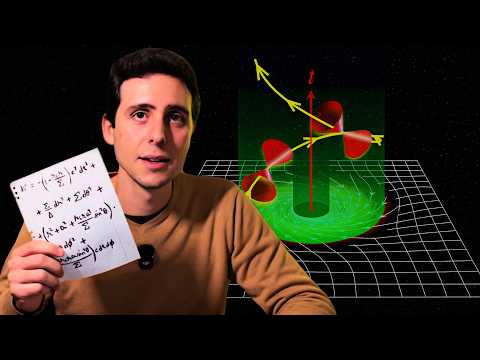 Watch on YouTube ↗
Key takeaways
- 🎯The Kerr metric models rotating uncharged black holes, with the spin parameter $a_{*}$ crucial for understanding their properties.02:05
- 🚀Focus on understanding the spin parameter $a_{*}$ as it dictates most properties of a rotating black hole.02:05
- 📈As the spin parameter approaches 1, the event horizon shrinks, and the ergosphere expands, fundamentally altering black hole geometry.06:55
- 📝Practice deriving horizons and ergosphere boundaries from the delta and sigma functions to internalize the geometry.07:57
- 💡Frame dragging occurs around rotating black holes, causing spacetime to twist and affecting the light cones, especially inside the ergosphere.09:50
- 📚Study the light cone behavior near horizons to grasp how rotation influences causality and particle paths.12:40
Chapters
- 0:00🎯 Introduction and Historical Background
- 0:51🎯 The Kerr Metric and Its Components
- 2:24🎯 Physical Quantities - Angular Momentum
- 3:29🎯 Black Hole Spin and Its Significance
- 4:25🎯 Real Black Hole Example: Sagittarius A*
- 8:37🎯 Event Horizon, Ergospere, and Light Cone Behavior
- 11:05🎯 Inside the Ergosphere and Frame Dragging
- 15:27🎯 Mathematical Representation and Solutions
- 19:41🎯 Significance of the Kerr Solution Parameters
- 20:46🎯 Conclusion and Further Resources
The digest
High Level Overview
This presentation meticulously unpacks the Kerr metric—a fundamental exact solution to Einstein’s field equations that describes the spacetime geometry around a rotating, uncharged black hole. It explains the historical development of black hole metrics, outlines the key mathematical components unique to rotating black holes, and connects these abstract equations to physical phenomena observed in astronomical objects like Sagittarius A*, the supermassive black hole at our galaxy’s center. Designed for students and enthusiasts of general relativity, it clarifies complex concepts such as angular momentum, event horizons, and frame dragging, helping viewers appreciate the intricate interplay between rotation and gravity in curved spacetime.
Keep reading in The Digest
The full 7-minute article, 12 more sections, and every new episode from DIBEOS and the creators you follow.
- Historical Context and Classification of Black Hole Metrics [00:00–02:13]
- Key Parameters of the Kerr Metric: Specific Angular Momentum, Sigma, and Delta [02:13–07:02]
- Physical Example: Sagittarius A* and Application of the Kerr Metric [04:25–06:10]
- Changes in Black Hole Structure Due to Rotation [06:10–07:58]
- The Ergosphere and g_tt Component Significance [08:44–11:32]
- Light Cone Behavior and Causal Structure Near Black Holes [11:32–14:15]
- Mathematical Derivation of Horizons and the Ergosphere [15:27–17:29]
- Frame Dragging and Coupling of Time and Space [18:30–20:04]
- Summary and Final Insights [19:41–20:55]
- Key Framework: The Kerr Metric Components and Their Physical Interpretations
- Practical Implications & Takeaways
- Action-Oriented Summary: Applying Insights from the Kerr Metric
More from DIBEOS

The Roadmap to Linear Algebra I Wish I Had
Master linear algebra through language, operations, and structure. Understand vectors beyond arrows, grasp transformations via matrices, and uncover eigenvalues/eigenvectors for hidden behaviors.

The Roadmap to Calculus I Wish I Had
Master calculus by deeply understanding language, change, accumulation, and flow; these concepts unlock advanced topics and correct foundational gaps.