HistoryMarche · Video summary
The Blunder That Ruined the First Crusade: Ascalon 1099
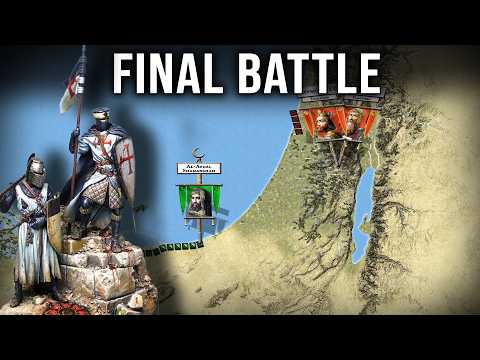
History Marche covers the First Crusade's aftermath, detailing the siege of Jerusalem, the political maneuvering for its control, and the decisive Battle of Ascalon.

 Watch on YouTube ↗
Key takeaways
- ⚔️The First Crusade's capture of Jerusalem was followed by a brutal massacre of prisoners, driven by fear of a Fatimid counter-attack.03:33
- 👑The political maneuvering for control of Jerusalem after its capture was intense, with Raymond of Toulouse attempting to secure the throne through cunning tactics.05:32
- ♟️Godfrey of Bouillon outsmarted Raymond of Toulouse by accepting an ecclesiastical title, thereby gaining secular power and rendering Raymond's political machinations useless.09:02
- 🛡️The Crusader army, despite being severely depleted and demoralized, adopted a unique square formation for the Battle of Ascalon, forged by years of Eastern warfare.17:11
- 🐑A clever ruse involving livestock made the Fatimid army appear much larger, but the Crusaders' discipline allowed them to march past the temptation of food without breaking ranks.21:56
- 🐎Robert of Normandy's daring charge into the heart of the Fatimid camp, seizing the Vizier's standard, was a pivotal moment that broke the enemy's morale and led to their rout.24:30
Chapters
- 0:00The First Crusade: Jerusalem's Fall
- 0:17The Fatimid Counter-Attack
- 1:49The Siege of Jerusalem and its Aftermath
- 7:24The Political Struggle for Jerusalem's Crown
- 17:23The March to Ascalon and the Battle
- 43:22The Legacy of Ascalon
The digest
In July 1099, the First Crusade culminated in the brutal capture of Jerusalem. The streets of the Holy City ran red with blood as the pilgrim soldiers, after years of arduous marching, disease, starvation, and slaughter, finally achieved their objective. However, their euphoric thanks were short-lived, as their conquest had already summoned a formidable response from the Fatimid Caliphate.
The Fatimid Counter-Attack
Al-Afdal Shahanshah, the Grand Vizier of the Fatimid Caliphate, swiftly mustered a force of approximately 20,000 men, supported by an Egyptian fleet, and began a northward march. His orders were unambiguous: obliterate the Frankish invaders and cleanse the holy places. Rumors of the Crusaders' savagery, including cannibalism and the desecration of bodies for swallowed gold, fueled the Vizier's determination to restore order and eliminate what he perceived as a pestilence.
Keep reading in The Digest
The full 6-minute article, 4 more sections, and every new episode from HistoryMarche and the creators you follow.
- The Siege of Jerusalem and its Aftermath
- The Political Struggle for Jerusalem's Crown
- The March to Ascalon and the Battle
- The Legacy of Ascalon
More from HistoryMarche

How One Rifle Destroyed the Austrian Empire: Battle of Königgrätz, 1866
HistoryMarche covers the Austro-Prussian War of 1866, focusing on the Battle of Königgrätz and the factors that led to Prussia's decisive victory and the unification of Germany.
Led by a Madman - Battle of Villaviciosa, 1710
The War of the Spanish Succession reaches a critical point in 1710 as France, facing immense pressure, decides to shift its focus to Spain, leading to a series of pivotal battles that reshape the conflict.

Hannibal 212 BC - The Illusion of Victory: First Battle of Capua (Part 22)
In this episode from HistoryMarche, the First Battle of Capua highlights the precarious situation of Hannibal as he struggles to secure Tarentum while facing a desperate Roman counteroffensive led by consuls Flaccus and Appius, ultimately leading to a tactical draw but significant Roman losses. The episode underscores the strategic challenges both sides faced in the ongoing conflict.

Forget Vienna: The Battle That ACTUALLY Broke the Ottomans - Párkány, 1683
In "Forget Vienna: The Battle That ACTUALLY Broke the Ottomans - Párkány, 1683," HistoryMarche details how the decisive victory at Párkány, following the siege of Vienna, marked a pivotal moment in the decline of the Ottoman Empire in Eastern Europe, shattering their myth of invincibility and sealing their fate in the region.

How the Leper King Outmaneuvered Saladin: Battle of Belvoir Castle, 1182 AD
In this video, HistoryMarche explores the Battle of Belvoir Castle in 1182, where the Leper King Baldwin manages to outmaneuver Saladin, showcasing the resilience of the Kingdom of Jerusalem despite Baldwin's deteriorating health and the looming threat of Saladin's growing power. The battle illustrates the ongoing struggle between the Crusaders and Ayyubids amid complex political dynamics and military challenges.

Marlborough vs Villars: A Lethal Chess Match - Battle of Malplaquet, 1709
In this video, HistoryMarche details the intense and bloody Battle of Malplaquet in 1709, where Allied forces under Marlborough and Eugene face off against the revitalized French army led by Villars, resulting in a costly victory for the Allies but ultimately halting their advance toward Paris. The battle exemplifies the devastating toll of the War of the Spanish Succession, showcasing the grim reality of war with staggering casualties on both sides.