3Blue1Brown · Video summary
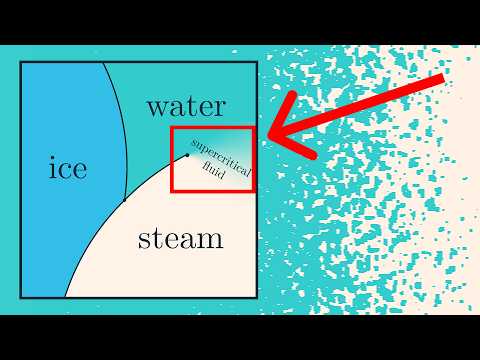
Simulating and understanding phase change | Guest video by Vilas Winstein
This video explores phase transitions using a liquid vapor model simulation, explaining the Boltzmann equation and its implications on system behavior.
 Watch on YouTube ↗
Key takeaways
- 🎯Phase transitions are defined not by chemical reactions but by molecular interactions that shift based on temperature and pressure.01:00
- ⚡Implement simulations that utilize randomness to approximate phase behaviors in particles rather than deterministic models.09:00
- 💡Understanding Boltzmann's distribution is key to predicting phase transitions, linking energy states and temperature through probability.10:00
- 📈At low temperatures, phase transitions occur abruptly between gas and liquid states, highlighting a general principle of free energy minimization.12:00
- 📝Review key thermodynamic principles that explain energy, entropy, and phase transitions, focusing on their practical applications.12:00
- 🚀Explore how varying parameters like temperature and chemical potential affect molecular density in simulations.31:00
Chapters
- 0:06🎯 Introduction to phase transitions
- 0:56🎯 Understanding phases of matter
- 1:55🎯 What is a phase transition?
- 2:52🎯 Introducing the liquid vapor model
- 3:03🎯 Parameters controlling the simulation
- 6:21🎯 The Boltzmann distribution
- 6:32🎯 Why randomness is used
- 11:02🎯 Microstates and macrostate probabilities
- 11:26🎯 Energy, entropy, and the free energy
- 12:10🎯 Simulating phase behavior
- 13:24🎯 Simulating molecular interactions
The digest
High Level Overview
This analysis explores the simulation of phase transitions in a simplified fluid model called the liquid vapor model. The core aim is to explain how this discrete model reproduces the complex behavior of matter changing phases—such as from gas to liquid—by leveraging fundamental physical concepts, especially the Boltzmann formula from statistical mechanics. The discussion clarifies the role of temperature, chemical potential, and energy-entropy competition in phase transitions, providing insights accessible to those interested in physics, computational modeling, or thermodynamics.
Keep reading in The Digest
The full 7-minute article, 15 more sections, and every new episode from 3Blue1Brown and the creators you follow.
- Understanding Phase Transitions and the Liquid Vapor Model
- The Boltzmann Distribution and Its Role in Phase Transitions
- Deriving Temperature and Understanding Equilibrium
- Sampling the Boltzmann Distribution: Kawasaki Dynamics
- Extending to Variable Molecule Number and Chemical Potential
- Observed Phase Behavior and Universality
- Connections to Other Models and Dimensions
- Key Frameworks and Models
- 1. Boltzmann Distribution
- 2. Free Energy Minimization
- 3. Temperature Definition via Entropy
- 4. Chemical Potential
- 5. Kawasaki Dynamics (MCMC Sampling)
- Practical Implications & Takeaways
- Action-Oriented Summary
More from 3Blue1Brown

This picture broke my brain
Explore the mathematical underpinnings of M.C. Escher's "Print Gallery," revealing how conformal maps and complex logarithms unlock its self-referential paradox.

The most beautiful formula not enough people understand
Explore the beautiful, counterintuitive math behind high-dimensional spheres, revealing the surprising behavior of volumes and the elegance of formulas like $V_n(R) = \frac{\pi^{n/2}}{\Gamma(n/2 + 1)} R^n$.

The Hairy Ball Theorem
The Hairy Ball Theorem states you can't comb hair on a sphere flat without a cowlick. This has surprising implications in fields like game development and physics.

Why Laplace transforms are so useful
Learn how Laplace transforms simplify the analysis of differential equations, providing valuable insights into system dynamics.

But what is a Laplace Transform?
The Laplace Transform is a powerful tool converting functions into exponential forms, revealing key insights into differential equations.

The Physics of Euler's Formula | Laplace Transform Prelude
This video explores the power of Euler's Formula and its connection to complex numbers, leading toward understanding the Laplace transform.