Institute for Advanced Study · Video summary
Reverse Mathematics of Complexity Lower Bounds, Part I - Hanlin Ren
The video explores the motivations and methods for studying the provability and complexity of lower bounds in computational complexity, introducing reverse mathematics as a key framework.

 Watch on YouTube ↗
Key takeaways
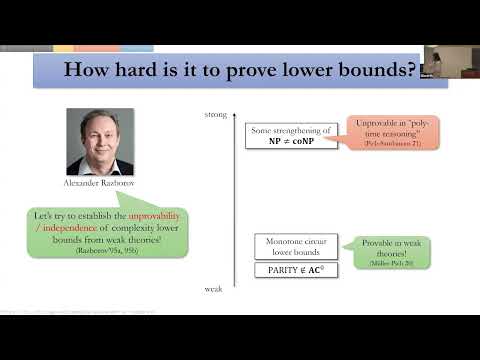
- 🎯Proving strong lower bounds (e.g., for SAT) is exceptionally difficult, with current techniques yielding only marginal improvements and facing significant theoretical barriers like the natural proof barrier.02:38
- 🚀Consider the provability of your own complex claims or results, not just their truth, by exploring connections to foundational principles.12:12
- 💡Reverse mathematics offers a framework to understand the reasoning power required for lower bounds by establishing equivalences between lower bounds and logical/combinatorial principles.12:12
- 🔍Some proven complexity lower bounds are equivalent to classical combinatorial principles (like the Pigeonhole Principle) in disguise, suggesting deeper connections between computational hardness and fundamental mathematical truths.15:27
- 💡Explore the simplest known combinatorial principles (like the Pigeonhole Principle) that might be equivalent to the computational hardness you are studying.15:27
- ⚡Analyzing the provability of lower bounds in weak theories reveals that proving lower bounds for certain systems (like resolution) requires reasoning power strictly stronger than the system itself.17:51
Chapters
- 0:15🎯 Introduction and Motivation
- 2:44🎯 Separation of Lower Bound Types
- 5:08🎯 Barriers to Proving Lower Bounds
- 10:21🎯 Complexity of Lower Bound Provability
- 15:27🎯 Reverse Mathematics and Equivalence Classes
- 17:43🎯 Natural Lower Bounds as Combinatorial Principles
- 17:58🎯 Minimal Reasoning for Analyzing Models
- 20:40🎯 Relationship between Lower Bounds and Reasoning Power
- 21:42🎯 Refilter Problems and Reductions
- 24:00🎯 Complexity of Refute Problems and Lower Bounds
- 39:02🎯 Pigeonhole Principle and Logical Principles
- 48:23🎯 Formalization via Bounded Arithmetic and Proof Systems
- 1:01:20🎯 Equivalence of Principles and Formal Theories
- 1:56:13🎯 Reverse Mathematics as Equivalence of Theorems
- 1:56:35🎯 Implications and Perspectives
The digest
This lecture explores the discipline of reverse mathematics applied to complexity lower bounds, focusing on understanding why proving strong complexity lower bounds is exceptionally difficult. It examines how one can classify and compare lower bounds based on the minimal logical or computational strength required to prove them, using concepts from proof complexity, computational complexity, and bounded arithmetic. The discourse is mainly motivated for researchers working in complexity theory, proof complexity, and mathematical logic who aim to gain a deeper understanding of both the nature of hardness proofs and logical frameworks necessary to establish such bounds.
High-Level Overview
Complexity lower bounds—statements that certain computational problems require substantial resources (like super-polynomial circuit size or long proof length)—are notoriously hard to prove. While standard efforts have identified various barriers and partial results, the fundamental reasons for this difficulty remain elusive. This lecture advocates the study of the provability of lower bounds themselves via reverse mathematics, aiming to characterize the exact logical and computational strength necessary to prove different types of lower bounds. By mapping these lower bounds to well-studied combinatorial or logical principles, one can cluster and compare them, shedding light on the logical essence behind known lower bounds and possibly guiding progress on longstanding open problems.
Keep reading in The Digest
The full 9-minute article, 12 more sections, and every new episode from Institute for Advanced Study and the creators you follow.
- Understanding the Difficulty of Lower Bounds [00:20–10:20]
- Motivation for Reverse Mathematics of Lower Bounds [10:20–14:00]
- Phenomena Revealed by Reverse Mathematics of Lower Bounds [14:00–18:00]
- Formalizing the Reasoning Complexity via Refuter Problems [21:30–29:00]
- Examples of Refuter Problems and Their Complexity Status [29:00–38:00]
- Main Case Study: One-Tape, Two-Head Turing Machine Lower Bound and PWP Completeness [38:00–45:00]
- Sketch of the Reduction from Lower Bound to WPHP [45:00–1:09:00]
- Converse Reduction: From WPHP to Lower Bound Refuter Problem [1:09:00–1:17:00]
- Logical Foundations: Bounded Arithmetic and Induction Schemas [1:17:00–1:08:30]
- Key Framework: Reverse Mathematics of Lower Bounds via Refuter Problems
- Practical Implications & Takeaways
- Action-Oriented Summary
More from Institute for Advanced Study

Multi-scale Analysis in Projection Theory III - Hong Wang
This lecture explores multi-scale analysis in projection theory, focusing on removing regularity assumptions for improved bounds in geometric measure theory.

Product of Random Matrices: From Scaling Limits to Neural Networks - Yi Han
Yi Han discusses scaling limits, spectral behavior, and universality classes of products of random matrices, with connections to neural networks and phase transitions.

Inside Astronomically Realistic Black Holes - Andrew Hamilton
Exploring inside astrophysical black holes reveals that the singularity is a surface, not a point, and the inner horizon of rotating black holes may be a site of baby universe creation.

Multi-scale Analysis in Projection Theory II - Hong Wang
Hong Wang's lecture explores multiscale analysis and projection theorems, revealing how almost regular sets develop product structures to compare projection sizes across scales.

There is a Mildly Mixing Rank 1 Transformation with an Interesting Joining - Jonathan Chaika
Jonathan Chaika proves the existence of mildly mixing rank one transformations with no minimal self-joinings, challenging assumptions about rank and mixing properties.

Existence and Regularity of Nonlocal Minimal Surfaces - Michele Caselli
This talk introduces fractional minimal surfaces as a novel approach to proving existence and regularity of classical minimal surfaces, particularly addressing limitations in min-max constructions.