Computerphile · Video summary
Path Planning for Robotics - Computerphile
Robotics path planning involves the sense-plan-act cycle, using algorithms like A* and RRT to navigate complex environments efficiently and avoid obstacles.

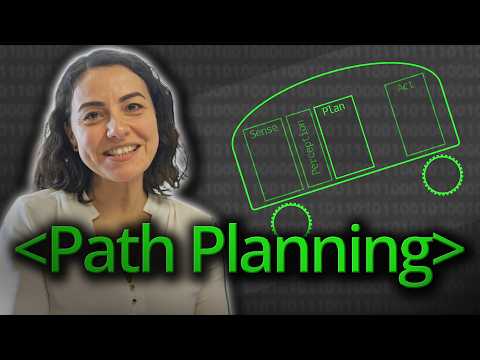 Watch on YouTube ↗
Key takeaways
- 🎯Robotics is fundamentally a computer science problem focused on building intelligent systems, with path planning being a core challenge due to real-world noise and uncertainty.00:07
- 💡The sense-plan-act cycle is crucial for robots: sensing gathers data, perception interprets it (object recognition, localization, mapping), planning finds a route, and acting executes movement.01:17
- 🚀Understand the sense-plan-act cycle as a fundamental framework for robot operation and intelligence.01:17
- 🔧Consider discretization (e.g., occupancy grids) as a common method for representing environments in path planning algorithms.02:24
- 📈Path planning often relies on discretizing the environment into grids (occupancy grids) to represent free space, obstacles, and unknown areas, enabling algorithmic processing.02:24
- 🔍Graph-based algorithms like A* are effective for path planning by discretizing the state space and using heuristics (H-cost) to prioritize exploration towards the goal, balancing incurred cost (G-cost) and estimated future cost.14:01
Chapters
- 0:00🎯 Introduction to Robotics Path Planning
- 1:21🚶♂️ Cycle of Sense, Plan, Act
- 3:31🗺️ Mapping and Localization
- 4:58🧭 Path Planning Demonstration
- 14:19📊 Grid and Search Algorithms
- 21:53🚀 Advanced Path Planning Techniques
- 27:52🔄 Combining Algorithms and Higher Dimensions
- 29:05⚙️ Practical Considerations and Final Thoughts
The digest
High Level Overview
Path planning is a fundamental problem in robotics that involves finding an efficient and obstacle-free route for a robot to move from a start position to a goal position. This task is critical because robots operate in complex, noisy, and uncertain real-world environments unlike controlled simulations. The discussion focuses on how computer science contributes to robotics through algorithms for sensing, perception, localization, and especially planning paths. It is intended for professionals and students interested in robotics, autonomous systems, and algorithmic problem-solving in high-dimensional spaces.
Keep reading in The Digest
The full 5-minute article, 10 more sections, and every new episode from Computerphile and the creators you follow.
- Understanding the Robotics Sense-Plan-Act Cycle
- Representing the World: Maps and Grids
- From Starting Point to Goal: The Planning Problem
- Graph-Based Path Planning and the Role of Heuristics
- Scalability Challenges: High-Dimensional Planning
- Sampling-Based Planning: Rapidly Exploring Random Trees (RRT)
- RRT*: Optimizing Random Sampling
- Algorithm Selection and Hybrid Approaches
- Practical Implications & Takeaways
- Actionable Recommendations
More from Computerphile

Procedural Generation in Games - Computerphile
This video explores procedural generation in games, focusing on the wave function collapse algorithm, exemplified by games like Carcassonne.

The Hard Problem of Controlling Powerful AI Systems - Computerphile
Understanding the hard problem of controlling powerful AI systems is crucial for ensuring safety and preventing misuse. A new subfield of security may emerge as AI becomes more autonomous.