Institute for Advanced Study · Video summary
On Turán Numbers of hyper Graphs - Maya Sankar
In this talk on Turán Numbers of hypergraphs, Maya Sankar explores theorems related to chromatic numbers and extremal graphs.

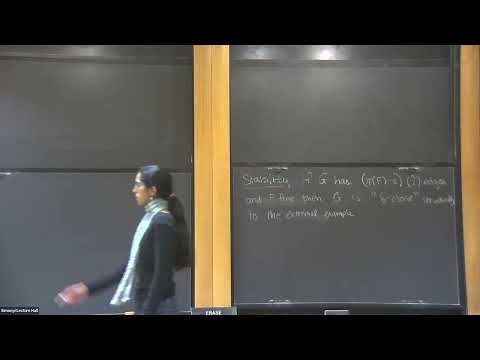 Watch on YouTube ↗
Key takeaways
- 🎯The Turán number defines the maximum edges in a graph without a specific forbidden subgraph.01:17
- 🚀Explore the theorems of Turán numbers in different contexts, especially hypergraphs.02:20
- 📊Structural results provide insight into how extremal configurations behave under various conditions.06:00
- 🌟Investigate the implications of stability results in graph theory for future projects.11:40
- 🔍Stability results are crucial, indicating that graphs close to maximum edges are structurally similar to extremal graphs.11:48
- 💡Probabilistic methods can effectively determine the size of cliques within graphs.12:52
Chapters
- 0:15🎯 Introduction
- 0:25📚 Overview of Turán Numbers
- 0:26🔗 Proofs of Turán's Theorem
- 0:37📖 Turán's Theorem
- 0:40🔍 Understanding Turán Density
- 0:45🎓 Stability Results
- 0:56🧩 Large Cliques in Graphs
- 1:00🔄 Inductive Proof Technique
- 1:20🔭 Erdős-Stone Theorem
- 1:40🧮 Bipartite Graphs and Turán Numbers
- 2:00📈 Counting Copies of K1,s
- 2:20🔗 Hypergraphs and Turán Density
- 2:40🎉 Super Saturation Phenomenon
- 3:00🔄 Limit Points in Hypergraphs
- 3:30🔬 Conclusion and Implications
The digest
High-Level Overview
This presentation explores the theory of Turán numbers, focusing on both classical graphs and their extension to hypergraphs. Turán numbers quantify the maximum edges possible in a graph or hypergraph that excludes a particular forbidden subgraph. The talk combines exposition of foundational results—including Turán's theorem and the Erdős–Stone theorem—with more advanced concepts such as stability, asymptotic densities, and hypergraph generalizations. It highlights both exact and asymptotic results, proof strategies, and open questions. This is essential for researchers in combinatorics and graph theory interested in extremal graph theory, providing a comprehensive understanding of extremal constructions and density thresholds.
Keep reading in The Digest
The full 7-minute article, 14 more sections, and every new episode from Institute for Advanced Study and the creators you follow.
- Structured Deep Dive
- Understanding Turán Numbers and Extremal Graphs (00:29–03:20)
- Turán’s Theorem and Balanced Blow-ups (04:34–07:15)
- Numerical, Structural, and Stability Results (07:25–10:30)
- Proof Sketch: Probabilistic Method for Turán’s Theorem (11:30–16:00)
- Proof Sketch: Inductive Neighborhood Approach (18:00–25:10)
- Erdős–Stone Theorem: Generalizing to Chromatic Number (25:40–28:04)
- Kővári–Sós–Turán (KST) Theorem for Bipartite Graphs (29:01–34:00)
- Extensions to Hypergraphs (36:50–45:10)
- Jump Phenomena and Turán Densities in Hypergraphs (45:11–49:10)
- Supersaturation Phenomenon (49:20–51:20)
- Key Frameworks, Models, and Mental Maps
- Practical Implications & Takeaways
- Action-Oriented Summary
More from Institute for Advanced Study

Multi-scale Analysis in Projection Theory III - Hong Wang
This lecture explores multi-scale analysis in projection theory, focusing on removing regularity assumptions for improved bounds in geometric measure theory.

Product of Random Matrices: From Scaling Limits to Neural Networks - Yi Han
Yi Han discusses scaling limits, spectral behavior, and universality classes of products of random matrices, with connections to neural networks and phase transitions.

Inside Astronomically Realistic Black Holes - Andrew Hamilton
Exploring inside astrophysical black holes reveals that the singularity is a surface, not a point, and the inner horizon of rotating black holes may be a site of baby universe creation.

Multi-scale Analysis in Projection Theory II - Hong Wang
Hong Wang's lecture explores multiscale analysis and projection theorems, revealing how almost regular sets develop product structures to compare projection sizes across scales.

There is a Mildly Mixing Rank 1 Transformation with an Interesting Joining - Jonathan Chaika
Jonathan Chaika proves the existence of mildly mixing rank one transformations with no minimal self-joinings, challenging assumptions about rank and mixing properties.

Existence and Regularity of Nonlocal Minimal Surfaces - Michele Caselli
This talk introduces fractional minimal surfaces as a novel approach to proving existence and regularity of classical minimal surfaces, particularly addressing limitations in min-max constructions.