Institute for Advanced Study · Video summary
On the Topological Invariance of Helicity - Oliver Edtmair
Oliver Edtmair discusses the topological invariance of helicity, providing insights into its mathematical foundations and applications in fluid dynamics.

 Watch on YouTube ↗
Key takeaways
- 🔍Helicity is an important invariant under volume preserving diffeomorphisms, relevant in both topology and fluid dynamics.02:39
- 🚀Explore the implications of helicity in fluid dynamics to enhance understanding of fluid behavior.05:20
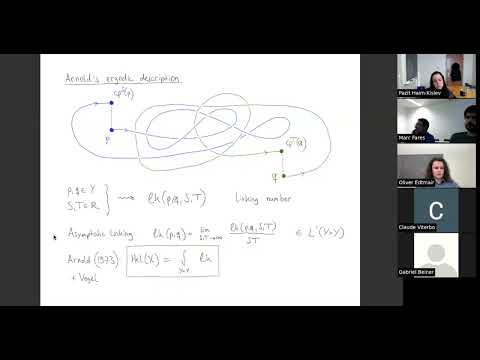
- 📊Helicity can be defined via the linking of flow lines, tying together geometry and the behavior of vector fields.06:29
- 💻Develop studies around C0 flows to expand the theoretical framework surrounding helicity.25:04
- ⚡The relationship between helicity and the Calabi invariant signifies deeper connections between dynamics and topology.28:52
- 🔧Investigate the relationship between helicity and topological properties to uncover potential new applications.30:01
Chapters
- 0:14🗣️ Introduction
- 0:50🔍 Definition of Helicity
- 1:42🔗 Independence of Alpha
- 2:13⚖️ Invariance under Volume Preserving Diffeomorphisms
- 2:59🌊 Origins in Hydrodynamics
- 3:38📈 Helicity and Vorticity
- 4:19📜 Helmholz and Kelvin Theorem
- 5:29🔄 Arnold's Description of Helicity
- 6:17🎯 Measuring Linking of Flow Lines
- 7:02🔍 Asymptotic Linking Number
- 7:32❓ Arnold's Questions
- 8:22🎉 Motivations for the Questions
- 9:17🚧 Challenges in Defining Invariance
- 10:49📊 Main Results
- 12:23🔬 Previous Works Overview
- 13:17🔧 Proof of Theorem
- 13:54📏 Transverse Measure
- 15:07🧩 Helicity via Measured Foliation
- 16:30📐 Insertions and Changes
- 17:16🔄 Changes in Helicity
- 19:12🔗 Generalization of Helicity
- 20:35🧩 Final Notes on Proving Extensions
- 22:10🔍 Conclusion
The digest
High Level Overview
This presentation by Oliver Edtmair addresses the concept of helicity, a topological invariant associated with volume-preserving vector fields on three-dimensional manifolds, particularly focusing on its properties and implications in hydrodynamics. The exploration is critical for those in mathematics and physics, especially researchers interested in the dynamical behavior of fluid systems and topological aspects of vector fields.
Keep reading in The Digest
The full 4-minute article, 12 more sections, and every new episode from Institute for Advanced Study and the creators you follow.
- Structured Deep Dive
- 1. Defining Helicity (00:14 - 02:27)
- 2. Important Property: Invariance (02:28 - 05:17)
- 3. Historical Context and Mathematical Origins (05:18 - 08:40)
- 4. Questions of Invariance and Extension by Arnold (08:41 - 12:36)
- 5. Key Results on Invariance and Extensions (12:37 - 16:12)
- 6. Framework and Methodology for Proof (16:13 - 25:26)
- 7. Implications from Recent Works (25:27 - 38:10)
- 8. Conclusions and Future Directions (38:11 - 47:09)
- Key Frameworks, Models, or Mental Maps
- Practical Implications & Takeaways
- Action-Oriented Summary
More from Institute for Advanced Study

Multi-scale Analysis in Projection Theory III - Hong Wang
This lecture explores multi-scale analysis in projection theory, focusing on removing regularity assumptions for improved bounds in geometric measure theory.

Product of Random Matrices: From Scaling Limits to Neural Networks - Yi Han
Yi Han discusses scaling limits, spectral behavior, and universality classes of products of random matrices, with connections to neural networks and phase transitions.

Inside Astronomically Realistic Black Holes - Andrew Hamilton
Exploring inside astrophysical black holes reveals that the singularity is a surface, not a point, and the inner horizon of rotating black holes may be a site of baby universe creation.

Multi-scale Analysis in Projection Theory II - Hong Wang
Hong Wang's lecture explores multiscale analysis and projection theorems, revealing how almost regular sets develop product structures to compare projection sizes across scales.

There is a Mildly Mixing Rank 1 Transformation with an Interesting Joining - Jonathan Chaika
Jonathan Chaika proves the existence of mildly mixing rank one transformations with no minimal self-joinings, challenging assumptions about rank and mixing properties.

Existence and Regularity of Nonlocal Minimal Surfaces - Michele Caselli
This talk introduces fractional minimal surfaces as a novel approach to proving existence and regularity of classical minimal surfaces, particularly addressing limitations in min-max constructions.