Institute for Advanced Study · Video summary
On SNARGs for NP and Nullstellensatz Proofs - Alex Lombardi
This talk explores constructing SNARKs for NP using lattice-based cryptography and tackling a polynomial norm decomposition problem to achieve full NP coverage.

 Watch on YouTube ↗
Key takeaways
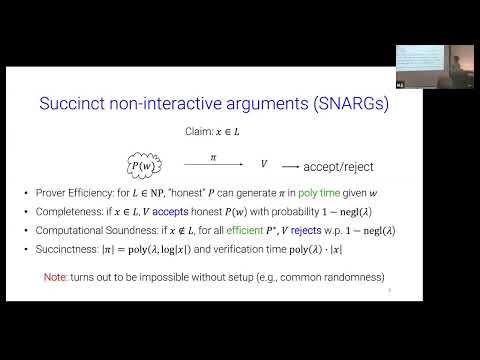
- 🎯A Succinct Non-interactive ARgument (SNARK) for NP aims to enable efficient verification of complex computational claims, where proofs are short and verification is fast.04:03
- 💡Existing heuristic SNARK constructions for NP, like the Merkle tree-based one, rely on idealized models (e.g., random oracles) and are not fully secure under standard cryptographic assumptions.21:20
- 🚀A significant barrier to building general SNARKs for NP is the Gentry-Wicks barrier, which suggests such systems might not be constructible from falsifiable hardness assumptions under black-box security proofs.26:41
- 🔧Understand the implications of the Gentry-Wicks barrier for constructing cryptographic systems from falsifiable assumptions.26:41
- 🔍The research presents a candidate SNARK for NP based on Learning With Errors (LWE), a lattice-based assumption, which is believed to be post-quantum secure.32:16
- 🚀Investigate lattice-based cryptography (e.g., LWE) if exploring post-quantum secure cryptographic primitives.32:16
Chapters
- 0:14🎯 Introduction and Motivation
- 2:04🎯 Constructing SNARGs for NP
- 5:53🎯 Efficiency and Security Parameters
- 10:56🎯 Common Reference String and Setup Assumptions
- 14:31🎯 Security Models and Non-Blackbox Assumptions
- 19:51🎯 Explicit Constructions and Assumptions
- 44:02🎯 Mathematical Problems and Conjectures
- 1:01:42🎯 Implications of the Mathematical Hypotheses
- 1:20:14🎯 Future Directions and Open Problems
The digest
This presentation explores the construction of Succinct Non-Interactive Arguments (SNARGs) for NP languages, focusing on recent lattice-based candidates and an intriguing open mathematical conjecture related to Nullstellensatz proofs over the boolean hypercube. It surveys the foundational setup and soundness challenges of SNARGs, known barriers to their existence, heuristic constructions, and a novel approach that leverages a hypothesis bounding the complexity of polynomial decompositions. The talk is aimed at researchers in complexity theory and cryptography interested in proof succinctness and security assumptions.
High Level Overview
Succinct Non-Interactive Arguments of Knowledge (SNARGs) provide a cryptographically compelling proof system where a prover convinces a verifier of membership in an NP language with minimal communication and verifier effort. Despite over 30 years of heuristic constructions, their formal security remains unresolved for general NP languages due to foundational complexity-theoretic barriers. Recent work introduces explicit lattice-based SNARG candidates and reduces their security to a new mathematical hypothesis regarding the size of Nullstellensatz decompositions of low-locality polynomials over the boolean hypercube. This connection bridges cryptographic constructions and algebraic proof complexity, offering a concrete problem whose resolution could finalize SNARG feasibility for NP.
Keep reading in The Digest
The full 6-minute article, 11 more sections, and every new episode from Institute for Advanced Study and the creators you follow.
- Detailed Explanation and Context
- SNARGs: Definitions and Goals (00:04–07:02)
- From PCPs to SNARGs: Classical Heuristic Construction (16:00–23:00)
- Complexity-Theoretic Barriers (25:00–29:30)
- Known Positive Results and Alternative Assumptions (29:40–31:50)
- Recent Lattice-Based SNARG Candidate for NP (32:00–36:25)
- Mathematical Conjecture at the Core: Low-Norm Nullstellensatz Hypothesis (44:50–59:50)
- Security Proof Sketch and Non-Blackbox Arguments (1:14:00–1:19:50)
- Key Framework: Low-Norm Nullstellensatz Hypothesis
- Practical Implications & Takeaways
- Action-Oriented Summary
More from Institute for Advanced Study

Multi-scale Analysis in Projection Theory III - Hong Wang
This lecture explores multi-scale analysis in projection theory, focusing on removing regularity assumptions for improved bounds in geometric measure theory.

Product of Random Matrices: From Scaling Limits to Neural Networks - Yi Han
Yi Han discusses scaling limits, spectral behavior, and universality classes of products of random matrices, with connections to neural networks and phase transitions.

Inside Astronomically Realistic Black Holes - Andrew Hamilton
Exploring inside astrophysical black holes reveals that the singularity is a surface, not a point, and the inner horizon of rotating black holes may be a site of baby universe creation.

Multi-scale Analysis in Projection Theory II - Hong Wang
Hong Wang's lecture explores multiscale analysis and projection theorems, revealing how almost regular sets develop product structures to compare projection sizes across scales.

There is a Mildly Mixing Rank 1 Transformation with an Interesting Joining - Jonathan Chaika
Jonathan Chaika proves the existence of mildly mixing rank one transformations with no minimal self-joinings, challenging assumptions about rank and mixing properties.

Existence and Regularity of Nonlocal Minimal Surfaces - Michele Caselli
This talk introduces fractional minimal surfaces as a novel approach to proving existence and regularity of classical minimal surfaces, particularly addressing limitations in min-max constructions.