ICTP Mathematics · Video summary
Monopole Floer homology for webs and foams
The talk introduces Monopole Floer homology for webs and foams, emphasizing the topological and combinatorial structures, and their relation to gauge theory and the four-color theorem.

 Watch on YouTube ↗
Key takeaways
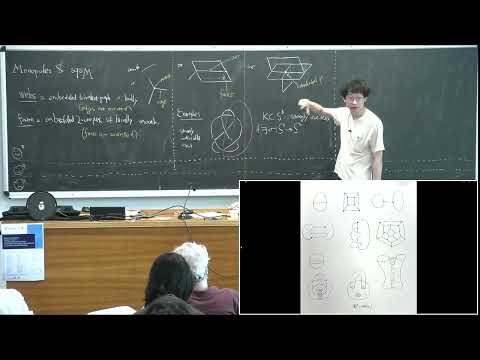
- 🎯Webs are embedded tri-valent graphs in 3-manifolds, with singularities like vertices and seams that resemble cones over tetra graphs.00:54
- 💡Colorings of edges and facets that satisfy local conditions relate directly to combinatorial invariants like Tait colorings and connect to the Four Color Theorem**.11:55
- 🚀To leverage these ideas, classify webs with specific colorings and use cobordisms to compute monopole homology, applying to problems like knot invariants and graph coloring.20:02
- 📝Use the coloring rules to classify webs and connect combinatorics to topology for simplified invariants.20:42
- 📈Monopole Floer homology for webs forms a functor with cobordisms and respects module structures over F₂, enabling algebraic analysis of topological properties.22:11
- 🔧Construct cobordisms between webs and analyze their homological maps to understand their topological features**.25:20
Chapters
- 0:06🎬 Introduction and Overview
- 0:45📊 Definition of Webs
- 3:39⚖️ Web Structures and Singularities
- 4:38🔄 Web and Foams Parameters
- 6:04🖼️ Examples of Webs and Embeddings
- 10:39🎨 Colorings of Webs and Foams
- 20:42📜 Invariants and Modules
- 25:42🔗 Cobordisms and Evaluation Maps
- 26:49🌐 Extensions to General 3-Manifolds
- 28:00⚙️ Module Structures and Endomorphisms
- 29:11📈 Exact Sequences and Long-Exact Sequence Analogs
- 31:24🧊 Vanishing Theorem and Bridges
The digest
High Level Overview
This presentation develops a construction of monopole Floer homology for webs—embedded trivalent graphs—and foams—two-dimensional cobordisms with singularities—within three- and four-dimensional manifolds. The talk establishes precise definitions of webs and foams, connects these topological objects to classical combinatorial ideas like colorings and the four-color theorem, and outlines how monopole Floer homology can be extended to these settings. The construction yields new invariants and functorial structures with potential applications in low-dimensional topology and knot theory.
This is significant for mathematicians working in gauge theory, Floer homology, and low-dimensional topology aiming to understand links between combinatorial graph theory and gauge-theoretic invariants, as well as researchers studying categorifications of traditional graph invariants.
Keep reading in The Digest
The full 6-minute article, 14 more sections, and every new episode from ICTP Mathematics and the creators you follow.
- Structured Deep Dive
- Defining Webs and Foams [00:13–04:20]
- Examples and Construction Motivations [05:05–09:56]
- Colorings of Webs and Their Relationship to the Four Color Theorem [10:00–13:55]
- One-Set Colorings for Webs and Foams [14:45–18:10]
- Defining Monopole Floer Homology for Webs Equipped with a One-Set [20:00–24:00]
- Module Structure and Exact Sequences [27:00–30:30]
- Vanishing Theorem for Webs Containing Bridges [31:00–32:45]
- Key Frameworks and Models
- 1. Definition of Webs and Foams
- 2. One-Set Coloring
- 3. Monopole Floer Homology for Webs with One-Sets
- Practical Implications & Takeaways
- Action-Oriented Summary
More from ICTP Mathematics

BASIC NOTIONS SEMINAR: The Calabi Problem
The seminar explains Calabi's problem on which complex varieties admit Kähler-Einstein metrics, highlighting differential and algebraic geometry connections.

Lefschetz fibrations and closed exotic 4-manifolds - 5
Lefschetz fibrations are explored through models of genus two vibrations and their implications for closed exotic 4-manifolds.

Real Seiberg-Witten theory - 5
Real Seiberg-Witten theory introduces insights about the topology of embeddings and their invariants in manifold theory, emphasizing surprises in smooth isotopic behaviors.

Skein lasagna modules - 5
The video discusses gluing of 4-manifolds in the Lee scheme lasagna modules, computing Rasmuson invariants for handle bodies, and stability conditions for limits of filtration levels.

Kontsevich invariants from configuration spaces 4
This lecture introduces handle replacement as a calculational tool for Kontsevich invariants, focusing on baromeia rings, cipher surfaces, and handlebody manipulations in embedding spaces.

Unoriented link Floer homology and Khovanov homology
This talk explores unoriented link Floer homology and its relationship with Khovanov homology, highlighting a new spectral sequence relating knot invariants.