Institute for Advanced Study · Video summary
Matrix Points on Varieties - Asvin Gothandaraman
Exploring non-commutative cycles via matrix points on varieties, revealing connections to classical geometry and algebraic structures.

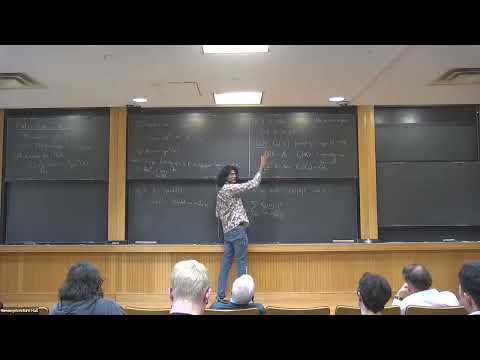 Watch on YouTube ↗
Key takeaways
- 🎯The concept of non-commutative cycles can be understood by studying maps from the structure sheaf of a variety $O_X$ to the matrix algebra $M_n(K)$, denoted as $C_n(X)$.04:08
- 🚀Explore the definition of $C_n(X)$ as maps from $O_X$ to $M_n(K)$ to understand non-commutative cycles.04:08
- 💡When $X$ is an affine space, $C_n(X)$ corresponds to selecting $n$ commuting matrices within $M_n(K)$, offering a concrete interpretation.04:27
- 🔧Investigate the relationship between $C_n(X)$ and classical geometric objects like $ ext{Sym}^n(X)$ to bridge commutative and non-commutative perspectives.07:13
- 🚀For smooth curves $X$, the zeta function of $X$ relates to a formal product involving $C_n(X)$, suggesting a deep connection between point counts and algebraic properties.16:33
- 📈The object $C_n(X)$ can be viewed as a moduli space parameterizing framed finite flat sheaves over $X imes T$, whose pushforward to $T$ is free as $O_T$-modules.18:01
Chapters
- 0:15🎯 Introduction to the topic
- 0:57🎯 Classical and non-commutative cycles
- 3:55🎯 Definition of $C_N(X)$
- 4:50🎯 Examples of $C_N(X)$
- 7:18🎯 Analogies and the importance of $C_N(X)$
- 8:06🎯 Power series and point counting
- 13:16🎯 Case of smooth curves and matrix counts
- 26:44🎯 Singularities and structure of $C_N(X)$
- 28:25🎯 Group actions and geometric structures
- 44:38🎯 Conditions for theorem validity
- 45:52🎯 Fiber analysis and $C_N(X)$ map properties
- 57:27🎯 Applications and potential extensions
- 1:01:17🎯 Concluding remarks and open questions
The digest
High Level Overview
This presentation introduces the concept of matrix points on algebraic varieties as a novel non-commutative analog of classical zero cycles on varieties. Traditional algebraic geometry studies zero cycles through symmetric powers of a variety, which corresponds to commutative finite algebras mapping into the variety. The talk proposes extending this perspective by considering points valued not in fields but in matrix algebras, thus entering the realm of non-commutative geometry. This approach defines new geometric objects, denoted $C_n(X)$, parameterizing maps from the structure sheaf of a variety to $n \times n$ matrix algebras, and explores their algebraic and geometric properties, including point counts over finite fields and cohomological invariants. The framework provides an alternative to Hilbert schemes, potentially simpler and richer in structure, with implications for non-commutative geometry and algebraic cycles.
This advanced study is relevant for algebraic geometers, representation theorists, and researchers in non-commutative geometry seeking new ways to encode geometric information and understand invariant structures extending classical cycle theory.
Keep reading in The Digest
The full 8-minute article, 18 more sections, and every new episode from Institute for Advanced Study and the creators you follow.
- Structured Deep Dive
- Classical Zero Cycles and Symmetric Powers (0:50–2:00)
- Introducing Matrix Points as Non-Commutative Cycles (2:00–4:00)
- Examples of Matrix Points (4:30–7:15)
- Product Formula and Zeta Functions (7:30–17:10)
- Moduli Interpretation of $C_n(X)$ (17:10–21:15)
- Relation to Hilbert Schemes and Simplifications (38:00–41:00)
- Cohomological Aspects: Singular and Intersection Cohomology (26:00–36:30)
- Techniques and Challenges in Proofs (43:30–52:00)
- Special Case: Curves and Flag Bundles (53:00–55:10)
- Broader Perspectives and Open Questions (55:10–59:00)
- Key Frameworks & Mental Models
- Matrix Points on Varieties ($C_n(X)$)
- Product Formula for Point Counts
- Cohomological Isomorphism
- Semi-simple vs. Nilpotent Decomposition
- Practical Implications & Takeaways
- Action-Oriented Summary: Applications in Research and Study
More from Institute for Advanced Study

Multi-scale Analysis in Projection Theory III - Hong Wang
This lecture explores multi-scale analysis in projection theory, focusing on removing regularity assumptions for improved bounds in geometric measure theory.

Product of Random Matrices: From Scaling Limits to Neural Networks - Yi Han
Yi Han discusses scaling limits, spectral behavior, and universality classes of products of random matrices, with connections to neural networks and phase transitions.

Inside Astronomically Realistic Black Holes - Andrew Hamilton
Exploring inside astrophysical black holes reveals that the singularity is a surface, not a point, and the inner horizon of rotating black holes may be a site of baby universe creation.

Multi-scale Analysis in Projection Theory II - Hong Wang
Hong Wang's lecture explores multiscale analysis and projection theorems, revealing how almost regular sets develop product structures to compare projection sizes across scales.

There is a Mildly Mixing Rank 1 Transformation with an Interesting Joining - Jonathan Chaika
Jonathan Chaika proves the existence of mildly mixing rank one transformations with no minimal self-joinings, challenging assumptions about rank and mixing properties.

Existence and Regularity of Nonlocal Minimal Surfaces - Michele Caselli
This talk introduces fractional minimal surfaces as a novel approach to proving existence and regularity of classical minimal surfaces, particularly addressing limitations in min-max constructions.