Institute for Advanced Study · Video summary
Learning from Complexity III - Maryanthe Malliaris
This lecture connects model theory with statistical learning and differential privacy, revealing deep structural parallels between seemingly disparate fields.

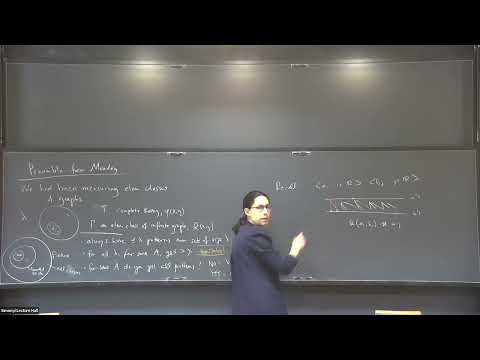 Watch on YouTube ↗
Key takeaways
- 🎯The fundamental theorem of statistical learning establishes that a class of sets is learnable if and only if it has a finite VC dimension. This links combinatorial properties to algorithmic learnability.15:45
- 🚀Explore the relationship between a hypothesis class's VC dimension and its learnability to understand why certain problems are computationally hard.16:04
- 🔧Consider how differential privacy guarantees impact algorithm design by analyzing the sensitivity of outputs to input changes, particularly in the context of learning.22:05
- 💡Differential privacy in learning requires that an algorithm's output distribution changes minimally when a single data point is altered. This is formally defined by epsilon-delta equivalence.24:52
- 🔍The concept of a 'half-graph' (where a formula holds in one direction but not the other) is a key indicator of instability in model theory, directly correlating with classes that are difficult to learn or are not differentially privately learnable.37:49
- 🔑The notion of stability trees in model theory, representing a recursive partitioning of a domain, is directly related to the dimension theory of hypothesis classes and is crucial for understanding learnability and definability.38:29
Chapters
- 0:15🗣️ Introduction and Recap of Previous Lectures
- 1:31📊 Measuring Complexity in Graph Classes
- 5:34📈 VC Dimension and Unbounded Classes
- 7:35🕸️ Example: Half Graphs
- 9:10🧠 Introduction to Statistical Learning
- 12:44💡 PAC Learning Formalization
- 15:10📜 Fundamental Theorem of Statistical Learning
- 18:52🔢 Example: Thresholds on Rationals
- 21:12⚖️ Sample Sensitivity and Privacy
- 24:08🔒 Differential Privacy Definition
- 26:55❌ Non-Private Algorithm Example
- 36:26🧮 The Unstable Formula Theorem
- 39:50🔗 Connecting Concepts: Stability and Learnability
- 44:03⚖️🔒 Differential Privacy and Stability Dichotomy
- 46:51📊⬆️ Learning Higher-Dimensional Structures
- 54:20🧱 Higher Dimensional Learning Theorem
- 56:19🤔 General Remarks on Learning from Complexity
- 59:07📏 Model Theory and Infinite Cardinals
- 1:05:56🔄 Unstable Formula Theorem Revisited
- 1:06:25💬 Continuity and Learning Algorithms
The digest
This lecture series explores the concept of "learning from complexity," examining how mathematical structures and theories can be used to understand and quantify complex phenomena, particularly in the realm of statistical learning and computer science. It delves into the relationship between model-theoretic concepts like stability and dimension with algorithmic capabilities, such as learnability and differential privacy. The target audience includes researchers and practitioners in mathematics, computer science, and machine learning who are interested in foundational theoretical connections between these fields.
Understanding Complexity in Graph Theory and Logic
The series begins by revisiting concepts from model theory related to understanding complexity in classes of graphs. A complete theory T defines a set of axioms for first-order logic, and an elementary class of infinite graphs consists of all graphs satisfying these axioms. The core idea is to analyze the number of distinct "patterns" or "labelings" that can arise when considering subsets of a given infinite size ($\lambda$) within these graphs.
- Stability: A class of graphs is considered stable if, for any infinite size $\lambda$, any subset of size $\lambda$ can be labeled in at most $\lambda$ distinct ways. This means the complexity of patterns is bounded relative to the size of the subset.
- Instability: Conversely, a class is unstable if there exists some infinite size $\lambda$ and some subset where more than $\lambda$ distinct patterns can be observed.
- VC Dimension: The Vapnik-Chervonenkis (VC) dimension provides a combinatorial measure of a set system's ability to shatter sets. A class has bounded VC dimension if there's a maximum size $N$ such that some set of size $N$ can be shattered (all $2^N$ possible labelings exist). Classes with infinite VC dimension can shatter arbitrarily large sets.
The lecture highlights a trichotomy:
- Bounded VC Dimension: The class can shatter sets, but not all possible patterns exist for all sets.
- Infinite VC Dimension: The class can shatter arbitrarily large sets.
- Stable Classes: A subset of infinite VC dimension classes where the number of patterns is always limited by the size of the set.
An example of a class that falls between infinite VC dimension and stable classes is the "half graph," where nodes $a_i$ and $b_j$ are connected if $i < j$, with no defined connections among $a$'s or $b$'s. This class exhibits instability but has a low VC dimension (one).
Keep reading in The Digest
The full 7-minute article, 7 more sections, and every new episode from Institute for Advanced Study and the creators you follow.
- Statistical Learning and the Fundamental Theorem
- Differential Privacy and Sample Sensitivity
- The Dichotomy: Stability, Dimension, and Learnability
- Higher-Dimensional Learning and Model Structure
- Key Frameworks, Models, or Mental Maps
- Practical Implications & Takeaways
- Action-Oriented Summary
More from Institute for Advanced Study

Multi-scale Analysis in Projection Theory III - Hong Wang
This lecture explores multi-scale analysis in projection theory, focusing on removing regularity assumptions for improved bounds in geometric measure theory.

Product of Random Matrices: From Scaling Limits to Neural Networks - Yi Han
Yi Han discusses scaling limits, spectral behavior, and universality classes of products of random matrices, with connections to neural networks and phase transitions.

Inside Astronomically Realistic Black Holes - Andrew Hamilton
Exploring inside astrophysical black holes reveals that the singularity is a surface, not a point, and the inner horizon of rotating black holes may be a site of baby universe creation.

Multi-scale Analysis in Projection Theory II - Hong Wang
Hong Wang's lecture explores multiscale analysis and projection theorems, revealing how almost regular sets develop product structures to compare projection sizes across scales.

There is a Mildly Mixing Rank 1 Transformation with an Interesting Joining - Jonathan Chaika
Jonathan Chaika proves the existence of mildly mixing rank one transformations with no minimal self-joinings, challenging assumptions about rank and mixing properties.

Existence and Regularity of Nonlocal Minimal Surfaces - Michele Caselli
This talk introduces fractional minimal surfaces as a novel approach to proving existence and regularity of classical minimal surfaces, particularly addressing limitations in min-max constructions.