Mike Benz · Video summary
Joe Rogan Recap - Going Over Our Most Recent Episode
Understanding the sticky middle layer of "fixers" is key to dismantling complex systems like the censorship industrial complex and understanding geopolitical dynamics.

 Watch on YouTube ↗
Key takeaways
- 🚀Effective communication requires translating complex, often uncomfortable truths into understandable terms, even if it alienates parts of the audience, to shift paradigms.05:07
- 📊The censorship industrial complex is a business driven by profit, making financial incentives the core to target for dismantling it.40:56
- ⚡The European Union's Digital Censorship Act exemplifies how regulatory pretexts are used to enforce censorship, often originating from diplomatic pressure.41:41
- 📝The National Science Foundation has been a significant direct funder of censorship organizations and universities in the US, impacting free speech.49:39
- 🔍Understanding the anatomy of complex systems, rather than just labeling them as "evil," is crucial for effective reform and avoiding superficial solutions.57:17
- 🔧When evaluating complex issues, look beyond simple labels of "good" or "evil" and understand the underlying incentives and mechanics that drive decisions.57:17
Chapters
- 0:04🤔 Introduction: The Artist's Struggle
- 1:55🗣️ The Challenge of Explaining Complexities
- 2:00🚫 The Censorship Industrial Complex
- 4:04🔫 The 'Perspective Gun' Analogy
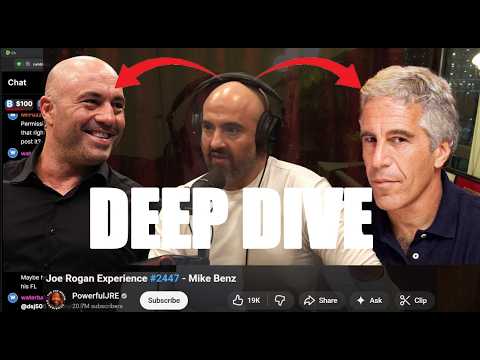
- 7:02🎙️ Preparing for Joe Rogan Episode #2447
- 8:25📰 The Epstein Files Drop
- 9:03🏛️ Calls to Action: FOIA and Legislation
- 11:18📄 The Limitations of Current Epstein Files
- 13:16🚀 Success in Initiating FOIA Requests
- 16:50🤯 The Divisive Nature of the Epstein Issue
- 18:37⚖️ Navigating Multiple Angles of the Epstein Story
- 25:42🗺️ Understanding Epstein's Global Network
- 39:40🔮 Foresight on Censorship Trends
- 40:16💼 The 'Censorship Industry' as a Business
- 41:41🇪🇺 EU Digital Censorship Act and Transatlantic Attack
- 48:15😇 The Importance of Understanding Motivations
- 49:07🔬 The National Science Foundation's Role in Censorship
- 1:06:12🤝 The 'Fixer' Class and the Sticky Layer
- 1:11:58🎖️ Eric Smerella Case Study: Leaking and Incentives
- 1:24:36💰 The Favor Bank and Inverted Incentives
- 1:26:44🇺🇦 Atlantic Council's Influence on Ukraine Policy
- 1:49:12🇮🇱 Navigating Israeli Connections in the Epstein Files
- 1:54:34🔄 Ehud Barak's Role and Epstein's Network
- 2:18:36🤝 The 'Syan' - Civilian Support for Intelligence Operations
- 2:25:49🔄 Epstein's Rotating Government Partnerships
- 2:27:13❓ The Importance of Understanding US Government's Role
The digest
High-Level Overview
This deep reflection explores the challenges of communicating complex, controversial topics such as Jeffrey Epstein’s expansive network, government entanglements, and the censorship industrial complex through the lens of a Joe Rogan podcast episode. It highlights the difficulty of conveying multifaceted truths that upset entrenched beliefs, the necessity of precise, actionable insights to fuel reform, and the intricate interplay between intelligence agencies, private fixers, and political incentives. This content is essential for professionals seeking a nuanced understanding of modern political power structures, covert influence, and information control mechanisms.
Keep reading in The Digest
The full 7-minute article, 14 more sections, and every new episode from Mike Benz and the creators you follow.
- Structured Deep Dive
- 1. The Difficulty of Communicating Complex Truths (00:04 – 05:50)
- 2. Paradigm Shifts and the “Perspective Gun” Effect (03:45 – 06:10)
- 3. Preparation and Spontaneity in the Joe Rogan Episode (06:40 – 14:00)
- 4. The Epstein Files: A Multifaceted and Divisive Issue (16:50 – 22:00)
- 5. The “Sticky Middle Layer”: Epstein as a Professional Fixer (23:00 – 33:00)
- 6. Incentives and the Inversion of Service in Government (33:30 – 48:00)
- 7. The Role of US Government Agencies and Think Tanks (48:00 – 58:00)
- 8. Contextualizing Israeli Involvement and US-Israeli Relations (49:00 – 1:02:00)
- 9. Tactical Lessons and Communication Reflections (1:02:10 – 1:04:50)
- 10. Concluding Analogy and Future Outlook (1:05:30 – 1:09:00)
- Key Framework: The “Sticky Middle Layer” Model of Influence
- Practical Implications & Takeaways
- Action-Oriented Summary
More from Mike Benz

Brazil's 1st Election After USAID
Brazil's recent election was an "earthquake," reflecting years of public rage at the ballot box. This outcome is linked to the closure of USAID and its controversial activities in Latin America.

USAID & The Rap Game (Part 2)
The CIA used rap music to topple the government of Senegal in 2012, funding a youth movement that led to violent riots and the ousting of the president. This operation was part of a broader strategy of using cultural diplomacy to achieve geopolitical objectives.

USAID & The Rap Game (Part 1)
This video explores the intricate relationship between the music industry and government intelligence agencies, revealing how soft power and cultural diplomacy are leveraged to influence global narratives and achieve strategic objectives.

Crazy New State Dept Censorship Files
Mike Benz exposes the State Department's Global Engagement Center (GEC) and its alleged involvement in domestic censorship and the manipulation of public discourse, particularly concerning "gendered disinformation."

USAID and Internews: A CIA Love Story
In this video, Mike Benz explores the controversial connections between Internews, a media nonprofit, and the CIA, revealing how it has been funded by U.S. government agencies to influence media narratives globally, particularly during regime changes and conflicts. Benz argues that Internews operates as a significant player in the censorship industrial complex, promoting U.S. geopolitical interests under the guise of independent journalism.

The Business Side of the Censorship Industry (Part 2)
In Part 2 of "The Business Side of the Censorship Industry," Mike Benz explores the economics of the counter disinformation industry, detailing its evolution from a niche market to a multi-billion dollar sector driven by corporate interests and government partnerships, while highlighting the roles of key players like NewsGuard and the Global Disinformation Index.