Institut des Hautes Etudes Scientifiques (IHES) · Video summary
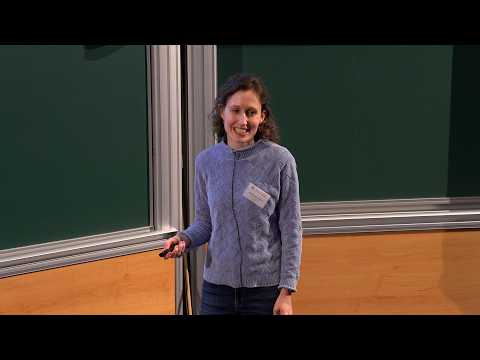
Isabel Garcia Garcia - Abelian Instantons in Quantum Field Theory and Gravity
This talk explores abelian instantons in quantum field theory and gravity, linking them to magnetic monopoles and their implications for physical parameters like the electromagnetic theta term.

 Watch on YouTube ↗
Key takeaways
- 🎯The standard model, despite its symmetry breaking, does not possess topologically stable defects like domain walls, cosmic strings, or magnetic monopoles due to its homotopy groups being trivial for these defect types.02:25
- 💡The existence of magnetic monopoles, even if not directly present in a theory like electromagnetism alone, is implied by the Completeness Hypothesis when electromagnetism is coupled to gravity, manifesting as magnetically charged black holes.04:33
- ⚡The Witten effect demonstrates that the electromagnetic theta term, typically unphysical in U(1) gauge theories, becomes a physical parameter in the presence of magnetic monopoles, influencing their electric charge and mass.11:01
- 🚀Consider the implications of magnetic monopoles and the Witten effect for theories beyond the Standard Model, particularly in extensions involving axions.11:13
- 🔄Abelian instantons can be realized through configurations of closed monopole worldlines where the gauge field winds around the monopole line, leading to a non-zero integral of F ∧ F.14:01
- 🌌In the context of Einstein-Maxwell theory, a magnetically charged black hole solution acts as an abelian instanton, representing a non-trivial field configuration with a finite action that contributes to the gravitational path integral.36:40
Chapters
- 0:12📝 Introduction and Background on Topological Defects
- 3:57⚛️ Magnetic Monopoles in Extensions of the Standard Model
- 5:05🧲 Magnetically Charged Black Holes as Monopoles
- 10:16🔄 The Witten Effect and Physical Theta Terms
- 11:48💡 Axions and Theta-Dependent Potentials
- 12:40🌌 Abelian Instantons and Field Configurations
- 14:14〰️ Monopole Worldlines and Sheets
- 17:59🌐 Topologically Non-trivial Manifolds and Abelian Instantons
- 21:43❓ Quantization of Field Configurations
- 26:30🔗 Sources for Monopole Configurations
- 28:36🧲⚡ Connection to Non-Abelian Instantons
- 36:40🌌➕ UV Completing Monopoles with Gravity
- 40:13🧲⚫ Euclidean Black Holes as Abelian Instantons
- 41:52🕳️ Geometry of Euclidean Black Holes
- 56:40🌀 Conical Singularities and Path Integrals
- 58:01🧮 Constraint Actions for Path Integrals
- 1:01:43📈 Contribution to the Path Integral
- 1:03:21⚡ Finite Euclidean Action
- 1:07:26🧲↔️⚡ Theta-Dependent Observables
- 1:11:11🔭 Window into Quantum Gravity and UV Physics
- 1:11:54💡 Future Directions and Open Questions
The digest
This presentation explores the concept of "abelian instantons" and their implications in both quantum field theory (QFT) and gravity. It argues that the presence of magnetic monopoles, even in theories without explicit magnetic charges, can render the electromagnetic theta term physical. This phenomenon has significant consequences for understanding fundamental physics, from the early universe to the structure of spacetime. The talk delves into the mathematical underpinnings of these abelian instantons, examining their behavior in Euclidean space and their connection to black hole solutions in Einstein-Maxwell theory.
1. The Significance of Defects and Symmetry Breaking
The standard model of particle physics and its extensions rely heavily on non-abelian dynamics, which are crucial for phenomena like spontaneous symmetry breaking. This breaking can lead to the formation of various topological defects, including magnetic monopoles, cosmic strings, and domain walls. The existence and properties of these defects are often characterized by the homotopy groups of the vacuum manifold.
- Homotopy Groups and Defects:
- $\pi_0$ non-trivial: Domain walls
- $\pi_1$ non-trivial: Cosmic strings
- $\pi_2$ non-trivial: Magnetic monopoles
- $\pi_3$ non-trivial: Instantons
The electroweak sector of the Standard Model, with its $SU(2) \times U(1)$ symmetry breaking to $U(1)_{\text{EM}}$, has a vacuum manifold equivalent to a 3-sphere. The homotopy groups of the 3-sphere are trivial for $\pi_0, \pi_1, \pi_2$, meaning there are no domain walls, cosmic strings, or magnetic monopoles within the Standard Model's electroweak sector alone. The first non-trivial group is $\pi_3$, indicating the presence of instantons.
Any experimental evidence of defects or non-equilibrium dynamics in the early universe would strongly suggest physics beyond the Standard Model.
Keep reading in The Digest
The full 8-minute article, 8 more sections, and every new episode from Institut des Hautes Etudes Scientifiques (IHES) and the creators you follow.
- 2. Magnetic Monopoles and the Completeness Hypothesis
- 3. The Witten Effect: Making the Electromagnetic Theta Term Physical
- 4. Abelian Instantons in Quantum Field Theory
- The Monopole Loop Configuration
- 5. Abelian Instantons in Gravity
- 6. Practical Implications and Takeaways
- 7. Key Frameworks and Concepts
- 8. Action-Oriented Summary
More from Institut des Hautes Etudes Scientifiques (IHES)

Alba Grassi - From Mirror Symmetry to Black Hole Perturbation Theory
Discover how mirror symmetry and topological string theory offer new analytic tools to solve complex black hole perturbation problems, bridging seemingly disparate fields.

Marc Henneaux - The ADM description of the Bondi-Metzner-Sachs group of asymptotically flat spaces
This talk explores asymptotic symmetries in gravity, distinguishing between proper and improper gauge transformations to define physical observables and extending the BMS group to spatial infinity.

Gustav U. Jakobsen - Black Hole Scattering at High Precision
Gustav Jakobsen discusses high-precision black hole scattering using quantum field theory and effective field theory, linking it to gravitational wave physics and advanced calculations.

Zvi Bern - Progress at the 5th post-Minkowskian order
Leveraging quantum field theory and scattering amplitudes to calculate higher-order post-Minkowskian effects for gravitational waves, overcoming complex integrals and revealing new physics.

Thibault Damour - Encounters with Two Gravitational-Wave Pioneers: Luis Bel et Alain Brillet
This video highlights the scientific legacies of gravitational wave pioneers Louis Bel and Alain Brillet, focusing on their contributions to physics and the development of gravitational wave detection.

Manuela Campanelli - GRMHD Simulations of Spinning Supermassive Black Hole Binaries: Gas (...)
GRMHD simulations reveal supermassive binary black holes are luminous during inspiral, merger, and post-merger due to gas dynamics, with mini-discs and shocks driving radiation and jets.
All Institut des Hautes Etudes Scientifiques (IHES) summaries →