UC Berkeley Events · Video summary
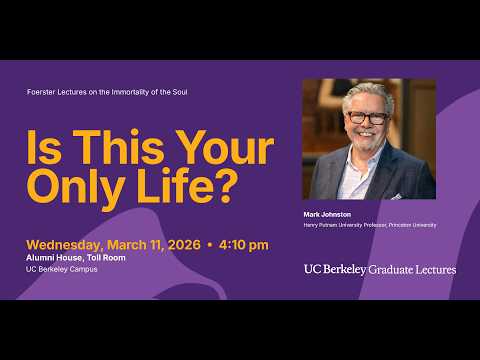
Is This Your Only Life?
Philosopher Mark Johnston argues that reductive materialism fails because it makes ethical life unworkable, opening the door for a non-reductive view of embodiment and the possibility of an afterlife.
 Watch on YouTube ↗
Key takeaways
- 🚀Near-death experiences (NDEs), while not definitive proof of an afterlife, highlight that the fear of death can be overcome and that the subjective experience can feel more real than ordinary perception, suggesting a disconnect from purely physical explanations.07:52
- 🔑The traditional Cartesian view of the soul as an immaterial substance is contrasted with a non-Cartesian view where beings are essentially material but capable of having different embodiments, suggesting that what survives death might be the same person, differently embodied.15:08
- 💪The nature of matter itself, as understood by quantum field theory, is process-like, implying that even physical embodiments are constantly changing successions of events, which challenges the idea of a static, purely material self.17:50
- 🔍The concept of 'moral worth' is central to the argument against reductive materialism; only beings with moral status (conscious valuers of value who can act) can be wronged, and the proliferation of such beings under reductive materialism makes ethical obligations impossible to fulfill.23:46
- 🎯Reductive materialism, which claims we are identical to or nothing over and above our material embodiment (especially as process-like entities), leads to an 'explosion' of moral status for all subprocesses of a person's life, rendering ethical life unworkable due to the demands of moral status.29:55
- 📈A non-reductive account of embodiment suggests we are essentially embodied wills, requiring some material embodiment to implement our agency and experiences, but not necessarily our current specific embodiment, thus leaving open the possibility of other forms of embodiment after death.36:34
Chapters
- 0:00🎯 Introduction and Background (0-118s)
- 1:58🎯 History of the Forester Lectures (118-202s)
- 3:22🎯 Introduction of Dr. Mark Johnston (202-265s)
- 4:25🎯 Dr. Johnston's Opening Remarks (265-417s)
- 6:57🎯 Refutation of Hope in an Afterlife (417-611s)
- 10:11🎯 Near-Death Experiences and Empirical Evidence (611-652s)
- 10:52🎯 Theories of Embodiment and Materialism (652-899s)
- 14:59🎯 Arguments Against Reductive Materialism (899-1504s)
- 25:04🎯 Non-Reductive Account of Embodiment (1504-2202s)
- 36:42🎯 The Metaphysics of Embodiment and Afterlife (2202-3534s)
- 58:54🎯 Implications for Moral and Ethical Life (3534-4002s)
- 1:06:42🎯 Questions and Audience Interaction (4002-5262s)
The digest
High Level Overview This lecture by Princeton philosopher Mark Johnston critically examines the philosophical possibility of an afterlife and the nature of human embodiment. Challenging reductive materialism—which equates persons strictly with their physical, biological processes—Johnston develops a non-reductive framework for understanding embodiment and moral worth. He argues that it is metaphysically coherent to conceive of survival beyond one’s current physical embodiment. The talk navigates complex ontological and ethical questions about identity, consciousness, and the moral implications of how we understand the self and its persistence through time. It is essential viewing for philosophers, ethicists, cognitive scientists, and anyone interested in the foundations of personal identity, the mind-body problem, and afterlife inquiry—particularly from a purely philosophical perspective divorced from theological claims.
# Structured Deep Dive
Historical Context and Setting (00:00–04:25)
The lecture series, sponsored by UC Berkeley’s Graduate Council and Philosophy Department, honors a bequest established in 1928 by Edith Zybrook to explore spiritual topics, especially the immortality of the soul. Mark Johnston, known for influential work in ontology, philosophy of mind, and philosophy of religion, was invited for his expertise. This background frames the importance of philosophical reflection on death and what lies beyond.
Keep reading in The Digest
The full 7-minute article, 11 more sections, and every new episode from UC Berkeley Events and the creators you follow.
- Revising Past Positions on the Afterlife (05:00–06:50)
- Near-Death Experiences as Anecdotal Data (07:00–12:10)
- The Traditional vs. Non-Cartesian Soul and Embodiment (13:00–17:30)
- Quantum Field Theory and Processual Nature of Matter (17:40–19:30)
- Reductive Materialism and Its Ethical Consequences (19:40–35:10)
- The Failure of Ontological Reduction to Mental or Personal Phenomena (36:00–49:40)
- Non-Reductive Account of Embodiment and Its Moral Significance (49:50–56:00)
- Implications for the Afterlife and Final Remarks (56:00–59:40)
- Ontological Reduction (36:00–40:50)
- Moral Worth and Similarity Constraints (23:40–28:10)
- Embodied Wills and Grounding Relations (51:00–56:00)
