Institute for Advanced Study · Video summary
Is String Theory Unique? - Clifford Cheung
String theory's uniqueness is explored via the scattering amplitudes bootstrap, a method to systematically identify theories with specific miraculous mathematical and physical properties.

 Watch on YouTube ↗
Key takeaways
- 🎯The core question is not whether string theory describes our universe, but whether it's the unique theoretical framework capable of achieving its observed consistency, particularly in unifying gravity and quantum mechanics.01:18
- 💡The scattering amplitudes bootstrap offers a systematic approach by defining the space of all possible theories through their scattering amplitudes, then building constraints based on observed properties.02:16
- 🚀Explore the scattering amplitudes bootstrap framework to understand how theoretical constraints can systematically identify unique physical theories.02:16
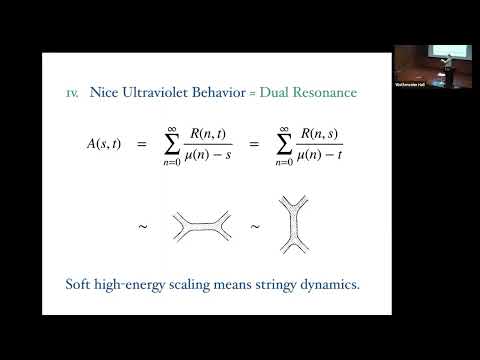
- 🔍String amplitudes possess unique properties like consistently coupling infinite towers of particles, well-behaved short-distance behavior, and dual resonance, which can be framed as mathematical constraints.03:34
- 🚀Positivity bounds generalize to higher point functions (multi-positivity), revealing that minors of a residue matrix must be non-negative, providing constraints on effective field theories and ruling out some deformed string amplitudes.19:27
- 🔧Investigate positivity bounds and their generalizations to higher point functions as a tool for ruling out inconsistent effective field theories.19:27
Chapters
- 0:27❓ Introduction: Is String Theory Unique?
- 2:16💡 The Scattering Amplitudes Bootstrap
- 3:32✨ Miraculous Properties of String Amplitudes
- 5:20✅ Conservative Assumptions for the Bootstrap
- 7:57📈 Strongest Assumption: Ultraviolet Behavior
- 10:00🧮 Exploring the Space of Amplitudes
- 15:05🔧 Tools for Ruling Out Theories: Positivity
- 16:21➕ Multipostivity: Generalizing Positivity
- 21:11📉 Logarithm of Amplitudes and Dispersion Relations
- 26:02🔢 Heil Matrix and Finite Rank
- 27:24🎯 Sculpting String Amplitudes: Two Assumptions
- 29:50🔄 Reggie Zeros and Consistency
- 33:50⬆️ Ultrasoftness Explained
- 34:12✔️ Minimal Zeros and Minimal Consistency
- 36:41📜 Deriving the Veneziano Amplitude
- 38:56⚖️ Completeness and Conserved Charges
- 40:19🔌 Amplitude Perspective on Completeness
- 43:13🚀 Iterative Deduction of Charged States
- 45:43⚖️ Graviton Pole and Charge Distribution
- 46:15🏁 Conclusions and Future Directions
The digest
Uniqueness of String Theory: A Bootstrap Approach to Amplitude Structure
This presentation explores the theoretical question of whether string theory is the unique framework capable of describing gravity and quantum mechanics at fundamental scales. Instead of directly testing string theory against reality, the focus shifts to a theoretical bootstrap approach, analyzing the mathematical properties of scattering amplitudes. The goal is to identify fundamental constraints that might uniquely select string theory or reveal a broader landscape of consistent theories. This analysis is particularly relevant for theoretical physicists and cosmologists seeking to understand the fundamental nature of reality and the underlying principles of quantum gravity.
Keep reading in The Digest
The full 6-minute article, 7 more sections, and every new episode from Institute for Advanced Study and the creators you follow.
- The Scattering Amplitude Bootstrap: A Theoretical Playground
- Miraculous Properties of String Amplitudes
- Key Assumptions for the Bootstrap
- Beyond String Theory: A Broader Landscape
- New Tools for Constraining Amplitudes
- Deriving String Amplitudes from Minimal Assumptions
- Completeness and Conserved Charges in Quantum Gravity
More from Institute for Advanced Study

Multi-scale Analysis in Projection Theory III - Hong Wang
This lecture explores multi-scale analysis in projection theory, focusing on removing regularity assumptions for improved bounds in geometric measure theory.

Product of Random Matrices: From Scaling Limits to Neural Networks - Yi Han
Yi Han discusses scaling limits, spectral behavior, and universality classes of products of random matrices, with connections to neural networks and phase transitions.

Inside Astronomically Realistic Black Holes - Andrew Hamilton
Exploring inside astrophysical black holes reveals that the singularity is a surface, not a point, and the inner horizon of rotating black holes may be a site of baby universe creation.

Multi-scale Analysis in Projection Theory II - Hong Wang
Hong Wang's lecture explores multiscale analysis and projection theorems, revealing how almost regular sets develop product structures to compare projection sizes across scales.

There is a Mildly Mixing Rank 1 Transformation with an Interesting Joining - Jonathan Chaika
Jonathan Chaika proves the existence of mildly mixing rank one transformations with no minimal self-joinings, challenging assumptions about rank and mixing properties.

Existence and Regularity of Nonlocal Minimal Surfaces - Michele Caselli
This talk introduces fractional minimal surfaces as a novel approach to proving existence and regularity of classical minimal surfaces, particularly addressing limitations in min-max constructions.