Institute for Advanced Study · Video summary
Invariant Distances on Legendrian Spaces - Pierre-Alexandre Arlove
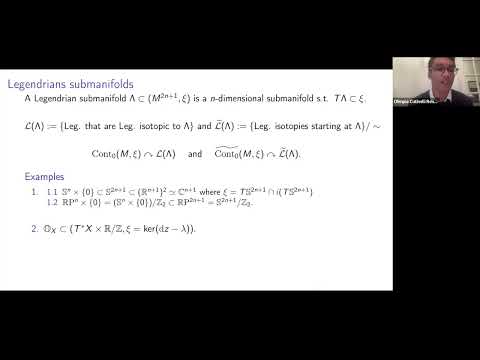
In this lecture, Pierre-Alexandre Arlove discusses invariant distances on legendrian spaces and their global properties.

 Watch on YouTube ↗
Key takeaways
- 🎯Contact manifolds are of odd dimension, with flexibility in their geometry.01:16
- 💡The Daru theorem shows that local behavior in contact geometry is not interesting; focus on global properties.01:44
- 📈Invariant quantities cannot arise simply from local values due to transitive action of contactomorphisms.03:11
- 📝Study the Daru theorem implications on global properties of contact manifolds.04:00
- 🔍Unique invariant distances exist on leandrean submanifolds, showcasing more rigidity than points.05:54
- 📚Interesting distances arise from projects like the periodic one-jet bundle and the projectivized cotangent, extending the existing theories.09:11
Chapters
- 0:16🗣️ Introduction to Legendrian Geometry
- 0:38🔑 Daru's Theorem and Contact Structure
- 0:56🔄 Contactomorphism and Symmetry Groups
- 1:50⚖️ Invariant Global Quantities
- 2:26🧩 Leandrean Submanifolds
- 3:59🗺️ Examples of Contact Structures
- 5:47💡 Properties of Leandrean Isotopies
- 7:18📏 Discriminant Distance Concept
- 8:30🌌 Unbounded Distances in Leandreans
- 10:33🔄 Generalization of Theorems
- 11:23🔍 Historical Context of Invariant Distances
- 13:38🚧 Flexibility vs. Rigidity in Distances
- 14:19🔬 Proof of Theorem A
- 16:03📐 Applications of Invariant Distances
- 17:41📏 Proof of Theorem B
- 18:20🔄 Vinstein Neighborhood Theorem
- 19:11🔑 Compactly Supported Contactomorphism
The digest
This presentation explores the construction and properties of invariant distances within the realm of contact geometry, particularly focusing on Legendrian submanifolds. It examines the rigidity phenomena inherent in Legendrian spaces, develops frameworks for defining meaningful global invariants, and extends classic results by showcasing new examples of unbounded invariant distances. The analysis is grounded in deep geometric concepts like contact isotopies, orderability, and generating function techniques, making it relevant for researchers working in symplectic and contact geometry, geometric topology, and related mathematical fields.
High-Level Overview
Contact manifolds, equipped with maximally non-integrable hyperplane distributions, lack locally interesting invariants due to their inherent flexibility, as established by Darboux’s theorem. This flexibility implies that local geometry is standard and uniform, driving the focus toward global phenomena to extract meaningful invariants. Legendrian submanifolds, being maximally tangent to the contact distribution, provide richer structure to study global invariants such as invariant distances. The presentation delves into the definition of such distances on spaces of Legendrian isotopies and their universal covers, revealing surprising rigidity properties and demonstrating the existence of unbounded, discrete invariant distances under certain geometric and topological conditions.
Keep reading in The Digest
The full 8-minute article, 19 more sections, and every new episode from Institute for Advanced Study and the creators you follow.
- Structured Deep Dive
- 1. Contact Manifolds and Legendrian Submanifolds (00:16–06:10)
- 2. Why Points Don’t Yield Interesting Invariants and the Role of Legendrians (03:04–05:14)
- 3. Examples of Legendrian Spaces (06:35–09:27)
- 4. Defining Invariant Distances on Legendrian Spaces and Key Results (09:35–14:00)
- 5. Orderability and Positive Loop Conditions (14:05–18:30)
- 6. Historical Context and Parallel Developments in Symplectic Geometry (25:00–29:00)
- 7. Discreteness and Rigidity of Invariant Distances (29:57–31:20)
- 8. Partial Order on Universal Covers and the Conceptual Framework of Orderability (31:20–34:30)
- 9. Proof Sketch of the Unboundedness Theorem (Theorem A) (34:40–42:00)
- 10. Additional Remarks and Alternative Distances (42:00–44:20)
- 11. Discreteness Theorem and Contact Neighborhoods (45:00–49:30)
- Key Frameworks and Concepts
- Contact Manifold & Legendrian Definitions
- Invariant Distances on Universal Covers of Legendrian Isotopies
- Orderability and Partial Order
- Loops and Reeb Flow
- Practical Implications & Takeaways
- Action-Oriented Summary
More from Institute for Advanced Study

Multi-scale Analysis in Projection Theory III - Hong Wang
This lecture explores multi-scale analysis in projection theory, focusing on removing regularity assumptions for improved bounds in geometric measure theory.

Product of Random Matrices: From Scaling Limits to Neural Networks - Yi Han
Yi Han discusses scaling limits, spectral behavior, and universality classes of products of random matrices, with connections to neural networks and phase transitions.

Inside Astronomically Realistic Black Holes - Andrew Hamilton
Exploring inside astrophysical black holes reveals that the singularity is a surface, not a point, and the inner horizon of rotating black holes may be a site of baby universe creation.

Multi-scale Analysis in Projection Theory II - Hong Wang
Hong Wang's lecture explores multiscale analysis and projection theorems, revealing how almost regular sets develop product structures to compare projection sizes across scales.

There is a Mildly Mixing Rank 1 Transformation with an Interesting Joining - Jonathan Chaika
Jonathan Chaika proves the existence of mildly mixing rank one transformations with no minimal self-joinings, challenging assumptions about rank and mixing properties.

Existence and Regularity of Nonlocal Minimal Surfaces - Michele Caselli
This talk introduces fractional minimal surfaces as a novel approach to proving existence and regularity of classical minimal surfaces, particularly addressing limitations in min-max constructions.