PBS Space Time · Video summary
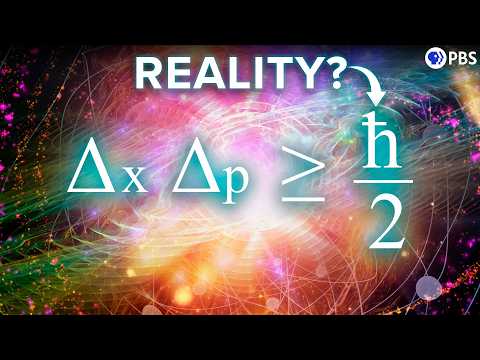
Heisenberg Made a Discovery in 1925. We Still Can't Explain It
In 1925, Heisenberg's revolutionary ideas on quantum mechanics transformed our understanding of reality, challenging determinism.
 Watch on YouTube ↗
Key takeaways
- 🎯2025 marks the centenary of quantum mechanics, celebrating its profound impact on science.00:04
- 💡Einstein's general relativity replaced Newtonian mechanics but maintained a deterministic worldview.02:17
- 📊Heisenberg's introduction of observable quantities reshaped how physicists view atomic behavior.09:28
- 🔧Investigate how matrix algebra is applied in quantum physics for practical experiments.11:20
- 🔑Heisenberg's uncertainty principle emerged from the non-commutative nature of matrix algebra.11:52
- 🔍Examine Heisenberg's uncertainty principle in relation to modern physics.11:52
Chapters
- 0:00🎉 Introduction and Celebration of Quantum Science
- 0:06📚 Understanding the Scientific Worldview of 1925
- 0:25🔍 The Quest for Understanding Electrons
- 0:45🚀 Heisenberg's Early Contributions
- 1:22🤔 Heisenberg's Approach to Quantum Theory
- 1:43🔗 Matrix Formulation of Quantum Mechanics
- 2:12🌊 The Helgoland Retreat
- 3:03🌅 Insights at Dawn
- 3:35🧠 Formalizing Matrix Mechanics
- 4:06🚫 Challenges and Reception of Matrix Mechanics
- 4:29🔄 Copenhagen Interpretation
- 4:50⚖️ The Uncertainty Principle
- 5:19🌪️ Schrodinger's Wave Mechanics
- 5:38🏔️ The Alpine Discovery
- 6:29📏 The Arrival of the Schrodinger Equation
- 6:42🌀 Comparison of Quantum Mechanisms
- 7:12🧩 Quantum Field Theory and Further Developments
- 8:02🎇 Conclusion: A Century of Quantum Mechanics
The digest
High Level Overview
In 1925, Werner Heisenberg formulated the first complete theory of quantum mechanics—matrix mechanics—marking a profound shift from classical physics’ deterministic worldview to a framework centered strictly on observable quantities. This revolutionary but abstract approach underpins modern quantum science and technology, yet fundamentally challenges our understanding of reality. Despite a century of advances, physicists still cannot fully explain what quantum mechanics means about the nature of existence beyond its practical predictive power. This summary traces Heisenberg’s discovery amid the physics of the early 20th century, contrasts it with Schrödinger’s wave mechanics, and reflects on the enduring mysteries quantum theory poses.
Keep reading in The Digest
The full 6-minute article, 9 more sections, and every new episode from PBS Space Time and the creators you follow.
- The Pre-Quantum View of the Universe: Determinism Reigns (00:11–05:03)
- Heisenberg’s Radical Leap: From Orbits to Observables (07:15–12:18)
- The Helgoland Moment: Confirmation Amid Solitude (12:39–15:09)
- Schrödinger’s Wave Mechanics: An Intuitive Alternative (17:12–20:55)
- Equivalence and Extensions: Dirac and Beyond (20:55–23:17)
- The Unfinished Story: Meaning, Reality, and Limits of Quantum Mechanics (24:06–25:25)
- Key Framework: Heisenberg’s Principles for Quantum Theory
- Practical Implications & Takeaways
- Action-Oriented Summary
More from PBS Space Time

We’ve Been Searching for Aliens the Wrong Way. That’s All About To Change. . .
In this episode, PBS Space Time discusses how our approach to searching for alien signals needs to evolve, emphasizing the importance of considering advanced civilizations that may use more efficient transmission technologies like lasers instead of traditional radio waves. The video highlights the potential of utilizing existing astronomical data to detect anomalies that could indicate extraterrestrial intelligence.

Martian Soil Is Deadly. And That's Why It Might Support Life.
Martian soil is deadly due to oxidizing salts, but life might persist in subsurface brine layers or ice-rich regions protected from radiation.

Most of Reality Is Invisible. We May Finally Be About to Reveal It.
The Higgs boson may be a portal to the dark sector, a parallel universe of invisible particles that could explain dark matter. New LHC upgrades aim to detect these elusive particles by analyzing displaced decay products.

The Universe Is Racing Apart. We May Finally Know Why.
The universe's accelerating expansion presents a cosmic puzzle. Time-delay cosmography using lensed quasars and supernovae offers a new, independent way to measure this expansion and potentially reveal the nature of dark energy.

This Particle Solved Everything. We Just Found Out It Isn't Real
This video reveals how the search for the sterile neutrino has led to new findings, suggesting it may not exist, challenging fundamental assumptions of the standard model.

The Universe Itself Might Be Hiding the Gravity Particle From Us
The universe's fundamental laws may prevent the detection of gravitons, the particles responsible for gravity, presenting implications for theories like quantum gravity.