Institute for Advanced Study · Video summary
Generalized convex toric domains and symplectic embedding problems - Nicki Magill
Nicki Magill discusses generalized convex toric domains and their symplectic embedding problems, revealing insights on obstructions and techniques.

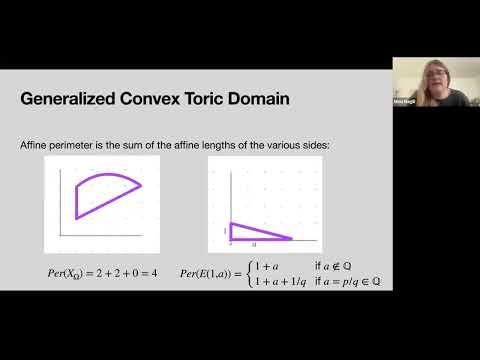 Watch on YouTube ↗
Key takeaways
- 💡Darboo's theorem states that all symplectic manifolds of the same dimension locally resemble each other.01:00
- 🎯Symplectic embeddings depend on preserving the two-form structure, highlighting volume constraints.02:04
- 🚀Explore symplectic embeddings and their implications on volume preservation in contexts of generalized convex domains.02:31
- 📈The volume obstruction implies a domain's volume cannot exceed its target for successful embeddings.02:49
- 🔍Gromov's non-squeezing theorem establishes limitations for symplectic embeddings of balls and cylinders.04:02
- 📚Study Gromov's non-squeezing theorem closely for insights on embedding constraints.04:13
Chapters
- 0:15👋 Introduction
- 0:32📚 Basic Definitions
- 0:49🔍 Symplectic Embeddings
- 2:24⚖️ Gromov's Non-Squeezing Theorem
- 4:04📏 Generalized Convex Toric Domains
- 5:28🌐 Properties of Convex Toric Domains
- 7:38📏 Affine Perimeter Definition
- 9:07🔢 ECH Capacities
- 13:31🔧 Subleading Asymptotics
- 17:55⚙️ Proof of Main Result
- 22:17🏛️ Applications
- 24:15❓ Packing Stability
- 30:32💡 Ellipsoid Embedding Function
- 34:30📉 Accumulation Point Theorem
- 37:53🔄 Final Thoughts
The digest
This comprehensive presentation explores the structure and embedding properties of generalized convex toric domains within four-dimensional symplectic geometry. It focuses on advanced invariants known as Embedded Contact Homology (ECH) capacities and their asymptotic behaviors to establish new obstructions and insights into symplectic embedding challenges, including packing stability and the existence of infinite staircases in ellipsoid embedding functions. Intended for researchers and practitioners in symplectic topology and geometric analysis, it bridges foundational principles with recent results extending known frameworks to more general settings.
Introduction to Symplectic Manifolds and Embeddings
Symplectic manifolds are smooth manifolds equipped with a closed, non-degenerate 2-form called the symplectic form. Locally, as per Darboux’s theorem, all symplectic manifolds of the same dimension look identical and admit standard form coordinates. This talk focuses on 4-dimensional symplectic manifolds embedded in \(\mathbb{R}^4\) with the standard symplectic structure.
A symplectic embedding between two such manifolds is a smooth embedding preserving the symplectic form, thus preserving an induced volume form. Consequently, a fundamental necessary condition for a symplectic embedding to exist is that the volume of the domain manifold does not exceed that of the target.
However, volume alone does not characterize symplectic embeddings, as revealed by Gromov’s non-squeezing theorem, which restricts embeddings of balls into cylinders based on radius, revealing obstructions beyond volume.
Keep reading in The Digest
The full 7-minute article, 17 more sections, and every new episode from Institute for Advanced Study and the creators you follow.
- Generalized Convex Toric Domains: Definitions and Geometry
- Affine Perimeter and Its Role in Symplectic Embeddings
- Embedded Contact Homology (ECH) Capacities: An Advanced Symplectic Invariant
- Subleading Asymptotics of ECH Capacities and Main Theorem
- Applications to Symplectic Packing and Embedding Stability
- Packing Stability and Full Fillings
- Obstruction from Affine Perimeter
- Ellipsoid Embedding Functions and Infinite Staircases
- Accumulation Point Theorem
- Implications for Full Fillings
- Classification of Infinite Staircases for Smooth Convex Toric Domains
- Key Frameworks and Mental Models
- Affine Perimeter (Invariant under \(\mathrm{SL}_2(\mathbb{Z})\))
- Subleading Asymptotics of ECH Capacities
- Weight Sequence Decomposition
- Practical Implications and Takeaways
- Action-Oriented Summary
More from Institute for Advanced Study

Multi-scale Analysis in Projection Theory III - Hong Wang
This lecture explores multi-scale analysis in projection theory, focusing on removing regularity assumptions for improved bounds in geometric measure theory.

Product of Random Matrices: From Scaling Limits to Neural Networks - Yi Han
Yi Han discusses scaling limits, spectral behavior, and universality classes of products of random matrices, with connections to neural networks and phase transitions.

Inside Astronomically Realistic Black Holes - Andrew Hamilton
Exploring inside astrophysical black holes reveals that the singularity is a surface, not a point, and the inner horizon of rotating black holes may be a site of baby universe creation.

Multi-scale Analysis in Projection Theory II - Hong Wang
Hong Wang's lecture explores multiscale analysis and projection theorems, revealing how almost regular sets develop product structures to compare projection sizes across scales.

There is a Mildly Mixing Rank 1 Transformation with an Interesting Joining - Jonathan Chaika
Jonathan Chaika proves the existence of mildly mixing rank one transformations with no minimal self-joinings, challenging assumptions about rank and mixing properties.

Existence and Regularity of Nonlocal Minimal Surfaces - Michele Caselli
This talk introduces fractional minimal surfaces as a novel approach to proving existence and regularity of classical minimal surfaces, particularly addressing limitations in min-max constructions.