Real Engineering · Video summary
Earth to Mars in 10 Days
Explore Project Orion: a revolutionary but canceled nuclear pulse propulsion system that could enable rapid interplanetary travel and remains a high-leverage concept for future space exploration.

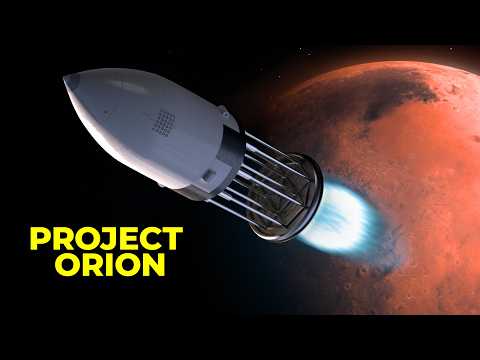 Watch on YouTube ↗
Key takeaways
- 📚Research the historical context and technical details of Project Orion to understand the potential and challenges of nuclear pulse propulsion.00:00
- 💡Nuclear pulse propulsion, like that explored in Project Orion, offers vastly superior performance over chemical rockets, enabling transit times like Earth to Mars in 10 days, a capability unmatched by current technology.00:02
- 🚀The core concept of Project Orion was to harness controlled nuclear explosions to propel a spacecraft, with pulse units detonating behind a pusher plate that transferred momentum to the ship via a sophisticated suspension system.01:20
- 🔧Key engineering challenges in Project Orion included developing miniaturized, high-yield nuclear pulse units (pulse units) and designing robust systems to withstand the immense forces, such as the pusher plate and multi-stage shock absorption.06:04
- ⚖️The cancellation of Project Orion was primarily due to political and bureaucratic reasons, including concerns over nuclear proliferation, public perception of fallout, and NASA's investment in established chemical rocket programs, rather than fundamental technical flaws.11:43
- 📈The Partial Nuclear Test Ban Treaty of 1963 was a critical turning point, prohibiting nuclear detonations in the atmosphere and space, effectively ending the viability of nuclear pulse propulsion systems like Orion for atmospheric or orbital launches.16:37
Chapters
- 0:00🚀 Introduction to Nuclear Propulsion
- 0:44💣 Project Orion's Origins
- 2:24🔬 Surviving Nuclear Blasts
- 3:56🌌 The Space Race Impact
- 5:28🛰️ Designing the Orion Ship
- 6:36⚛️ Nuclear Pulse Units Explained
- 10:06🔧 Engineering Challenges
- 12:14📉 Funding and Political Issues
- 13:18⚠️ Safety Concerns
- 15:00💥 Military Applications
- 17:00📜 End of Project Orion
- 18:30🔄 Reviving Nuclear Propulsion
- 20:40🔮 Future Prospects
- 23:00🎥 Documentary Promotion
The digest
Project Orion: The Nuclear Pulse Propulsion System That Could Have Revolutionized Space Travel
This summary details the ambitious, yet ultimately unfulfilled, Project Orion, which proposed using nuclear explosions to propel spacecraft. It explores the scientific and engineering challenges, the political and environmental hurdles that led to its demise, and the potential for its revival through modern technological advancements. The content is relevant for engineers, scientists, policymakers, and anyone interested in the history of space exploration and advanced propulsion systems.
Keep reading in The Digest
The full 4-minute article, 5 more sections, and every new episode from Real Engineering and the creators you follow.
- The Promise of Nuclear Pulse Propulsion
- The Science Behind Project Orion
- The Demise of Project Orion
- The Potential for Revival: Mini Mag Orion
- The Chicken and Egg Problem
More from Real Engineering

The Space Telescope That Will Reveal the Universe’s Biggest Secret
The Nancy Grace Roman Space Telescope is set to revolutionize our understanding of the universe, offering unprecedented views of dark matter and exoplanets. Its advanced engineering and unique orbit will provide a wealth of data, pushing the boundaries of astronomical discovery.

The Insane Engineering of the V-22 Osprey
In the video "The Insane Engineering of the V-22 Osprey," Real Engineering explores the complex design and operational capabilities of the V-22 Osprey, a hybrid aircraft that combines helicopter and airplane functionalities, highlighting its critical role in rescue missions despite its controversial safety record. The video details the innovative engineering solutions that allow the Osprey to perform unique flight transitions and operate efficiently in challenging conditions.

Why America’s Tank Failed in Ukraine
The M1A2 Abrams tank's jet engine, a relic of Cold War design, leads to unsustainable fuel consumption and logistical nightmares in modern warfare, contributing to its high loss rate in Ukraine.

How The ISS Solved Its Biggest Problem
The ISS faced a catastrophic halt post-Columbia disaster but overcame it through innovative engineering and a global alliance.

How We Built The ISS
Building the ISS was a monumental engineering feat, requiring international cooperation and overcoming challenges in orbital construction, docking, and life support.

Solar Farms in Space
Harnessing space-based solar power offers limitless, clean energy, overcoming Earth's intermittent renewables with advanced concepts like swarm satellites and reflective mirrors, though cost and light pollution remain challenges.