3Blue1Brown · Video summary
But how do AI images and videos actually work? | Guest video by Welch Labs
AI image/video generation uses diffusion models that reverse noise addition, guided by CLIP embeddings and classifier-free guidance for prompt adherence.
 Watch on YouTube ↗
Key takeaways
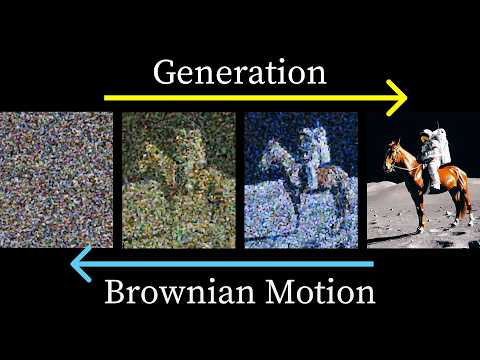
- 💡AI image generation models like WAN 2.1 and DALL-E 2 operate on a diffusion process that starts with pure noise and iteratively refines it into a coherent image or video, mimicking Brownian motion in reverse.00:14
- 🚀Explore open-source diffusion models like WAN 2.1 to understand practical applications and limitations.00:47
- 📚Investigate the CLIP model's architecture and training to grasp how text and image semantics are unified in a shared latent space.02:26
- 🎯The CLIP model creates a shared high-dimensional space where text and image vectors align, enabling semantic understanding and mathematical operations on concepts like 'hat' by vector subtraction.02:30
- 🔍Adding random noise during image generation (DDPM sampling) is crucial for quality, preventing generated images from collapsing to the average representation and ensuring diversity.10:03
- 📈Modern diffusion models, unlike naive approaches, are trained to predict the total noise added to an image rather than denoising one step at a time, which significantly improves learning efficiency and stability.11:00
Chapters
- 0:03🎯 Introduction to AI diffusion models
- 0:42🎯 Hands-on with open source diffusion model
- 1:27🎯 Generation process detail
- 2:11🎯 Connection to Brownian motion and physics
- 2:26🎯 Review of CLIP and shared embedding space
- 2:56🎯 Diffusion models training and noise removal
- 11:55🎯 Diffusion as learning a vector field
- 14:42🎯 Reverse diffusion and noise prediction
- 20:29🎯 Gaussian distribution and dataset mean
- 23:43🎯 From stochastic to deterministic diffusion: DDIM
- 25:43🎯 Combining CLIP with diffusion: prompt-guided generation
- 32:11🎯 Classifier-free guidance and steering
- 33:41🎯 Negative prompts and video generation
- 34:26🎯 Rapid progress in diffusion models
- 35:06🎯 Physics and high-dimensional intuition
- 35:18🎯 Final thoughts on AI image/video generation
- 35:32🎯 Guest channel and personal note
- 37:18🎯 Outro and encouragement
The digest
An in-depth explanation of how modern AI uses diffusion processes, inspired by physics, combined with text-image joint embeddings to produce realistic images and videos from textual prompts.
High Level Overview
Modern AI systems excel at converting text prompts into detailed images and videos. At the core of these advances is a method inspired by physical phenomena—diffusion, the random movement of particles—which AI models run in reverse to "denoise" random pixels into coherent visuals. This process operates in extremely high-dimensional spaces and is tightly coupled with powerful joint language-vision embeddings such as OpenAI’s CLIP model, enabling AI to "understand" and condition generation on textual descriptions. This summary unpacks the conceptual foundations, algorithms, and conditioning techniques that make these models work, bridging physics, machine learning, and natural language.
Keep reading in The Digest
The full 7-minute article, 15 more sections, and every new episode from 3Blue1Brown and the creators you follow.
- Understanding the Building Blocks of AI Image/Video Generation
- 1. From Noise to Video: Diffusion in Action (0:45 - 2:10)
- 2. CLIP: Building a Shared Language-Vision Embedding Space (3:00 - 8:00)
- 3. Fundamentals of Diffusion Models: The Physics Connection (8:00 - 16:20)
- 4. Improvements: DDIM and Flow-Based Models (21:50 - 24:56)
- 5. Conditioning Diffusion on Text: Steering Image/Video Generation (25:40 - 27:40)
- 6. Classifier-Free Guidance: Amplifying Focus on Prompts (29:00 - 33:30)
- 7. The Remarkable Integration of Components (34:00 - 35:30)
- Key Frameworks and Concepts
- CLIP Contrastive Training ([3:00 - 6:20])
- Diffusion Models Training & Sampling ([8:20 - 16:00])
- DDIM Sampling ([21:50 - 24:56])
- Classifier-Free Guidance ([29:00 - 33:30])
- Practical Implications & Takeaways
- Suggested Actions for Professionals Interested in AI Generation
More from 3Blue1Brown

This picture broke my brain
Explore the mathematical underpinnings of M.C. Escher's "Print Gallery," revealing how conformal maps and complex logarithms unlock its self-referential paradox.

The most beautiful formula not enough people understand
Explore the beautiful, counterintuitive math behind high-dimensional spheres, revealing the surprising behavior of volumes and the elegance of formulas like $V_n(R) = \frac{\pi^{n/2}}{\Gamma(n/2 + 1)} R^n$.

The Hairy Ball Theorem
The Hairy Ball Theorem states you can't comb hair on a sphere flat without a cowlick. This has surprising implications in fields like game development and physics.

Why Laplace transforms are so useful
Learn how Laplace transforms simplify the analysis of differential equations, providing valuable insights into system dynamics.

But what is a Laplace Transform?
The Laplace Transform is a powerful tool converting functions into exponential forms, revealing key insights into differential equations.

The Physics of Euler's Formula | Laplace Transform Prelude
This video explores the power of Euler's Formula and its connection to complex numbers, leading toward understanding the Laplace transform.