Institute for Advanced Study · Video summary
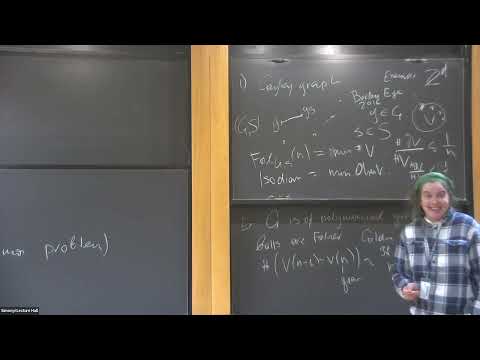
Asymptotic dimension, Isoperimetric Problem, and Traveling Salesman Problem in Groups- Anna Erschler
Anna Erschler explores asymptotic dimension, isoperimetric problems, and the Traveling Salesman Problem in groups, revealing deep links and open questions.

 Watch on YouTube ↗
Key takeaways
- 💡Boundary definitions (vertex versus edge) significantly affect isoperimetric problems, with exact solutions largely unknown even on well-understood groups like Z^d.05:22
- 📝Investigate the isoperimetric boundaries in groups for different definitions to identify where exact versus approximate solutions are attainable.05:22
- 📈Groups of polynomial growth have spheres (or shells) whose size differences resemble polynomial functions, but precise asymptotic behaviors remain open.09:05
- 🎯The asymptotic dimension of groups relates to covering properties and can be finite even when growth is polynomial, showing it captures more than just growth rate.20:01
- 🚀Explore relations between asymptotic dimension and growth functions to better understand group geometry.24:47
- 🔍The control function for asymptotic dimension often aligns with the contra function derived from growth, indicating a deep link between dimension and expansion properties.25:41
Chapters
- 0:32🎤 Introduction and Overview
- 2:18📈 Defining the Isoperimetric Problem in Groups
- 5:09📏 Boundary Definitions and Asymptotic Behavior
- 7:42🌐 Growth Function and Sphere Size in Groups
- 12:14🔍 Open Questions on Sphere Size and Optimality
- 19:22📐 Defining Asymptotic Dimension
- 25:21🔗 Connecting Isoperimetric and Asymptotic Dimension Functions
- 28:33⚖️ Lossless Groups and Invariance
- 31:06📊 Examples of Lossless and Non-Lossless Groups
- 36:12❓ Non-Lossless Examples and Open Questions
- 42:50🗺️ Defining the Universal Traveling Salesman Problem
- 45:26🌳 Traveling Salesman Problem on Trees and Hyperbolic Spaces
- 47:01🟩 Traveling Salesman Problem on Z^2 (The Plane)
- 51:47📈 Logarithmic Bounds and Open Questions for Z^2
- 53:51🔢 Doubling Spaces and Dimension
The digest
High Level Overview
This talk by Anna Erschler explores three ostensibly distinct but deeply interrelated topics in geometric group theory: the isoperimetric problem in groups, asymptotic dimension, and a variant of the traveling salesman problem (TSP) known as the universal traveling salesman problem. By focusing on finitely generated groups interpreted as metric spaces (via their Cayley graphs), the presentation reveals how these classical problems intertwine, particularly through key quantitative functions describing boundary sizes, diameters, and covering properties of sets in groups. The insights are relevant to researchers studying amenability, geometric analysis on groups, and algorithmic aspects of group theory.
Keep reading in The Digest
The full 6-minute article, 13 more sections, and every new episode from Institute for Advanced Study and the creators you follow.
- Structured Deep Dive
- 1. Definitions and Setup: Groups as Metric Spaces (00:30–03:00)
- 2. Known Results and Open Questions about Isoperimetric Profiles (04:45–15:30)
- 3. Asymptotic Dimension and Control Functions (19:00–25:00)
- 4. Classes of Groups and Losslessness of Diameter vs. Dimension Functions (26:00–40:00)
- 5. The Universal Traveling Salesman Problem in Metric Spaces and Groups (42:30–55:00)
- Key Frameworks, Models, or Mental Maps
- 1. Isoperimetric Function \( \mathrm{JS}(n) \) and Diameter Function \( I(n) \)
- 2. Asymptotic Dimension and Control Functions
- 3. Losslessness Concept
- 4. Universal Traveling Salesman Problem Approximation Ratio
- Practical Implications & Takeaways
- Action-Oriented Summary
More from Institute for Advanced Study

Multi-scale Analysis in Projection Theory III - Hong Wang
This lecture explores multi-scale analysis in projection theory, focusing on removing regularity assumptions for improved bounds in geometric measure theory.

Product of Random Matrices: From Scaling Limits to Neural Networks - Yi Han
Yi Han discusses scaling limits, spectral behavior, and universality classes of products of random matrices, with connections to neural networks and phase transitions.

Inside Astronomically Realistic Black Holes - Andrew Hamilton
Exploring inside astrophysical black holes reveals that the singularity is a surface, not a point, and the inner horizon of rotating black holes may be a site of baby universe creation.

Multi-scale Analysis in Projection Theory II - Hong Wang
Hong Wang's lecture explores multiscale analysis and projection theorems, revealing how almost regular sets develop product structures to compare projection sizes across scales.

There is a Mildly Mixing Rank 1 Transformation with an Interesting Joining - Jonathan Chaika
Jonathan Chaika proves the existence of mildly mixing rank one transformations with no minimal self-joinings, challenging assumptions about rank and mixing properties.

Existence and Regularity of Nonlocal Minimal Surfaces - Michele Caselli
This talk introduces fractional minimal surfaces as a novel approach to proving existence and regularity of classical minimal surfaces, particularly addressing limitations in min-max constructions.