On Purpose with Jay Shetty · Podcast summary
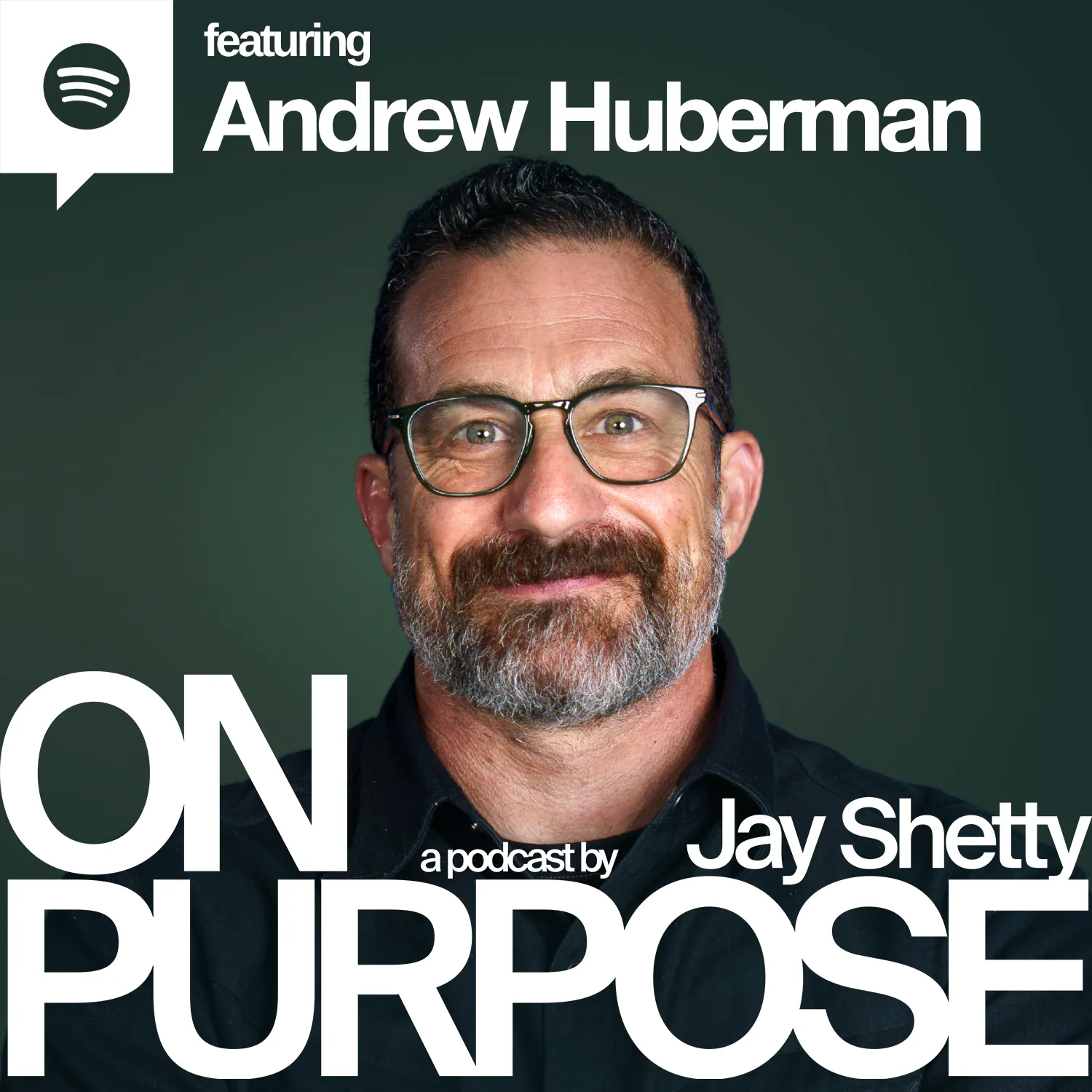
Andrew Huberman: The Simple Habits That Will Transform Your Health
Dr. Andrew Huberman, a neuroscientist and professor at Stanford School of Medicine, shares practical, science-backed tools for improving health, energy, focus, and performance.

 Listen on the show ↗
Key takeaways
- 🧘A 5-minute daily meditation can significantly improve heart rate, heart rate variability, mood, and sleep.08:51
- ☀️Spiking morning cortisol with bright light and hydration improves alertness, mood, cognition, and stress recovery, and sets you up for better sleep.09:55
- 💪A high morning cortisol peak is linked to a healthy immune system and better recovery from stress.12:04
- ☕Delaying caffeine intake by 60-90 minutes in the morning can help prevent the afternoon energy crash.19:51
- 😴Short breaks in the afternoon, like 10 minutes of yoga nidra or meditation, can restore mental and physical vigor without causing sleep inertia.21:09
- 🌬️Emphasizing exhales during breathing exercises slows your heart rate down, promoting relaxation.21:43
Chapters
- 4:07Introduction to Protocols
- 4:59The First Page of the Human Body Manual
- 8:35Morning Routine: Meditation & Sunlight
- 17:35Why Spike Morning Cortisol?
- 29:01The Afternoon Crash & How to Combat It
- 47:24The Power of Prayer and Faith
- 1:08:19Embracing the Human Condition
The digest
Dr. Andrew Huberman, a neuroscientist and professor at Stanford School of Medicine, joins Jay Shetty to discuss his new book, "Protocols: An Operating Manual for the Human Body." Huberman emphasizes that the book is not about becoming a robot or biohacking, but rather about understanding your biology and applying science-backed tools in a way that is compatible with your life, ultimately leading to more peace and ease.
The Power of Morning Routines
Huberman highlights the importance of a consistent morning routine to optimize your day. He suggests a simple yet effective sequence: upon waking, use the restroom, then return to bed for a 10-breath to 5-minute meditation. This brief practice, even just 10 breaths of focused awareness, can significantly improve your ability to navigate the day with intention and make better decisions. Studies have shown that even a 5-minute daily meditation can have a substantial positive effect on heart rate, heart rate variability, mood, and sleep. Huberman emphasizes that this isn't about ticking off a thousand different things, but rather understanding the core principles and applying them in a way that suits your individual needs and schedule.
Following meditation, Huberman recommends getting bright light in your eyes first thing in the morning. If the sun is out, go outside; if it's cloudy, still expose yourself to the natural light. Avoid sunglasses or brimmed hats during this time. This practice, along with hydration, deliberately elevates your morning cortisol by up to 50% above baseline levels. A high morning cortisol spike is crucial for increased alertness, better mood, and improved cognitive function throughout the day. It also sets you up for lower cortisol and better sleep at night. Furthermore, a strong morning cortisol peak helps you recover from stress more quickly and effectively later in the day. Conversely, a flattened cortisol curve, often seen in individuals who don't get enough morning light or hydration, can negatively impact mental health, blood sugar regulation, and sleep patterns.
Incorporating some form of physical exercise in the morning is also beneficial. This doesn't necessarily mean a full workout; even 25 jumping jacks or a brisk walk can make a difference. Early morning exercise further enhances the cortisol spike, leading to sustained energy levels throughout the day. Huberman notes that intense exercise later in the day can also spike cortisol, but if done, it should be followed by practices to lower cortisol before bedtime.
Keep reading in The Digest
The full 5-minute article, 4 more sections, and every new episode from On Purpose with Jay Shetty and the creators you follow.
- Understanding the Afternoon Crash
- The Role of Circadian Rhythms and Intentional Living
- The Power of Prayer and Faith
- Embracing the Human Condition
More from On Purpose with Jay Shetty
SYLVESTER STALLONE: “I Wasn’t Stupid. I Was Just Misunderstood.”
Sylvester Stallone reflects on his journey from hardship to Hollywood icon, revealing the resilience and philosophy behind his enduring career and the creation of Rocky.

3 Science-Backed Habits That Will Make You Feel Better Every Day
Jay shares three science-backed habits—movement, attention protection, and relationships—that instantly boost well-being and mental health.

LUCY HALE: “I Was Sabotaging My Life.”
Actress Lucy Hale opens up about her journey to sobriety, overcoming self-sabotage, and finding self-acceptance amidst the pressures of Hollywood and social media.

Your Brain Is Addicted To Worst-Case Scenarios (3 Ways To Break The Habit)
Jay Shetty explains why our brains are wired to anticipate the worst and offers three practical shifts to break free from this habit, fostering a more resilient and present mindset.

OPRAH WINFREY: The Life Lessons That Changed Everything
Oprah Winfrey joins Jay Shetty to discuss her incredible life journey, the power of intentional decision-making, and how to find your true purpose.

BENNY BLANCO: The Secret to Failing Your Way to Success
Benny Blanco, one of the most influential music producers of our generation, discusses his new book, "F*ck Failure," and shares profound insights on embracing failure, overcoming fear, and finding true success in life and relationships.