David Shapiro · Video summary
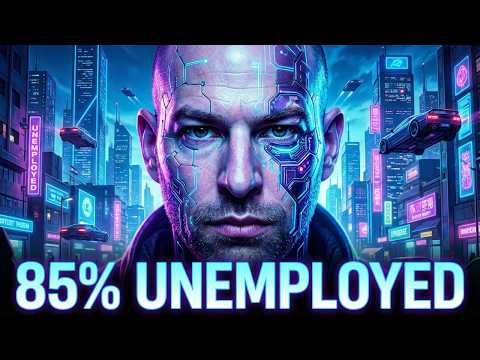
85% Of People Will be Unemployable
In a future dominated by AI and robotics, only 10-15% of the population may remain employed, reconfiguring the labor market.

 Watch on YouTube ↗
Key takeaways
- 🎯The future labor force participation rate may plummet to 10-15% due to advances in AI and robotics.01:05
- 💡Machines will outpace humans in all tasks, leading to an economy with infinite production capacity but finite human consumption.01:19
- 📈Expect a distinct divide, with statutory jobs and roles requiring human authenticity remaining intact.04:22
- 🔍Workers may shift towards high-touch services like therapy and care where human connection remains paramount.07:20
- 📊The overall labor force participation prediction suggests a drastic reduction from the current 62% to 10-15%.08:34
- 🔧Invest time in developing skills that enhance human interpersonal connections tailored for an emerging care economy.09:15
Chapters
- 0:00🌅 Introduction to Labor Economics
- 0:51📉 Understanding Labor Participation Rates
- 2:01🔍 Assumptions for Future Economy
- 3:33⚖️ Statutory Jobs and Human Premium
- 4:41🧑⚖️ Core of Human Employment
- 7:29💼 Authenticity Premium
- 9:42📊 Current vs Future Labor Rates
- 10:37⏳ Impact of Free Time
- 15:08🏖️ Experience Economy
- 17:45📈 Demand Side Expansion
- 19:40🔮 Future Job Estimates
- 22:20⚙️ Attention Economy
- 27:00💡 Monetizing Attention
- 30:30📉 Inequality in Attention Economy
- 41:00🔄 Conclusion and Future Outlook
The digest
High Level Overview
The analysis explores a near-future economic landscape where artificial intelligence (AI) and robotics outperform humans on nearly all productive tasks, drastically reducing the necessity for human labor. It quantifies this shift by projecting a labor force participation rate (LFPR) of roughly 10–15%, a dramatic decline from today's approximately 62%. This future economy will no longer be limited by production capacity but rather by human attention and time—a finite resource that machines cannot replace. The discussion is intended for policymakers, economists, technologists, and anyone interested in the societal implications of automation and AI-driven economic transformation.
Keep reading in The Digest
The full 6-minute article, 14 more sections, and every new episode from David Shapiro and the creators you follow.
- Structured Deep Dive
- Understanding Labor Force Participation and Its Future (00:00–05:00)
- The Irreducible Core of Human Employment (05:00–08:00)
- The Demand-Side Expansion Scenario: Increased Leisure and Its Impact (08:00–14:00)
- The Physics and Economics of Attention (14:00–18:00)
- Topologies of Attention Monetization (18:00–22:00)
- Zero Barriers and Rent Dissipation (22:00–26:00)
- Final Estimates and Implications (26:00–32:00)
- Key Frameworks and Mental Models
- Assumptions Underpinning the Model
- Attention Economy Topology
- Rent Dissipation
- Practical Implications & Takeaways
- Action-Oriented Summary
More from David Shapiro

Get ready for the plunge
The assumption of indispensability of labor (AIL) is ending as AI replaces human tasks, causing an ontological shock beyond economics, forcing a transition to self-determined purpose.

AI isn't going how we thought it would
AI accelerates creativity but can lead to rapid "well" depletion and burnout by removing natural bottlenecks, highlighting the human need for novelty and surprise.

How GOOD could AGI become?
Exploring the golden path for AGI/ASI, moving beyond human control to a future of maximized optionality and minimized waste entropy.

How AGI will DESTROY the ELITES
AGI will commoditize competence, shifting elite power from managers to visionaries and liability holders.

The gap is widening
The autonomous agent paradigm is rapidly evolving, but organizational inertia and risk aversion create a significant gap between cutting-edge possibilities and enterprise adoption.

Chatbots ≠ Agents
Chatbots are reactive, conversation-focused AI, while agents are proactive, goal-oriented systems. The core LLM is a flexible engine, but its behavior is shaped by its training and architecture.